
Construction has never been short on moving parts. A single project means constant coordination — from schedules and suppliers to paperwork and on-site calls. In 2026, there’s less cushion for error, and far greater pressure to deliver on time and on budget.
That’s where construction AI agents come in. Unlike traditional construction AI tools that only generate reports or dashboards, these systems can analyze data, detect risks, and trigger actions across scheduling, budgeting, procurement, and safety workflows.
In this article, we’ll explain what AI agents for construction actually are, how they work in practice, and which companies benefit most from implementing them — from contractors and developers to project and safety managers.
What are construction AI agents?
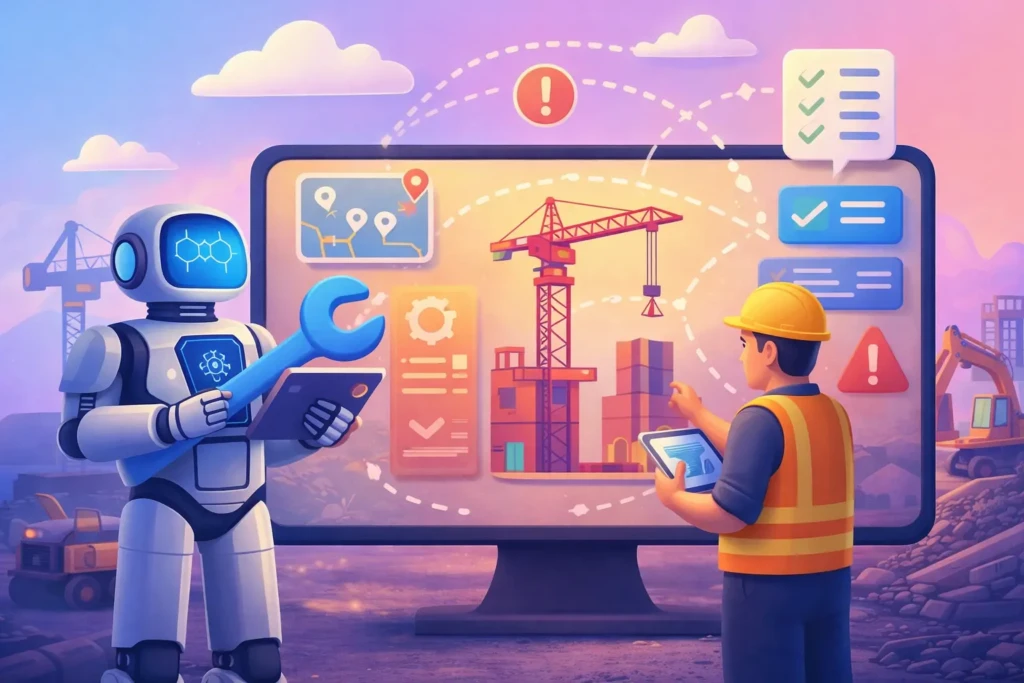
At a practical level, construction AI agents are digital systems that don’t just analyze information — they act on it.
Digital tools have become standard in construction — tracking timelines, spending, compliance, and field updates. Yet insight alone doesn’t move a project forward. Someone has to interpret the information and decide what happens next. And when teams are stretched thin, that gap between data and action can slow everything down.
AI agents in construction are designed to reduce that gap.
They plug into the systems teams already rely on — project management platforms, ERPs, BIM models, procurement software, field reporting apps — and keep track of project activity as it unfolds. When something looks off, or when an opportunity appears, they can:
- Flag it in real time
- Recommend a corrective action
- Trigger a workflow
- Notify the right stakeholder
- Update forecasts automatically
In other words, they move beyond passive analytics.
It’s also important to separate construction AI agents from traditional automation. Standard automation follows fixed rules: “If X happens, send email Y.” AI agents operate in more complex environments. They weigh multiple variables — schedule dependencies, cost trends, supplier performance, weather, workforce availability — before determining the most appropriate response.
That’s why many teams think of them less as tools and more as operational support. They don’t replace leadership on site — they reduce the load. Routine checks run in the background, and early risks are flagged quickly, helping teams keep pace without adding extra headcount.
In 2026, their role in construction is becoming clearer. They’re no longer side experiments or innovation pilots. Instead, they’re steadily becoming part of everyday operations — helping companies make steadier, more predictable decisions.
How do AI agents for construction work in practice?
To understand how AI agents for construction work, it helps to look at what actually happens on a typical project — not at the technical theory behind it.
Every construction site generates a steady flow of information: revised schedules, shifting budgets, RFIs and submittals, delivery updates, safety reports, weather changes, and equipment logs. It never really stops. Most of it flows into different systems. The challenge isn’t collecting data anymore. On the contrary, it’s keeping up with it.
Most of it flows into different systems. The challenge isn’t collecting data anymore. On the contrary, it’s keeping up with it.
This is where AI agents in construction step in.
In practice, they work through an ongoing cycle:
- Monitor. Connected to core project platforms, they follow performance continuously. Deviations are surfaced in real time, rather than being discovered days later during reporting.
- Analyze. Every new update is checked against what was planned and what typically happens on similar jobs. So if a trade begins slipping on a key task, it’s spotted while there’s still time to adjust — not after the impact spreads.
- Decide. Based on defined rules and predictive models, the system evaluates possible next steps. Should the issue be escalated? Should the schedule be adjusted? Is the cost forecast now at risk?
- Act. Rather than stopping at a notification, many construction AI agents can trigger workflows automatically — updating forecasts, sending alerts to the right manager, generating revised reports, or flagging procurement adjustments.
Importantly, this doesn’t remove people from the process. There’s still a human hand on the wheel. Leaders define the limits, choosing which actions can run automatically and which ones need a second look.
In the broader AI agents construction industry context, the real shift is speed. Decisions that once took days — because someone had to compile reports and reconcile data — can now happen in near real time.
Instead of reacting to problems after they surface in meetings, teams can address them while they’re still small and manageable.
What powers construction AI agents in 2026?
Behind every effective system is a solid foundation. Construction AI agents don’t operate in isolation — they rely on a combination of data, integrations, and decision logic that allows them to function inside real project environments.
In 2026, three layers typically make this possible.
1. The data layer
Everything starts with access to reliable data.
That includes:
- Project schedules
- Budget and cost reports
- Procurement and supplier records
- BIM models
- Daily field logs
- Safety documentation
- Equipment usage data
- Contractual milestones
The stronger and more structured the data environment, the more accurate AI agents in construction industry settings become. When systems are siloed or inconsistent, the results are limited. When data flows across platforms, the value increases significantly.
2. The integration layer
Most construction companies already use established platforms, such as project management tools, ERPs, accounting systems, document control software, and BIM environments.
AI agents for construction connect to these systems through APIs and secure integrations. They don’t replace them. Instead, they sit on top of the existing tech stack and coordinate information across it.
This integration layer is critical. Without it, even the most advanced construction AI tools can’t operate effectively because they lack full visibility.
3. The decision & automation layer
Once connected and supplied with data, the system needs logic. This includes the following:
- Predictive models trained on historical project data
- Rule-based triggers aligned with company policies
- Workflow engines that can escalate or automate actions
For instance:
- A delayed delivery triggers an alert to procurement and a revised cost outlook.
- Sustained productivity drops are surfaced early to the project manager.
- A spike in safety incidents in one area immediately reaches the safety lead.
In the broader AI agents construction industry landscape, what distinguishes 2026 solutions from earlier tools is orchestration. They don’t just analyze a single data stream but connect scheduling, finance, procurement, and field execution into one coordinated system.
And that’s what allows construction AI agents to move from reporting tools to operational support systems.
What work can AI agents automate across a construction project?
The real question isn’t whether construction AI agents are technically impressive. It’s where they actually save time, reduce friction, and improve outcomes on a live project.
In 2026, the value shows up throughout the entire project, from preconstruction to closeout.
Preconstruction and bidding support
Before ground is even broken, teams are already dealing with tight timelines and large volumes of documentation.
AI agents for construction companies can:
- Review bid packages and highlight missing or inconsistent information.
- Compare subcontractor proposals against historical cost patterns.
- Flag contract clauses that carry unusual risk.
- Identify scope gaps before they become change orders.
Teams can forget about digging through piles of documents. They get a clearer picture right away, without the unnecessary back-and-forth.
Planning and scheduling
Scheduling is still among the most fragile elements of any project. Here, AI agents in construction have the following capabilities:
- Detecting conflicts between trades before they hit the field.
- Monitoring critical path activities in real time.
- Identifying early signs of schedule drift.
- Simulating alternative sequencing options.
Instead of discovering delays during weekly coordination meetings, teams address them while adjustments are still manageable.
Cost control and procurement
Cost overruns rarely happen overnight. They build gradually through small deviations that go unnoticed.
Construction AI agents support cost control by:
- Tracking spending trends against baseline budgets.
- Flagging unusual invoice patterns.
- Keeping track of how reliably suppliers deliver and spotting patterns before they become problems.
- Updating budget projections when procurement timelines start to move.
For CFOs and project controllers, that means clearer visibility into what’s coming — and fewer unpleasant surprises toward the end of the project.
Field execution and reporting
On-site reporting often becomes a bottleneck, particularly when teams are stretched thin. AI agents can:
- Summarize daily field logs.
- Identify discrepancies between planned and actual progress.
- Assist with RFI categorization and prioritization.
- Track equipment utilization automatically.
Instead of piecing together daily summaries, managers can focus on what actually drives progress — communication, adjustments, and on-site coordination.
Quality and rework prevention
Rework remains one of the most expensive drains on construction budgets. Within the AI agents construction industry landscape, quality monitoring is becoming a key use case. Here’s what agents can do:
- Compare field conditions with design intent
- Identify recurring defect patterns
- Flag specification inconsistencies
- Highlight high-risk work zones based on past issues
By catching issues early, teams avoid the cascade effect that rework often creates.
This is where the shift becomes clear: construction AI tools typically provide visibility. But construction AI agents go even further: they help teams respond faster and more consistently.
AI agents in construction
In 2026, these systems aren’t confined to isolated experiments. They’re most effective when they connect the dots across a project — from scheduling and budgeting to procurement and on-site execution.
Construction has always relied on experience and instinct. Strong project leaders can sense when something is drifting off track. The challenge is scale. When a company runs multiple projects at once, small deviations can multiply quickly. What feels manageable on one site becomes harder to control across five or ten.
This is where construction AI agents start to change the dynamic.
Instead of discovering issues during weekly coordination meetings, teams can see risks forming much earlier. Changes in the schedule, creeping costs, slowing productivity, or supplier delays don’t get lost across different platforms — they’re surfaced in time to act. They are connected.
More importantly, actions become aligned:
- A schedule delay automatically reflects in cost projections.
- A procurement issue updates risk forecasts.
- A productivity dip triggers both operational and financial review.
That cross-functional awareness is what distinguishes AI agents in construction industry environments from standalone construction AI tools. Tools often analyze one domain. Agents connect them.
For construction companies managing complex portfolios, this creates a shift from reactive management to controlled execution. Decisions become less about catching up and more about steering early.
Who uses AI agents in construction day to day?
In 2026, adoption isn’t limited to IT departments. The primary users of AI agents for construction companies are operational roles:
- Project managers rely on early warnings rather than post-factum reports.
- Superintendents benefit from clearer coordination signals.
- Estimators and planners refine assumptions based on live performance data.
- Procurement leads track supplier reliability trends.
- Finance teams monitor cost exposure in near real time.
The real difference isn’t only speed, it’s confidence. When teams have a steady stream of insight instead of relying on occasional reports, there are fewer surprises and fewer gaps in visibility.
And that’s becoming a real advantage. Firms that weave this level of oversight into everyday operations often see more stable margins, more predictable schedules, and fewer last-minute disruptions.
AI agents in safety
No construction project can afford to treat safety lightly. Even so, procedures and checklists don’t eliminate risk entirely. Problems tend to build quietly — through repeated minor issues that don’t always raise alarms early on.
By 2026, AI agents in safety are helping teams move from reacting after incidents to stepping in earlier. Construction sites already produce plenty of safety data — daily logs, inspection notes, near-miss reports, equipment records, camera footage, and access logs. The challenge has never been collecting information, but keeping up with it. The challenge isn’t collecting it but connecting it.
That’s where AI agents in construction make a difference. Instead of reviewing incidents after they happen, safety teams gain continuous visibility into emerging risks.
AI agents in safety monitoring and risk mitigation
In practice, these systems cover the following:
- Detect repeated safety violations in specific zones.
- Identify patterns in near-miss reports.
- Monitor whether the required protective equipment is being used.
- Flag unsafe proximity between workers and heavy machinery.
- Track fatigue-related risk factors across extended shifts.
If incidents start appearing repeatedly in the same part of the site, the safety lead is notified early. And if certain tasks keep generating near-misses, supervisors can step in and review procedures before someone gets seriously hurt.
The goal isn’t to replace safety managers. It’s to give them better foresight:
- If minor fall hazards appear repeatedly in scaffolding zones, inspections can be increased proactively.
- If one subcontractor shows a higher rate of violations, targeted retraining can be scheduled.
- If extended overtime correlates with incident spikes, staffing adjustments can be considered.
Across the construction industry, safety is often where the impact becomes visible first. When incidents decline, insurance risks decrease, work interruptions are reduced, and compliance becomes easier to maintain.
But beyond the numbers, it also sends a message. Workers see that risks are taken seriously, and clients gain confidence in how the project is being run.
What data do AI agents in construction need to be reliable?
Any system works well only with good input. The same applies to AI agents in construction industry environments. Their effectiveness depends heavily on the quality, consistency, and accessibility of project data.
The good news is that most construction companies already generate the necessary information. The challenge is how it’s stored, structured, and connected.
Core data sources
For construction AI agents to deliver meaningful results, they typically rely on the following:
- Baseline project schedules and updates
- Budget breakdowns and cost codes
- Procurement records and supplier histories
- Contract terms and milestone definitions
- Daily field reports and progress logs
- Safety documentation and inspection records
- Equipment utilization data
- BIM and design models
When this data flows across systems instead of remaining siloed, agents detect patterns that would otherwise stay hidden.
The reality of data gaps
In practice, data environments aren’t always clean. Common challenges include:
- Inconsistent cost coding across projects
- Manually entered field logs with varying formats
- Missing productivity benchmarks
- Siloed procurement and financial systems
- Limited historical data for comparison
That doesn’t mean implementation is impossible. However, companies may need a short preparation phase, aligning cost structures, cleaning historical records, and ensuring systems can communicate properly.
Minimum vs. mature data environments
Besides, AI agents for construction companies don’t require perfect data from day one. With a basic level of structured scheduling, cost tracking, and effective reporting, they deliver early warnings and coordination support.
Data maturity improves along with accuracy:
- Forecasts become more precise.
- Risk detection becomes earlier.
- Cross-project benchmarking becomes possible.
In 2026, the companies seeing the strongest results are not necessarily the ones with more data, but those with connected data.
How construction AI agents reduce costs, delays, and operational risk in 2026
At the end of the day, construction companies don’t invest in technology for the sake of innovation. They invest in it to see better results.
In 2026, construction AI agents are showing their value not through flashy features. They rely on steady operational improvements. The impact isn’t dramatic overnight. It builds gradually — by trimming small inefficiencies before they grow into expensive problems.
1. Fewer delays
Most delays don’t appear suddenly. They build gradually — a late delivery here, a productivity dip there, a coordination gap that goes unnoticed for a few days.
AI agents in construction industry environments help surface those early signals. When schedule drift is detected while it’s still minor, adjustments are easier and less expensive. A subcontractor slowdown can be addressed before it affects the critical path. A procurement delay can be absorbed before it cascades into idle labor.
The earlier a deviation is identified, the lower its cost.
2. Tighter cost control
Cost overruns often creep in gradually, starting with minor differences between projections and reality. A slight shift in material pricing. A supplier performance issue. Overtime is creeping up on key tasks.
By continuously aligning schedule data, procurement updates, and financial tracking, AI agents for construction companies provide clearer visibility into margin exposure. Forecasts adjust as conditions change, not weeks later during financial reconciliation.
For leadership, it simply means fewer unpleasant surprises toward the end of a project — and better control over the bottom line.
3. Reduced rework and operational waste
Rework doesn’t just cost money — it slows momentum. And it often begins with small mismatches between what was planned and what’s actually being built.
If differences between drawings and real-world execution are caught in time, small tweaks can fix the issue — rather than costly tear-outs later. That means less disruption — and far less strain on the budget.
4. Lower risk exposure
Whether it’s safety risk, contractual exposure, or supplier reliability, construction businesses operate under constant uncertainty.
By connecting operational signals across systems, AI agents in construction help companies anticipate problems rather than simply document them. That shift reduces:
- Insurance exposure
- Compliance pressure
- Idle equipment time
- Workforce inefficiencies
Over multiple projects, these incremental improvements create a measurable financial impact.
Who benefits the most in 2026?
Construction companies don’t all operate under the same degree of complexity. The strongest impact is typically seen in:
- General contractors managing multiple concurrent projects, where cross-project visibility matters.
- Developers and real estate companies under investor pressure to maintain predictable delivery timelines.
- Mid-to-large construction firms facing tight margins and workforce constraints.
For real estate and development-focused organizations, the advantage goes beyond individual project efficiency. Portfolio-level visibility becomes possible — allowing leadership to track capital deployment, timeline performance, and risk exposure across multiple sites.
Companies investing in digital solutions across the real estate lifecycle are increasingly embedding intelligent operational systems into their workflows — not as experimental add-ons, but as part of a long-term efficiency strategy.
Conclusion: From experiment to operational standard
Construction companies don’t adopt new systems for hype. They adopt them when pressure on margins, timelines, and safety leaves no room for inefficiency.
Construction AI agents are moving beyond experiments. Their impact isn’t dramatic overnight. It shows up in fewer surprises, earlier risk detection, steadier budgets, and more predictable project delivery.
The real difference isn’t simply deploying AI agents in construction. It’s embedding them into everyday workflows, connecting planning, procurement, finance, and field execution in a way that supports how teams already operate.
For general contractors, developers, and real estate companies managing multiple projects, that integration becomes a structural advantage. Small operational improvements, applied consistently, compound into stronger margins and tighter control.
If you’re exploring how AI agents for construction companies could fit into your operations, now is the right time to evaluate where they deliver real value, and where they don’t.Get in touch with Alltegrio experts to discuss how construction AI agents can be tailored to your workflows and business goals.
'%3E%3C/rect%3E%3Cpath d='M21.0079 11.1156L21.6244 11.1841C24.4986 11.5025 26.6656 13.982 26.6656 16.9507V24.7908C26.6656 26.3373 27.4992 27.7759 28.8412 28.5458C28.957 28.6124 29.0564 28.7011 29.1345 28.8053H12.8746C12.9528 28.7011 13.0521 28.6124 13.1679 28.5458C14.51 27.7768 15.3436 26.3383 15.3436 24.7908V16.808C15.3436 13.9145 17.5095 11.4967 20.3827 11.1831L21.007 11.1146M21.0041 8.5C20.5902 8.5 20.2554 8.83575 20.2554 9.24869V10.0147C16.8323 10.3881 14.1684 13.2854 14.1684 16.808V24.7908C14.1684 25.9206 13.5635 26.9635 12.5832 27.526C11.9137 27.91 11.5007 28.622 11.5007 29.3939C11.5007 29.718 11.7632 29.9805 12.0873 29.9805H29.9199C30.244 29.9805 30.5065 29.718 30.5065 29.3939C30.5065 28.622 30.0935 27.91 29.424 27.526C28.4437 26.9645 27.8388 25.9206 27.8388 24.7908V16.9507C27.8388 13.4138 25.2048 10.3987 21.7518 10.0157V9.24869C21.7518 8.83479 21.417 8.5 21.0041 8.5Z' fill='white'%3E%3C/path%3E%3Cpath d='M21.0041 8.5C20.5902 8.5 20.2554 8.83575 20.2554 9.24869V10.0147C16.8323 10.3881 14.1684 13.2854 14.1684 16.808V24.7908C14.1684 25.9206 13.5635 26.9635 12.5832 27.526C11.9137 27.91 11.5007 28.622 11.5007 29.3939C11.5007 29.718 11.7632 29.9805 12.0873 29.9805H29.9199C30.244 29.9805 30.5065 29.718 30.5065 29.3939C30.5065 28.622 30.0935 27.91 29.424 27.526C28.4437 26.9645 27.8388 25.9206 27.8388 24.7908V16.9507C27.8388 13.4138 25.2048 10.3987 21.7518 10.0157V9.24869C21.7518 8.83479 21.417 8.5 21.0041 8.5Z' fill='white'%3E%3C/path%3E%3Cpath d='M23.582 31.1199H18.426C18.5698 32.4166 19.6687 33.4267 21.004 33.4267C22.3393 33.4267 23.4382 32.4175 23.582 31.1199Z' fill='white'%3E%3C/path%3E%3Cdefs%3E%3ClinearGradient id='paint0_linear_1536_57632' x1='0' y1='0' x2='42' y2='42' gradientUnits='userSpaceOnUse'%3E%3Cstop stop-color='%2300CBBF'%3E%3C/stop%3E%3Cstop offset='1' stop-color='%23007DFE'%3E%3C/stop%3E%3C/linearGradient%3E%3C/defs%3E%3C/svg%3E)