
Generative AI Development Services
Alltegrio Generative AI services can help you create solutions that will automate multiple tasks, boost your marketing, and save your business a lot of money. Stay ahead by adopting GenAI technology that is revolutionizing the world.
Facing a similar challenge? Let's see what results like these could look like for your business.
See What AI Can Do for My BusinessFree 30-min call · Scope, timeline & cost estimate · No commitment
Generative AI Services We Offer
As a Generative AI development company, Alltegrio offers a wide range of services that will create custom solutions that suit your business needs exactly. We work with all top GenAI platforms, including ChatGPT, Gemini, Llama, Midjourney, DALL-E, and Copilot.
How We Build a Generative AI Solution Step-by-Step
At Alltegrio, we believe that even the smallest detail matters in creating Generative AI solutions that meet the client’s needs exactly. Therefore, we always take a structured approach to project development and test every solution at different stages.
Benefits of Implementing Generative AI Technologies in Your Business
Implementing Generative AI solutions can benefit your business on multiple levels because of their versatility. The main advantages they offer are automation and cost-savings that come with it.

Task Automation
Generative AI tools can be used to automate tasks like customer support, query processing, onboarding, content creation, and more. Such an improvement can give your human employees more time to focus on tasks that add more value to your business.
Costs Reduction
Automation leads to cost savings by default. Moreover, the immense creative ability of some Generative AI models can allow SMEs to obtain high-value creative materials at a cost that fits within their often limited budgets.
Superb Personalization
A Generative AI solution, like a chatbot, can deliver a top level of personalization in customer service or marketing and sales content creation. The more personalized your approach is, the easier it is for businesses to increase conversions.
Creativity Boost
Generative AI models develop and grow more sophisticated by the day. This enhances their capability for creativity. In the context of GenAI development, this means that you get more effective tools and more value for money.
How Businesses from Various Industries Can Use Generative AI Technology
The biggest advantage of integrating Generative AI models into software is their versatility in implementation. Any business, regardless of the industry, can find a way to benefit from GenAI tools in some way.
Sport and Wellness
Sports teams and clubs can benefit from implementing Generative AI tools for marketing especially for managing their fanbase and automating communication with fans worldwide.
Logistics
Logistics businesses can implement Generative AI solutions both for customer service and marketing. However, they can also use these models as part of a solution that will update contracts when any changes in legal regulations occur. This type of automation can be highly beneficial for logistics and transportation businesses that work internationally.
Real Estate
Real estate businesses can implement Generative AI models for marketing solutions, integrate them into their CMS to generate personalized emails or create chatbots that can help buyers find the perfect property for them.
Healthcare
Healthcare businesses can use Generative AI tools to automate much of the contact with patients, like setting up appointments or offering basic guidance on diagnostics, at-home medical care, and the use of prescribed medications.
E-commerce and Retail
Versatile Generative AI tools can completely elevate any retail or e-commerce business. High level of personalization, 24/7 customer support in multiple languages, creative and optimized product descriptions, and appealing visuals. You can have it all using GenAI-powered custom software. This also includes tools that will work with augmented and virtual reality to help customers truly visualize their potential purchases and boost conversions for the store.
Let’s Talk About Your Project
Contact the Alltegrio Generative AI company to develop a custom solution that will help your business achieve your goals and then go a step further!
Facing a similar challenge? Let's see what results like these could look like for your business.
See What AI Can Do for My BusinessFree 30-min call · Scope, timeline & cost estimate · No commitment
Why Choose Alltegrio Generative AI Company
Alltegrio has been offering a wide range of Generative AI development services for years. We have experience in working with products for multiple industries, including retail, real estate, and healthcare. Our engineers know exactly how to make Generative AI models deliver accurate results and we will make sure they can do it for you.
Success Cases
Generative AI Bot for Customer Service
Discover how Alltegrio developed a Generative AI bot to revolutionize customer service by implementing Machine Learning to provide accurate and helpful responses from historical records and product manuals.
Read more →
Interactive Chatbot with an Animated Avatar
Our client is a subsidiary of Japan’s largest telecommunications holding company. We developed an interactive self-learning chatbot with a 2D animated avatar inspired by Tamagotchi. The chatbot provides support and can learn new words from users.
Read more →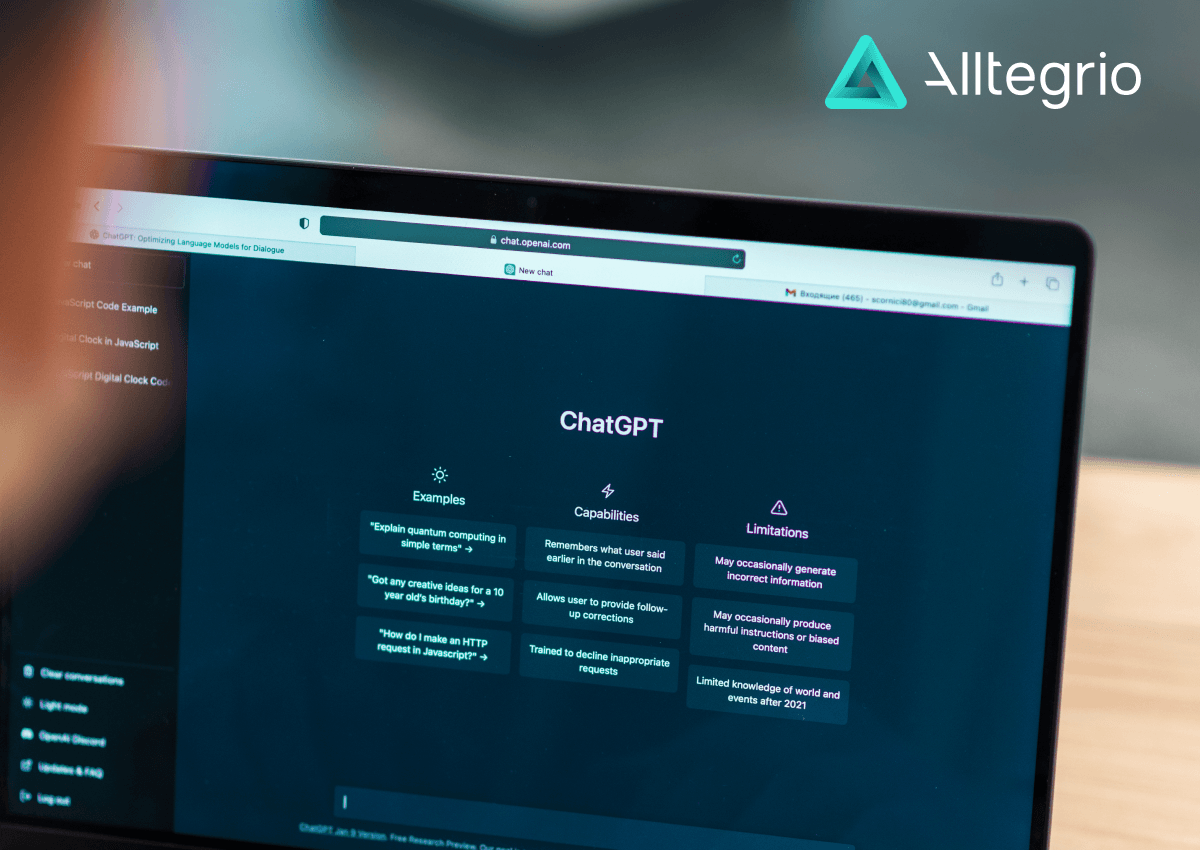
ChatGPT-Powered Content Generation Platform
We developed a customizable prompt library and content generation platform for the real estate market, with partner management and user analytics. The platform leverages Chat GPT to create compelling copy that aligns with the brand’s tone of voice.
Read more →
Computer Vision + ChatGPT-Powered Recommendations
Our client, one of the beauty market leaders, required a Shopify app with an AI solution to enhance client interactions. We developed a Computer Vision solution that analyzes the user’s selfies and generates personalized product recommendations.
Read more →
SaaS Marketing Content Generation Platform for Healthcare
We developed an AI/ML-powered SaaS platform tailored for the healthcare sector that automates content creation for blogging and digital marketing. The solution provides features such as SEO optimization, plagiarism detection, tone analysis, etc.
Read more →
ML/AI Technical Due Diligence for Startup Acquisition
A Japanese multinational conglomerate with substantial investments in technology, energy, and finance aimed to acquire a startup specializing in AI technologies. We provided comprehensive Technical Due Diligence to evaluate the startup’s potential.
Read more →
AI/ML-Driven Telecom Network Optimization
In this project, the Alltegrio team implemented AI/ML solutions to optimize telecom networks and enhance customer experience, leveraging advanced Machine Learning models and automated operations.
Read more →
ML/AI Technical Due Diligence for SporTech
An international sports data firm sought to acquire a technology company specializing in video analysis. We provided the client with a comprehensive assessment of the company’s strategic direction, development capabilities, and growth potential.
Read more →
AI Assistant for Report Generation & Visualization
Our client is a prominent telecommunication leader based in North America. The Alltegrio team created an AI-powered cloud-based project management platform designed to assist Business Analysts in generating visual representations for ad-hoc requests.
Read more →Hire Our Generative AI Developers
Our Dedicated Developer
- ✓Immediate Onboarding
- ✓Quick Replacement
- ✓1 Month Notice To Release Resource
- ✓Review Of Work By Senior Developers
- ✓Tracking Software
- ✓Access To Senior Developer In House Traine
Offshore Managed Team
- ✓Everything In Dedicated Developer
- ✓Dedicated HR Manager
- ✓Transparent Pricing (Cost Break Down Will Be Shared With You)
- ✓Flexible Working Hours
- ✓Credit Gifts And Bonus Directly To Resources
- ✓Training For Specific Skillset
- ✓Requirement Based Hiring From Marke
- ✓Customize Policies
- ✓Define Work Culture
Fixed Cost Project
- ✓Share Requirement Document
- ✓Get Quotation
- ✓Single Point Of Contact
- ✓Milestones Based Reports
- ✗Access To Developers
- ✗On-The-Go Requirement Changes
- ✗Dedicated Developers
Customer testimonials
“The project led to significant improvements in our data analytics and SEO strategies. The integration of ChatGPT enhanced our customer service, while the data annotation services improved the accuracy of our AI models. These outcomes have strengthened our competitive edge and demonstrated the substantial impact of Alltegrio’s services on our operations.”

Marina Ruban
COO, Luxeo.team
“As industry leaders, we needed to integrate advanced technologies like computer vision and machine learning to enhance our content creation and user engagement. Our goal was to develop cutting-edge facial recognition capabilities to streamline production processes and create more immersive experiences for our audience.”

Alex Johnson
CTO, Entertainment Company
“Alltegrio took us through a comprehensive AI journey, starting with consulting to understand our specific needs and crafting a custom strategy. They then analyzed and prepared our user and real-time data to train powerful AI models. These custom models weren’t off-the-shelf solutions – they were built specifically to generate highly relevant property recommendations and engaging content for our users.”

Emily Thompson
CMO, Real Estate Company
“The project led to significant improvements in user experience and operational efficiency. Our software now offers more personalized interactions and has automated several internal processes, demonstrating the value and success of our partnership with Alltegrio.”

Head of Marketing
SaaS Development Firm
“Alltegrio provided comprehensive services, including predictive analytics, video analysis AI, and machine learning for sports data. Their team of data scientists, AI experts, and project managers collaborated closely with our in-house analysts.”

John Davis
CTO, Bet Sports Analytics Company
Our Technology Stack for AI and ML Development
We offer our tech skills and technology stack, including AI, machine learning, data analytics, and frameworks
 Gemma
 VertexAI
 OpenAI
 Midjourney
 Llama
 Claude
 Mixtral
 Grok
 PaLM
 Anthropic Claude
 Mistral
 NVIDIA
 MS AzureGemmaVertexAIOpenAIMidjourneyLlamaClaudeMixtralGrokPaLMAnthropic ClaudeMistralNVIDIAMS Azure
Frequently Asked Questions
How long does it take to build a custom generative AI solution?+
Plan in phases, not in a single number. Discovery and feasibility typically take two to four weeks. A pilot in production with real users takes eight to 12 weeks. A full production build usually runs three to six months from that point. Anyone quoting a total timeline before seeing the data is quoting a guess. What each phase actually delivers:
- Discovery, two to four weeks. Data audit, feasibility, architecture, and an evaluation plan. The main output is often a decision not to build something, and that decision is cheap here and expensive later.
- Pilot, eight to 12 weeks. One workflow, real users, measured against a baseline. Not a demo. A demo proves the model can produce a good answer once; a pilot proves it does so reliably on live input.
- Production, three to six months. Integrations, evaluation harness, monitoring, cost controls, access permissions, and handover.
What extends the timeline, ranked by how often it happens: data that is not where it was said to be, a success criterion nobody agreed on before the build, security and procurement review, and integration with systems whose owners were not in the kickoff. What compresses it: one workflow instead of five, a documented process, a named decision-maker, and access to the data on day one rather than in week six.
When should you build custom generative AI instead of using an off-the-shelf tool?+
Buy off-the-shelf when the workflow is standard and the tool already does it. Build custom when the workflow is specific to your business, when the system needs your private data, when the output must integrate deeply with internal systems, or when the process itself is the competitive advantage. If a subscription tool solves the problem, building is the wrong decision. Buy when:
- The workflow is common across companies (support deflection, meeting notes, document search).
- The data can leave your environment under a standard agreement.
- Time to value matters more than fit.
- The process is not a differentiator, and doing it the same way as everyone else costs you nothing.
Build when:
- The workflow depends on proprietary data, proprietary logic, or a process that is genuinely yours.
- Off-the-shelf tools get you most of the way and stall, which is the most common trigger and usually appears in month four of a subscription.
- Compliance or data residency rules out the vendor's hosting model.
- The economics invert at scale: per-seat pricing that was reasonable for 50 users becomes indefensible at 5,000.
- The system must act inside your stack, not adjacent to it.
The honest test.
Write down what the off-the-shelf tool cannot do, then ask whether that gap is worth a six-figure engineering project. If the gap is convenience, buy. If the gap is capability that changes an economic outcome, build. Most companies should do both: buy for the commodity workflows, build for the two or three that actually differentiate them.
What is included in custom generative AI development services?+
A complete engagement covers six things: discovery and feasibility, architecture and model selection, the data and retrieval layer, the application and integrations, an evaluation harness that proves it works, and the operations layer that keeps it working. The build is the visible part. Evaluation and operations are where most of the effort goes. What each piece means in practice:
- Discovery. Data audit, use case assessment, architecture, cost model, and a written success criterion. The stage that most often prevents an expensive mistake.
- Architecture and model selection. Which model, hosted where, with what fallback. Chosen against your constraints on cost, latency, and data residency, not against a benchmark leaderboard.
- Data and retrieval layer. Ingestion, chunking, indexing, permissions, and the grounding rules that force exact values to come from records rather than from generated text.
- Application and integrations. The product itself, and the connections into the systems it has to read from and write to.
- Evaluation. A repeatable test set, run before every release, so quality is measured rather than asserted. This is the line between an engineering firm and a prototype shop.
- Operations. Monitoring, drift detection, cost per transaction, logging, and incident response.
What is frequently not included, and should be asked about explicitly: the cost to run the system after launch, data quality remediation, retraining or re-evaluation when the underlying model is updated, and handover documentation good enough for your team to operate it alone.
Let's talk about your project
We'll help you harness AI and ML technologies to create innovative software solutions