
The betting landscape hasn’t just grown — it has accelerated. Markets update instantly, public sentiment shifts within minutes, and small edges close quickly. Managing that environment manually has become increasingly difficult.
That’s why many serious bettors are moving beyond spreadsheets and gut feeling toward structured systems powered by AI in sports betting. AI agents don’t just generate a one-off prediction. They continuously process data, adjust probability estimates, enforce risk rules, and support disciplined decision-making. Instead of reacting emotionally to market shifts, they operate within defined objectives and constraints.
This guide explains what AI agents in sports betting actually are, how they use data to produce AI-based predictions, and where they fit into modern AI in sports environments. We’ll explore how they support analysis of betting decisions, automate parts of the workflow, and identify where their limits and risks still remain. The goal is clarity, not hype, about what these systems can realistically do in 2026.
AI agents in sports betting: What they actually are
The term “AI agent” is often used loosely in betting discussions. Sometimes it refers to a predictive model. Sometimes, to a bot that automatically places bets. And sometimes to a platform that simply summarizes match statistics using generative AI in sports applications. These tools may use artificial intelligence, but they are not necessarily AI agents.
An AI agent in sports betting is more than a model that outputs a probability. It is a structured system designed to operate toward a defined objective under specific constraints. That objective might be maximizing long-term expected value, controlling volatility, identifying market inefficiencies, or protecting a sportsbook from unusual exposure.
What makes it an agent is not just prediction but decision logic. A typical AI agent can do the following:
- Continuously process new data.
- Update probability estimates.
- Compare those estimates to market odds.
- Apply risk rules.
- Decide whether to act or not.
- Log outcomes and adapt over time.
In other words, it doesn’t stop at analysis. It participates in a workflow.
This distinction matters because AI in sports betting is no longer limited to producing forecasts. Modern systems integrate modeling, automation, monitoring, and feedback loops into one structured environment. A standalone model might say, “Team A has a 58% chance of winning.” An AI agent takes the next step. It runs that probability through additional filters: Is there a true edge once the margin is considered? Does the bet fit the bankroll model? Are liquidity and line movement stable enough to proceed?
Another important clarification: AI agents are not inherently aggressive or fully autonomous. In many professional setups, they operate with human oversight. A trader, analyst, or risk manager may review signals before execution. The system supports structured analysis of betting, but it does not eliminate judgment. These agents appear in multiple environments:
- On the bettor’s side, assisting with AI sports analysis and structured strategy management.
- On the operator side, monitoring exposure, pricing efficiency, and fraud patterns.
- Inside analytics platforms that provide AI-based predictions combined with risk controls.
Understanding this difference between a predictive model and a decision-making agent is the foundation for everything that follows.
Key technologies used in AI in sports betting
Behind every serious AI agent in sports betting sits a combination of statistical modeling, machine learning, data engineering, and monitoring systems. The “AI” label can sound abstract, but in practice, these systems are built from well-defined components that each serve a specific purpose.
At the core are probability models. They can be built on classic statistical frameworks or more advanced machine learning methods like gradient boosting, neural networks, and ensemble techniques. The objective isn’t to guess the exact final score, but to estimate realistic, well-calibrated probabilities — essentially, how likely an outcome is given the current context.
Calibration is critical. When a model estimates a 60% chance, reality should reflect that frequency over a large enough sample. When that alignment breaks down, even complex AI sports analysis loses credibility.
Beyond modeling, modern systems rely heavily on real-time data pipelines. In live markets, odds and match events change rapidly. AI agents need to process live event feeds, refresh their input variables, and update probabilities almost instantly. Even a delay of a few seconds can change the outcome, particularly in fast-moving in-play markets.
Monitoring layers are equally important. Modern AI in sports betting environments incorporates drift detection to identify performance deterioration early. Structural changes, from roster turnover to tactical evolution or regulatory updates, can alter the data landscape. Without continuous oversight, predictive accuracy can decline long before it becomes obvious in headline results.
Where does generative AI in sports fit into this stack? Mostly in supportive roles. Large language models can summarize injury reports, extract structured insights from news articles, or analyze unstructured commentary. However, they are rarely responsible for core probability modeling. Generative systems are useful for context extraction, not for replacing structured predictive models.
Taken together, these technologies form the backbone of modern AI agents. They enable structured analysis of betting environments at scale and introduce new layers of complexity that must be carefully managed.
How AI agents use data
AI agents operate within the limits of their data environment. In sports betting, the quality and structure of inputs often matter more than model complexity.
At the core is historical performance data, from match results to advanced metrics. Around that, contextual details — injuries, lineups, rest days, weather — add nuance that raw statistics alone can’t capture.
Market data is equally important. Odds movement, implied probabilities, volatility, and liquidity signals provide additional information that serious AI in sports betting systems treat as part of the dataset, not noise.
In live settings, event-stream data becomes critical. Each goal, foul, or substitution updates probability estimates in real time. Some platforms also process unstructured inputs — news, interviews, social signals — using generative AI in sports applications, though these require strict filtering to avoid noise.
Data quality ultimately determines stability. Inconsistent feeds, delayed updates, or leakage during training can undermine performance. Strong, clean inputs support reliable decisions; flawed data quietly distorts outcomes, regardless of modeling sophistication.
How are AI agents used in sports betting today?
Understanding how AI agents are built is only part of the picture. The real question is how they operate in live betting environments in 2026.
Use cases generally fall into five areas: pre-match modeling, real-time decision support, automated value detection, capital management, and market monitoring. While the underlying technology may be similar, the operational demands differ significantly.
Before kickoff, agents focus on structured analysis. They process historical trends, contextual inputs, and market pricing to generate AI-based predictions. The emphasis here is depth — identifying potential mispricing in relatively stable conditions.
Once the match begins, the pace changes. Live markets require constant recalculation. Goals, fouls, substitutions, and momentum shifts immediately affect probability estimates, making timing critical. Even brief delays can erase the edge.
In addition to modeling outcomes, AI agents compare internal probabilities against market pricing to uncover an edge once costs are considered. Simultaneously, they manage exposure by enforcing position-sizing rules and monitoring cumulative risk.
On the operator side, similar systems track abnormal betting activity and exposure shifts, supporting pricing stability and fraud detection.
Across all applications, AI agents function not as isolated prediction tools, but as components within structured decision frameworks balancing opportunity and risk.
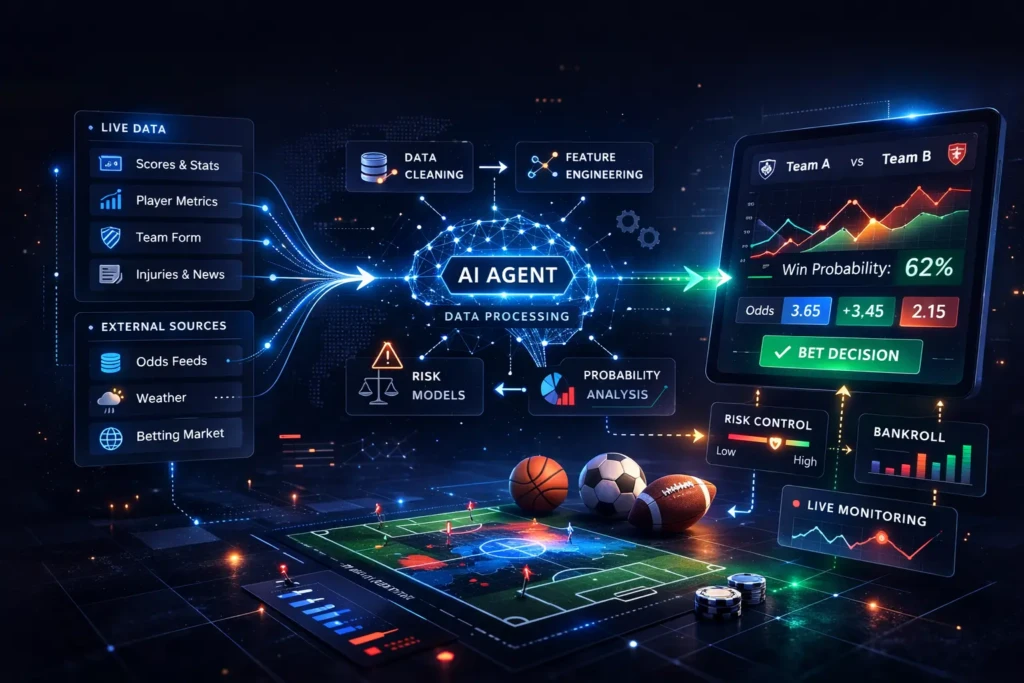
1. AI-based predictions: How do AI agents analyze sports data?
At the center of most AI systems in sports betting lies probability estimation. Not guessing exact scores. Not declaring “Team A will win.” But calculating how likely different outcomes are under current conditions.
The process usually unfolds in a clear sequence.
Data is first aggregated from multiple sources — past performance, contextual variables, and current pricing signals. That information is then engineered into measurable features that capture trends, efficiency patterns, matchup dynamics, and situational context.
Next comes probability modeling. The system examines historical scenarios with comparable signal profiles and calculates the frequency of each outcome. Rather than outputting one fixed prediction, it assigns probabilities across multiple market possibilities — match results, totals, spreads, or player-based markets.
This is where AI-based predictions differ from casual forecasting. The focus is on calibration and expected value, not narrative. A model might assign a 54% win probability where the market implies 50%. Once adjusted for margin, that gap represents a potential edge.
Validation plays a critical role. Before deployment, models are tested on out-of-sample data to measure stability. Backtesting helps identify whether performance holds across seasons, leagues, and market conditions. Without this step, short-term success can be misleading.
In 2026, more mature AI in sports betting systems will also incorporate confidence estimation. Not every 54% signal carries equal reliability. Agents may weigh signals differently depending on data completeness, volatility, or market liquidity.
Importantly, the strongest systems do not attempt to “outsmart” the market blindly. Instead, they operate as structured analysis engines, identifying small inefficiencies within an increasingly efficient ecosystem.
In essence, AI agents convert vast amounts of sports data into structured probability estimates. What follows — whether to place a bet, determine stake size, or hold back — depends on the decision rules built around those probabilities.
2. Automated odds analysis and value betting discovery
Once an AI agent produces probability estimates, the next step is comparison. Probability alone has no meaning in betting until it is measured against market pricing.
Every betting odd implies a probability. For example, decimal odds of 2.00 suggest a 50% implied probability (before margin). AI agents convert market prices into implied probabilities and compare them against internally modeled estimates. Once adjusted for bookmaker margin, the gap between the two defines potential edge.
This is where structured analysis of betting becomes operational rather than theoretical.
When internal estimates suggest a 54% likelihood against a 50% implied market probability, the system must determine whether the differential remains meaningful once costs and market frictions are factored in. Minor mispricings often correct themselves rapidly.
Currently, automated odds analysis is rarely static. AI agents monitor line movement, volatility, and trading patterns. A signal that looks attractive at one moment may weaken as the market adjusts. Timing becomes part of the strategy.
Another important factor is market depth. Some leagues and prop markets are relatively illiquid. Even if a statistical edge exists, practical limitations (like stake limits, price impact, or rapid line shifts) may reduce or eliminate profitability.
That’s why serious systems don’t treat every probability gap as actionable. Many signals are filtered out after applying additional constraints: minimum edge thresholds, liquidity checks, volatility filters, or correlation rules.
In efficient markets, edges are often small and short-lived. The goal of AI in sports betting is not to find massive mispricing, but to systematically detect and evaluate marginal inefficiencies — and to do so consistently.
At this stage, probability modeling transitions into execution discipline. The agent must decide not only whether value exists, but whether conditions are favorable enough to act.
3. Real-time betting decisions
Live betting is where AI agents operate under the most pressure. Pre-match modeling allows for controlled analysis built on steady inputs. In-play markets, however, move continuously. One key event — a goal, dismissal, turnover, or momentum swing — can immediately reshape probability estimates.
AI agents process these event streams in near real time. As new information arrives, internal features update and probabilities are recalculated. But recalculation alone isn’t enough. The system must also evaluate whether execution is still viable under current market conditions.
In live markets, latency directly affects expected value. If a model reacts to a goal three seconds after the market has already adjusted, the opportunity may be gone. This makes infrastructure (including data feeds, processing pipelines, and execution systems) just as important as the model itself.
Another complexity is volatility. Live matches are dynamic, and short-term fluctuations can produce noisy signals. A disciplined AI agent does not respond to every minor shift. Instead, it operates within predefined thresholds, filtering out unstable or low-confidence situations.
Many professional setups also implement “no-bet” logic. Under conditions of low liquidity, degraded data quality, or elevated volatility, the agent may suspend execution based on predefined risk constraints. In rapid markets, avoiding suboptimal trades is as critical as capturing an edge.
This is where AI in sports betting differs from casual live betting. The goal is not rapid reaction alone, but controlled reaction. It’s about adjusting exposure in response to meaningful signals while maintaining structured risk discipline.
4. Bankroll management and risk control with AI agents
Identifying value is only part of the equation. How much to stake and when to reduce exposure — that’s what often determines whether a strategy survives over time.
AI agents typically embed structured bankroll rules directly into the decision process. Once a probability edge is identified, the system calculates position size based on predefined risk parameters. Approaches may range from fractional Kelly calculations to fixed capital percentages or volatility-adjusted models that adapt to changing risk conditions. The priority is not short-term acceleration, but consistent capital appreciation with controlled fluctuation.
Modern AI in sports betting environments also applies exposure limits across multiple dimensions. These can include caps per league, per market type, per time window, or even per correlated event. For example, multiple bets influenced by the same underlying factor may be treated as partially linked to avoid hidden concentration risk.
Another important component is drawdown management. AI agents track cumulative performance in real time and may reduce position sizes if volatility exceeds predefined limits. Some systems automatically scale down during losing streaks or unstable market conditions.
Importantly, risk management logic is applied consistently. Unlike human decision-making, which can be influenced by recent wins or losses, an AI agent follows predefined rules. This consistency is one of the most practical advantages of structured systems.
Without disciplined capital management, even accurate AI-based predictions can lead to unstable results. Edge alone does not guarantee sustainability. The interaction between probability, stake sizing, and variance determines whether a strategy compounds or collapses.
In this sense, bankroll management is not an accessory feature. It is a core component of any serious AI agent operating in competitive betting markets.
5. Fraud detection, pattern recognition, and market monitoring
Modern AI systems don’t stop at identifying an opportunity; they also safeguard the market environment. Automated systems scan for irregular patterns, exposure imbalances, and coordinated behavior that may signal instability.
Operators use AI to scan live betting flows for coordinated activity, unusual stake concentrations, and abnormal market behavior. Alerts are generated automatically, but enforcement remains human-led.
For bettors running automated strategies, monitoring tools serve a different purpose. They track pricing inconsistencies, liquidity changes, and abnormal line movement that may indicate unstable conditions. Detecting when a market behaves unpredictably can be as important as identifying opportunity.
Pattern recognition systems rely on historical baselines. When activity diverges significantly from historical baselines, the system generates alerts. Because anomaly detection is not perfect, advanced environments pair automated signals with human review to reduce false positives.
In modern AI in sports betting ecosystems, surveillance is not separate from strategy. It’s part of maintaining structural stability in increasingly competitive markets.
Analysis of betting
In 2026, effective analysis of betting goes beyond tracking wins and losses. Serious systems measure performance against expected value, not short-term outcomes. A profitable week can still hide negative expected value, while a losing streak may sit within statistical variance.
One of the key metrics is Closing Line Value (CLV) — whether a bet was placed at a better price than the market ultimately settled on. Consistently beating the closing line often indicates structural edge, even if short-term results fluctuate.
AI agents also monitor ROI relative to projected edge, volatility, and drawdowns across leagues and market types. This helps identify where a strategy remains stable — and where it degrades.
In structured AI in sports betting environments, analysis is continuous. Models are not judged by isolated outcomes but by long-term alignment between probability estimates and market behavior.
Practical benefits and responsible use of AI in sports betting
When implemented thoughtfully, AI in sports betting introduces structure into an environment that is otherwise reactive and emotionally charged. The benefits are not about “guaranteed wins,” but about decision quality, consistency, and measurable process control.
Key benefits
- Scalability of analysis. AI agents can monitor dozens of leagues, markets, and pricing movements simultaneously. What would overwhelm a human analyst becomes manageable through structured automation.
- Consistency in execution. The system applies the same logic every time. It does not overreact to recent wins, chase losses, or deviate from predefined strategy parameters.
- Speed and responsiveness. In live markets, automated recalculation enables rapid adaptation to meaningful events without sacrificing structure.
- Structured AI sports analysis. Instead of intuition-driven reasoning, the process relies on calibrated probabilities, measurable expected value, and predefined execution criteria.
- Capital discipline. Stake sizing and risk limits are executed systematically, reducing impulsive overexposure.
- Performance visibility. Advanced systems continuously track expected value, closing line value, volatility, and stability across different markets — enabling objective evaluation.
However, these advantages only materialize under responsible implementation.
AI agents need clearly articulated objectives, firm risk boundaries, and continuous performance oversight. They should function within controlled frameworks, supported by logging systems that enable auditing and review. Testing strategies in simulated or limited environments before scaling exposure remains critical.
In 2026, mature AI in sports betting environments treats automation as structured decision support — not as a replacement for oversight. Technology enhances speed and discipline, but long-term sustainability still depends on realistic expectations and controlled risk exposure.
The risks of AI-based sports betting
AI agents improve organization and execution speed, but uncertainty remains inherent. Weak design or oversight can magnify exposure rather than control it.
Key risks include the following:
- Over-optimization. Models tuned too closely to historical data may degrade when market conditions shift.
- Concept drift. Changes in team dynamics, player movement, tactics, or regulations can gradually erode predictive accuracy.
- Shrinking edge. As markets grow more efficient and automated participation increases, pricing gaps tend to shrink and correct more quickly.
- Liquidity limitations. A statistically valid signal may not scale if stake limits, price impact, or rapid line movement reduce realizable edge.
- Execution risk. Latency and market timing can materially affect outcomes in fast-moving environments.
- Behavioral overreliance. Treating probabilistic outputs as certainty may lead to excessive exposure.
Sustainable AI in sports betting requires continuous validation, realistic expectations, and disciplined risk control — not just strong modeling.
AI agents development
Building AI agents for sports betting involves more than training a predictive model. A production-ready system combines multiple coordinated layers within a controlled decision framework.
At a high level, AI agents development typically includes:
- Data layer. Collection, cleaning, and normalization of historical, contextual, market, and live event data. Stability here determines overall system reliability.
- Modeling layer. Probability modeling is built on statistical and machine learning methods, reinforced through calibration and independent validation testing.
- Decision engine. Logic that converts probabilities into actions, applying edge thresholds, position sizing rules, and exposure constraints.
- Execution layer. Integration with trading or betting infrastructure to ensure timely and controlled placement.
- Monitoring and feedback loop. Continuous performance tracking, drift detection, logging, and structured recalibration.
Before deployment, serious systems undergo simulation and stress testing to evaluate behavior under volatile or abnormal conditions. A model that performs well historically may still fail under real execution pressure.
Human oversight remains part of mature architectures. Automated components operate within predefined boundaries, supported by audit trails and performance reviews.
Developing AI agents is not simply a modeling exercise. It involves constructing a cohesive decision framework in which data integrity, risk controls, and continuous validation are foundational elements.
Looking ahead: The role of AI agents in sports betting
AI agents are becoming a structural part of modern sports betting environments. Not because they eliminate uncertainty, but because they introduce consistency, speed, and measurable decision logic into markets that move quickly and reward discipline.
In 2026, the difference is no longer between those who use AI and those who don’t. It is between those who treat AI agents as experimental tools and those who integrate them as structured decision systems — supported by clean data, clear risk parameters, and continuous validation.
Probability models alone are not enough. Sustainable performance depends on how those models are embedded into capital management, execution logic, and oversight processes.
For teams exploring AI in sports betting — whether on the bettor or operator side — the real question is not whether automation works, but how it fits into existing workflows and risk frameworks.
That conversation usually starts before any model is trained.If you’re evaluating how AI agents could fit into your betting infrastructure, from modeling and decision engines to risk controls and monitoring, it helps to start with the architecture, not the hype. If this is something you’re currently exploring, drop us a line — we at Alltegrio are ready to determine what makes sense for your specific setup.
'%3E%3C/rect%3E%3Cpath d='M21.0079 11.1156L21.6244 11.1841C24.4986 11.5025 26.6656 13.982 26.6656 16.9507V24.7908C26.6656 26.3373 27.4992 27.7759 28.8412 28.5458C28.957 28.6124 29.0564 28.7011 29.1345 28.8053H12.8746C12.9528 28.7011 13.0521 28.6124 13.1679 28.5458C14.51 27.7768 15.3436 26.3383 15.3436 24.7908V16.808C15.3436 13.9145 17.5095 11.4967 20.3827 11.1831L21.007 11.1146M21.0041 8.5C20.5902 8.5 20.2554 8.83575 20.2554 9.24869V10.0147C16.8323 10.3881 14.1684 13.2854 14.1684 16.808V24.7908C14.1684 25.9206 13.5635 26.9635 12.5832 27.526C11.9137 27.91 11.5007 28.622 11.5007 29.3939C11.5007 29.718 11.7632 29.9805 12.0873 29.9805H29.9199C30.244 29.9805 30.5065 29.718 30.5065 29.3939C30.5065 28.622 30.0935 27.91 29.424 27.526C28.4437 26.9645 27.8388 25.9206 27.8388 24.7908V16.9507C27.8388 13.4138 25.2048 10.3987 21.7518 10.0157V9.24869C21.7518 8.83479 21.417 8.5 21.0041 8.5Z' fill='white'%3E%3C/path%3E%3Cpath d='M21.0041 8.5C20.5902 8.5 20.2554 8.83575 20.2554 9.24869V10.0147C16.8323 10.3881 14.1684 13.2854 14.1684 16.808V24.7908C14.1684 25.9206 13.5635 26.9635 12.5832 27.526C11.9137 27.91 11.5007 28.622 11.5007 29.3939C11.5007 29.718 11.7632 29.9805 12.0873 29.9805H29.9199C30.244 29.9805 30.5065 29.718 30.5065 29.3939C30.5065 28.622 30.0935 27.91 29.424 27.526C28.4437 26.9645 27.8388 25.9206 27.8388 24.7908V16.9507C27.8388 13.4138 25.2048 10.3987 21.7518 10.0157V9.24869C21.7518 8.83479 21.417 8.5 21.0041 8.5Z' fill='white'%3E%3C/path%3E%3Cpath d='M23.582 31.1199H18.426C18.5698 32.4166 19.6687 33.4267 21.004 33.4267C22.3393 33.4267 23.4382 32.4175 23.582 31.1199Z' fill='white'%3E%3C/path%3E%3Cdefs%3E%3ClinearGradient id='paint0_linear_1536_57632' x1='0' y1='0' x2='42' y2='42' gradientUnits='userSpaceOnUse'%3E%3Cstop stop-color='%2300CBBF'%3E%3C/stop%3E%3Cstop offset='1' stop-color='%23007DFE'%3E%3C/stop%3E%3C/linearGradient%3E%3C/defs%3E%3C/svg%3E)