
Insurance used to move at the speed of paperwork. Quotes took days. Claims took weeks. Customers called, waited, repeated their story, and hoped someone would eventually call back.
That rhythm no longer matches reality.
Today’s policyholders expect the same responsiveness they get from e-commerce, digital banking, and ride-hailing apps. They want clarity, not jargon. They want updates without chasing them. They want a payment decision before frustration turns into a complaint.
This is the point where emerging startups are quietly transforming the sector.
Instead of layering innovation onto legacy infrastructure, insurtech companies build automation directly into their operational foundation. Increasingly, that automation is not just workflow scripts or chatbots — it is agentic AI insurance systems capable of taking actions, not just answering questions.
These AI agents are becoming embedded across the customer journey: from quote to onboarding, from policy changes to claims processing. The goal isn’t simply cost reduction. It’s a service that feels faster, clearer, and more predictable.
Let’s start with the foundation.
The new wave of insurance startups is built for speed
Insurance startups are not just smaller versions of traditional carriers. They are structurally different.
Many were launched in a world where customers already expected:
- Instant messaging over phone queues
- Mobile-first policy management
- Proactive alerts instead of reactive service
- Transparent pricing explanations
Because they aren’t burdened by deeply layered legacy IT systems, these companies can redesign operations around modern digital workflows. That flexibility allows them to integrate AI agents directly into core processes rather than bolt them on as a separate “chat layer.”
This is where agentic AI insurance capabilities begin to matter.
Older automation models typically did the following:
- Routed tickets
- Answered FAQs
- Triggered predefined workflows
Agentic systems go further. They can:
- Retrieve and interpret policy documents
- Cross-check customer history
- Draft compliant responses
- Initiate endorsements or updates
- Escalate with context when needed
For startups, this means service operations are no longer organized around “who is available to answer the next ticket,” but around “what outcome needs to happen next.”
Why Speed Is a Competitive Advantage
In insurance, customer acquisition costs are high. Retention matters. Reviews matter. Word-of-mouth makes a difference.
When a quote arrives within minutes, coverage can be adjusted without a phone call, claim updates are easy to track, and payment decisions don’t drag on, customers are far more likely to stay. Speed is not only about customer satisfaction. It is operational leverage.
AI for insurance agents allows startups to:
- Reduce repetitive administrative tasks
- Shorten resolution cycles
- Maintain consistent documentation
- Scale support without linear headcount growth
Instead of hiring ten more agents when ticket volume doubles, startups can redesign how work flows through AI-assisted systems.
But it’s important to clarify something early: these companies are not replacing humans entirely. They are redefining what humans focus on.
Routine verification? Automated. Basic coverage clarification? AI-assisted. Simple claims validation? Partially automated. Complex disputes, sensitive injury cases, regulatory exceptions? Human-led, supported by AI.
The real change isn’t about replacing people. It’s about reducing unnecessary friction. And in a trust-driven industry like insurance, that difference is significant.
Insurance startups: What they are and how they actually make money
Not every insurance startup looks the same. Some operate as fully licensed carriers. Others sit somewhere between broker and technology platform. A few don’t even feel like “insurance companies” at first glance. They embed coverage directly into another product or service.
Understanding these models matters because the way a company earns revenue shapes how it approaches customer experience and where AI agents fit.
1. Full-stack digital carriers
In this model, the company controls the entire insurance lifecycle — from underwriting and pricing to claims handling. Premiums flow directly to them, and they retain the risk, usually with support from reinsurers.
Controlling the full insurance cycle gives them room to embed agentic AI in insurance across core operations — automating underwriting logic, accelerating claims triage, and streamlining payment processes.
Their incentive is clear:
- Reduce operational cost per policy.
- Improve retention.
- Accelerate claim resolution without increasing fraud exposure.
AI agents become part of the operational backbone, not just a support feature.
2. MGAs and digital brokers
Managing General Agents (MGAs) and digital brokers focus on distribution. They may not carry the risk themselves, but they design products, handle onboarding, and manage customer relationships.
Here, AI for insurance agents plays a slightly different role. Instead of replacing underwriting systems, AI agents cover the following:
- Help advisors explain coverage options
- Summarize policy differences in plain language
- Assist with compliance documentation
- Reduce the back-and-forth during onboarding
A faster, clearer purchase process tends to lift conversion rates. In this model, operational speed isn’t just a service metric — it’s a growth driver.
3. Embedded insurance platforms
This is where insurance appears inside another product, such as:
- Еravel coverage inside a booking app
- Device insurance at checkout
- Gig worker coverage inside a marketplace platform
In embedded models, friction is the enemy. The insurance offer must be explained quickly, purchased in seconds, and serviced without pushing customers to a separate portal.
Here, AI agents often operate invisibly in the background to cover the following:
- Verify eligibility
- Check coverage logic
- Handle micro-claims
- Respond through in-app messaging
The entire experience must feel native.
Where customer experience breaks most often
Regardless of the model, friction usually appears in the same places:
- Quote forms that feel repetitive or unclear
- Coverage explanations filled with technical language
- Policy changes that require manual review
- Claims that stall due to missing documentation
- Customers repeating the same story across multiple channels
The friction isn’t usually obvious. It tends to surface in minor delays that compound over time. But in a competitive market, those small delays push customers to compare alternatives at renewal time.
That’s why many insurance startups are not only experimenting with automation. They are redesigning service workflows around AI agents from the start. Not as a marketing feature, but as infrastructure.
What are AI agents in insurance, really?
The term gets used loosely. Some vendors call any chatbot an “AI agent.” Others apply it to workflow automation with a conversational layer. But in practice, there’s a meaningful difference between scripted automation and agentic systems.
In insurance, that distinction matters. A traditional chatbot typically does the following:
- Answers predefined FAQs
- Routes tickets to departments
- Collects structured form inputs.
It reacts.
An AI agent, by contrast, can interpret context, decide what tool to use next, and take action toward a defined outcome within guardrails. That’s where AI for insurance agents and customers starts to shift from convenience to operational impact.
AI agents vs. automation vs. chatbots
Not all “AI-powered” systems operate at the same level. In insurance, the difference between rule-based automation, chatbots, and true AI agents has practical implications for customer experience and operational efficiency.
| Capability | Rule-Based Automation | Chatbots | AI Agents |
| Core Function | Executes predefined logic and workflows | Provides conversational interface | Coordinates actions to achieve defined outcomes |
| Best For | Stable, repetitive, predictable tasks | Answering FAQs, guiding users through forms | Complex, multi-step service and operational tasks |
| Handling Variability | Struggles with unexpected inputs or unstructured data | Limited flexibility unless integrated deeply | Can interpret context and adapt within guardrails |
| Document Processing | Requires structured inputs | Typically limited | Retrieves and analyzes policy documents and attachments |
| Access to Customer History | Minimal or predefined | Often partial | Full contextual awareness (claims, endorsements, prior interactions) |
| Workflow Execution | Follows fixed paths | Usually triggers backend workflows | Initiates, coordinates, and monitors internal processes (endorsements, document requests, status checks) |
| Escalation | Manual routing rules | Transfers conversation | Escalates with full context and structured summaries |
| Operational Role | Task execution | Interface layer | Service orchestration layer |
Instead of simply answering questions, AI agents coordinate systems, data, and workflows toward resolution.
That coordination is why many insurance startups are redesigning AI Customer Support around agent-based systems rather than relying solely on standalone chat tools.
What makes an AI agent “agentic” in insurance?
Agentic systems combine several components:
- Access to tools. Policy administration platforms, claims systems, billing software, CRM, payment gateways, and document repositories.
- Context awareness. Prior claims, endorsements, communication history, policy terms, risk profile.
- Reasoning within guardrails. The system evaluates its options while staying within compliance rules, coverage parameters, and escalation boundaries.
- Human oversight. When situations become sensitive, unclear, or financially significant, the case moves to a licensed professional.
In this model, Virtual Assistants evolve beyond simple chat interfaces. They function as coordinators, linking data, systems, and workflows in real time. And they operate as part of a broader human-supported framework.
An adjuster reviewing a claim, for example, might receive:
- A structured summary of the incident
- Extracted key details from uploaded documents
- Flagged inconsistencies
- Suggested next steps aligned with policy terms
The human still makes the final call, but with less manual digging.
Where this actually changes customer experience
From the customer’s perspective, the technical architecture is invisible. Here’s what they notice instead:
- Fewer repeated questions
- Faster answers
- Clearer explanations of coverage
- Claim updates without chasing support
- Consistent information across chat, email, and phone
The experience shifts from reactive to coordinated.
That’s why many startups view agentic AI insurance systems not as experimental technology, but as a service layer redesign.
Not just answering, not just routing, but resolving.
Agentic AI in insurance: Why it changes customer service outcomes
Agentic systems don’t just improve response time. They change how service work is structured.
Traditional customer support in insurance is reactive. A policyholder submits a request. A ticket is created. Someone reviews it, gathers context, checks policy terms, consults another system, and responds. Each step adds latency.
With agentic AI in insurance, the workflow shifts from “respond and pass along” to “resolve and coordinate.”
Instead of handling isolated tasks, AI agents can:
- Retrieve policy terms automatically.
- Cross-check prior communications.
- Validate coverage limits.
- Flag missing documentation.
- Initiate endorsements or updates.
- Prepare structured summaries for human review.
It’s an understated shift — and a meaningful one. The agent doesn’t just provide information. It moves the case forward.
From response to resolution
In traditional models, cases often pass through several hands before reaching completion. Even if each step runs efficiently, the accumulated delays can slow overall resolution.
Agentic systems reduce those handoffs. For instance:
- A policy change request doesn’t just get acknowledged. The system verifies eligibility and drafts the update.
- A claim submission isn’t just logged. Documents are analyzed, policy coverage is checked, and potential inconsistencies are flagged immediately.
- A billing inquiry doesn’t simply receive a canned reply. The system reconciles account history before responding.
The outcome is not just faster service. It’s fewer loops.
What improves for customers, and what improves internally
For customers, improvements are tangible:
- Less repetition of information
- Faster clarifications
Clearer explanations - More consistent answers across channels
Internally, startups see:
- Reduced ticket backlog
- Better documentation quality
- More predictable escalation
- Lower administrative overhead
This is why agentic AI insurance models are becoming foundational rather than experimental. They allow startups to scale service without scaling friction.
Claims automation and faster payment decisions
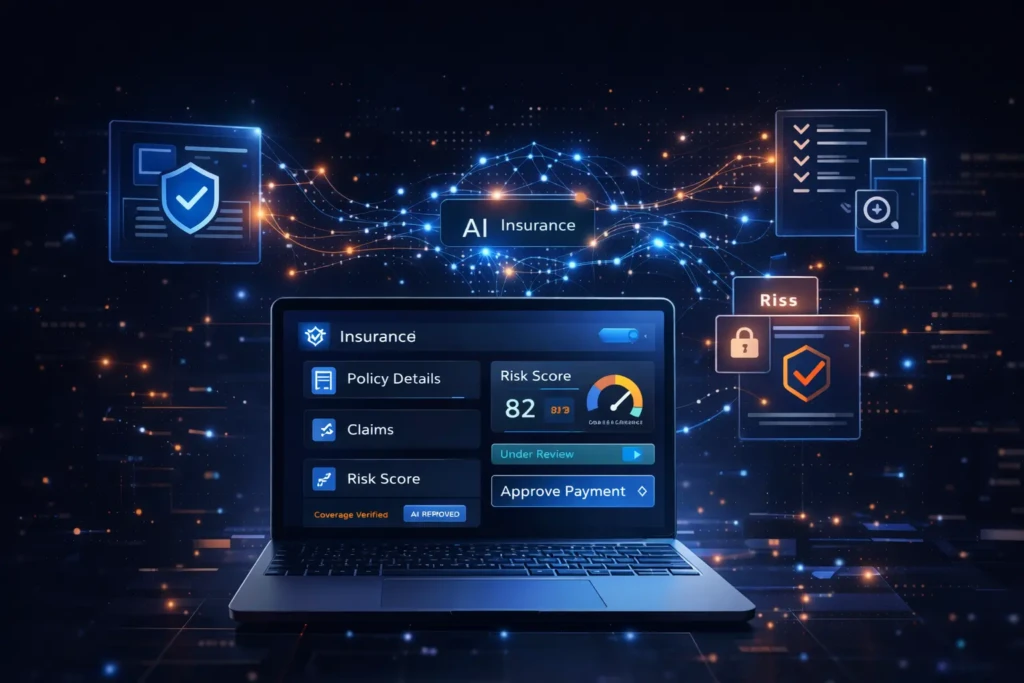
Claims are where insurance promises are tested.
A smooth onboarding experience builds confidence. A clear policy explanation builds trust. But a claim — especially after an accident, loss, or damage — is where customers decide whether the insurer truly delivers.
For insurance startups, this moment is critical.
Traditional claims handling often involves:
- Manual document review
- Repeated clarification requests
- Coverage checks across multiple systems
- Internal routing between adjusters, finance, and compliance
Even when teams are competent, the process can feel slow and fragmented.
This is where agentic AI insurance systems create measurable change.
Instead of treating claims as static tickets, AI agents can coordinate the flow from intake to decision.
They can:
- Extract key details from uploaded photos and documents
- Verify coverage terms against the policy
- Detect missing information immediately
- Flag inconsistencies or risk indicators
- Trigger next steps automatically
The goal is not full automation in every case. It’s structured acceleration.
Faster payment decisions
Speed matters most at the decision point. A customer who has just experienced damage or loss wants clarity:
- Is this covered?
- What happens next?
- When will I receive payment?
AI agents shorten this cycle by reducing idle time between steps.
In cases where the loss is minor and the documentation is clear, the process can move quickly. Coverage is confirmed, deductibles are calculated, and payouts are triggered in minutes — not days.
In more complex situations, AI still supports faster human review. It compiles case summaries, structures supporting documents, flags potential risk indicators, and drafts preliminary communications.
This reduces the administrative burden on licensed professionals and allows them to focus on judgment rather than data gathering. The outcome is not just speed, it’s predictability.
Customers receive faster updates. Internal teams work from structured summaries. Payment decisions become more consistent and auditable.
And for startups, faster resolution directly affects retention, reviews, and operational cost per claim.
AI customer support and virtual assistants in 24/7 service
Insurance doesn’t operate on a 9-to-5 schedule. Accidents happen at night. Travel plans change on weekends. Billing questions surface right before a policy lapses. For startups competing on experience, availability is no longer optional.
This is where AI Customer Support becomes foundational. Instead of expanding headcount to cover every time zone and peak period, insurance startups are deploying Virtual Assistants that handle the first layer of interaction — and, increasingly, much more than that.
But there’s an important distinction.
The goal is not to create a digital gatekeeper that blocks access to humans. The goal is to resolve what can be resolved instantly and route what cannot with full context.
What modern virtual assistants actually do
In early implementations, virtual assistants were largely FAQ bots. They answered basic policy questions and redirected customers elsewhere for anything more complex.
Today’s systems operate differently.
Modern Virtual Assistants can do the following:
- Retrieve specific policy clauses in plain language
- Check claim status in real time
- Explain deductible calculations
- Guide customers through endorsement requests
- Collect structured information for underwriting review
- Verify billing history before responding
Because they are connected to backend systems, such as policy administration, CRM, and claims platforms, they operate with context rather than scripts.
That shift is what separates basic chat tools from agent-based AI Customer Support.
Reducing friction without removing humans
Insurance conversations often involve nuance. A coverage explanation may require careful wording. A frustrated claimant may need empathy, not automation. Strong implementations acknowledge that.
AI agents handle:
- Routine questions
- Status updates
- Document collection
- Eligibility checks
Meanwhile, humans deal with:
- Disputed claims
- Emotional or high-stakes situations
- Regulatory edge cases
- Negotiation scenarios
The transition between the two matters. Instead of transferring a blank conversation, the system escalates with a structured summary — preserving history, documents, and prior explanations. The customer doesn’t need to repeat themselves.
That continuity is where service quality improves.
For insurance startups, this approach delivers two parallel outcomes:
- Customers experience faster responses and clearer guidance.
- Internal teams focus on judgment-heavy work rather than repetitive clarification tasks.
And as volume grows, the model scales without proportionally increasing support staff — a critical advantage in competitive markets.
Fraud detection and risk assessment in customer engagement
Speed in insurance is powerful. But speed without safeguards creates exposure.
Accelerating underwriting and claims processing improves customer experience — but it also increases exposure if risk safeguards aren’t reinforced. Without robust fraud oversight, operational efficiency can erode profitability.
This is where agentic systems shift from service tools to risk-control infrastructure. Traditional fraud workflows often look like this:
- A claim is submitted.
- A rule engine flags certain thresholds.
- The case is manually reviewed.
- Additional documentation is requested.
While effective in many cases, this approach is largely reactive.
AI agents allow startups to move toward continuous, contextual risk assessment. Instead of relying only on static rules, systems can:
- Compare claim details against historical patterns
- Detect inconsistencies across documents
- Identify unusual timing or behavioral anomalies
- Cross-reference structured and unstructured data
- Flag potential network correlations
Importantly, this doesn’t mean automatically rejecting suspicious cases. It prioritizes human attention intelligently.
Risk evaluation at multiple touchpoints
Fraud and risk assessment no longer need to happen only at the claim stage.
Agent-based systems can assist earlier.
During underwriting:
- Validate application data consistency
- Identify missing or conflicting inputs
- Flag unusual risk combinations
During policy changes:
- Monitor high-frequency adjustments
- Detect coverage increases immediately before claims
During claims intake:
- Analyze image metadata
- Compare reported damage patterns
- Highlight documentation anomalies
This layered approach reduces blind spots.
Balancing protection and customer trust
Over-aggressive fraud systems create false positives. False positives damage trust.
If a legitimate customer experiences unnecessary delays or invasive verification, the brand suffers — especially for startups building credibility.
Well-designed agentic AI insurance systems, therefore, focus on the following:
- Transparent verification steps
- Clear communication about additional review
- Human oversight in sensitive cases
- Auditable decision logic
The objective is not only loss prevention but fair and explainable decision-making.
Startups that get this balance right gain two advantages:
- Reduced fraud leakage
- Maintained customer confidence
And that combination is difficult to replicate with rigid rule engines alone.
Personalized policy recommendations and smarter pricing
Traditionally, insurance products have been built around standardized packages and broad risk groupings. Although underwriting has long relied on data, the customer experience itself often felt rigid — limited to preset options described in industry terminology.
AI agents change that dynamic. Instead of presenting generic bundles, startups can use contextual data to generate tailored recommendations.
An agent reviewing a customer profile can:
- Identify coverage gaps based on declared assets or lifestyle
- Explain optional add-ons in plain language
- Compare deductible scenarios transparently
- Highlight trade-offs between premium and protection
The difference is not just personalization for marketing purposes; it’s clarification. When customers understand why a recommendation appears and how it affects their premium, trust improves.
Dynamic pricing models also benefit from agentic support. Rather than recalculating rates in isolation, AI systems can:
- Monitor behavioral signals (where applicable and compliant)
- Flag material risk changes
- Trigger transparent explanations when premiums adjust
Importantly, personalization must remain explainable.
Unclear premium adjustments or poorly explained coverage suggestions can weaken trust. Companies that combine advanced analytics with transparent messaging gain a meaningful competitive advantage.
In this sense, some of the best AI for insurance agents is not the most aggressive pricing engine. The system can explain decisions clearly, consistently, and in language that customers understand.
Pros and cons of AI-powered customer service in insurance
AI-driven service models offer clear advantages. But they also introduce new responsibilities.
For insurance startups, the issue isn’t AI’s potential to optimize operations. It’s ensuring that implementation safeguards trust, compliance, and financial soundness.
The advantages
When deployed thoughtfully, AI-powered systems improve both customer experience and operational efficiency.
1. Availability and speed
24/7 support, faster claim triage, and quicker payment decisions reduce friction across the customer journey.
2. Consistency
AI agents retrieve information directly from policy documents and system records, reducing contradictory responses across channels.
3. Operational scalability
Startups can grow service volume without scaling headcount at the same rate, keeping cost per policy under control.
4. Better documentation
AI systems don’t just respond — they document. They capture what was decided, why it was decided, and what happened next. That transparency helps teams stay aligned and makes compliance checks far more manageable.
Strong operations don’t draw attention to themselves — they just make everything easier. And that ease keeps customers coming back.
The risks and limitations
At the same time, automation introduces new challenges.
1. Over-automation
If escalation paths are unclear, customers can feel trapped in automated loops.
2. Inaccurate outputs
AI systems that misinterpret policy language or produce overconfident answers create regulatory and reputational risk.
3. Bias and fairness concerns
Risk evaluation and pricing models must be monitored carefully to avoid unintended discrimination.
4. Security and data governance
Insurance data is sensitive. AI systems must meet strict security and compliance standards.
The startups that succeed with agentic AI insurance approaches are those that treat AI not as a shortcut — but as infrastructure. They implement guardrails, maintain human oversight, and continuously monitor performance.
Conclusion: AI agents as infrastructure, not experiment
AI agents are becoming a structural layer in modern insurance startups. Not because they remove uncertainty, but because they introduce coordination, speed, and measurable decision logic into workflows that were traditionally fragmented.
The real divide is no longer between companies that “use AI” and those that don’t. It’s the gap between startups that bolt AI onto a few processes and those that weave it into underwriting, claims, customer service, and risk oversight in a deliberate, coordinated way.
Sustainable performance depends on how agentic systems connect to clean data, clear escalation rules, compliance controls, and human expertise. Faster payment decisions, smarter personalization, and scalable AI Customer Support only work when they are backed by structured governance.
For insurance startups exploring AI, the critical question isn’t whether automation improves efficiency. It’s how those systems integrate into existing risk frameworks and service standards.
Reach out to the Alltegrio experts to discuss how AI agents can be integrated into your insurance workflows — with the right balance of automation, compliance, and control.
'%3E%3C/rect%3E%3Cpath d='M21.0079 11.1156L21.6244 11.1841C24.4986 11.5025 26.6656 13.982 26.6656 16.9507V24.7908C26.6656 26.3373 27.4992 27.7759 28.8412 28.5458C28.957 28.6124 29.0564 28.7011 29.1345 28.8053H12.8746C12.9528 28.7011 13.0521 28.6124 13.1679 28.5458C14.51 27.7768 15.3436 26.3383 15.3436 24.7908V16.808C15.3436 13.9145 17.5095 11.4967 20.3827 11.1831L21.007 11.1146M21.0041 8.5C20.5902 8.5 20.2554 8.83575 20.2554 9.24869V10.0147C16.8323 10.3881 14.1684 13.2854 14.1684 16.808V24.7908C14.1684 25.9206 13.5635 26.9635 12.5832 27.526C11.9137 27.91 11.5007 28.622 11.5007 29.3939C11.5007 29.718 11.7632 29.9805 12.0873 29.9805H29.9199C30.244 29.9805 30.5065 29.718 30.5065 29.3939C30.5065 28.622 30.0935 27.91 29.424 27.526C28.4437 26.9645 27.8388 25.9206 27.8388 24.7908V16.9507C27.8388 13.4138 25.2048 10.3987 21.7518 10.0157V9.24869C21.7518 8.83479 21.417 8.5 21.0041 8.5Z' fill='white'%3E%3C/path%3E%3Cpath d='M21.0041 8.5C20.5902 8.5 20.2554 8.83575 20.2554 9.24869V10.0147C16.8323 10.3881 14.1684 13.2854 14.1684 16.808V24.7908C14.1684 25.9206 13.5635 26.9635 12.5832 27.526C11.9137 27.91 11.5007 28.622 11.5007 29.3939C11.5007 29.718 11.7632 29.9805 12.0873 29.9805H29.9199C30.244 29.9805 30.5065 29.718 30.5065 29.3939C30.5065 28.622 30.0935 27.91 29.424 27.526C28.4437 26.9645 27.8388 25.9206 27.8388 24.7908V16.9507C27.8388 13.4138 25.2048 10.3987 21.7518 10.0157V9.24869C21.7518 8.83479 21.417 8.5 21.0041 8.5Z' fill='white'%3E%3C/path%3E%3Cpath d='M23.582 31.1199H18.426C18.5698 32.4166 19.6687 33.4267 21.004 33.4267C22.3393 33.4267 23.4382 32.4175 23.582 31.1199Z' fill='white'%3E%3C/path%3E%3Cdefs%3E%3ClinearGradient id='paint0_linear_1536_57632' x1='0' y1='0' x2='42' y2='42' gradientUnits='userSpaceOnUse'%3E%3Cstop stop-color='%2300CBBF'%3E%3C/stop%3E%3Cstop offset='1' stop-color='%23007DFE'%3E%3C/stop%3E%3C/linearGradient%3E%3C/defs%3E%3C/svg%3E)