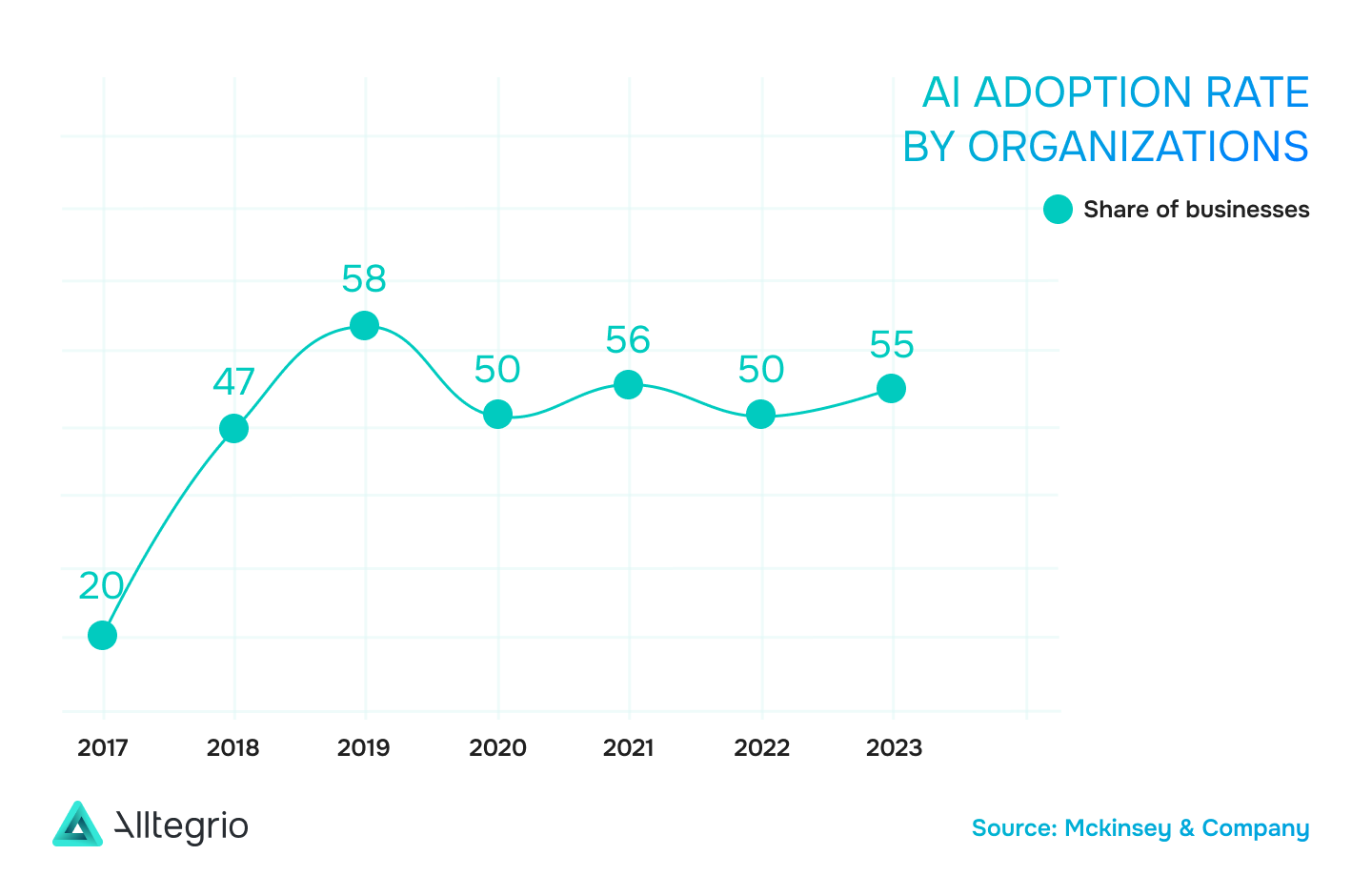
If you are googling how to create an AI app, you are already moving in the right direction as a business owner. In fact, your business is most likely doomed if you aren’t using any AI tools today. Already over 55% of businesses adopt AI in some of the processes, compared to only 20% in 2017. This trend shows that those who want to have a competitive advantage must use technology that can provide it.
Before You Build AI App: What Is AI and How Does It Work?
Simply put, Artificial Intelligence is the technology that emulates the work of the human mind by a machine. However, the reality of this technology is nowhere near as straightforward. On the technical level, AI models are extremely complex and require a tremendous amount of resources to supply their processing power. From our point as users we rarely think about how much goes into AI development.
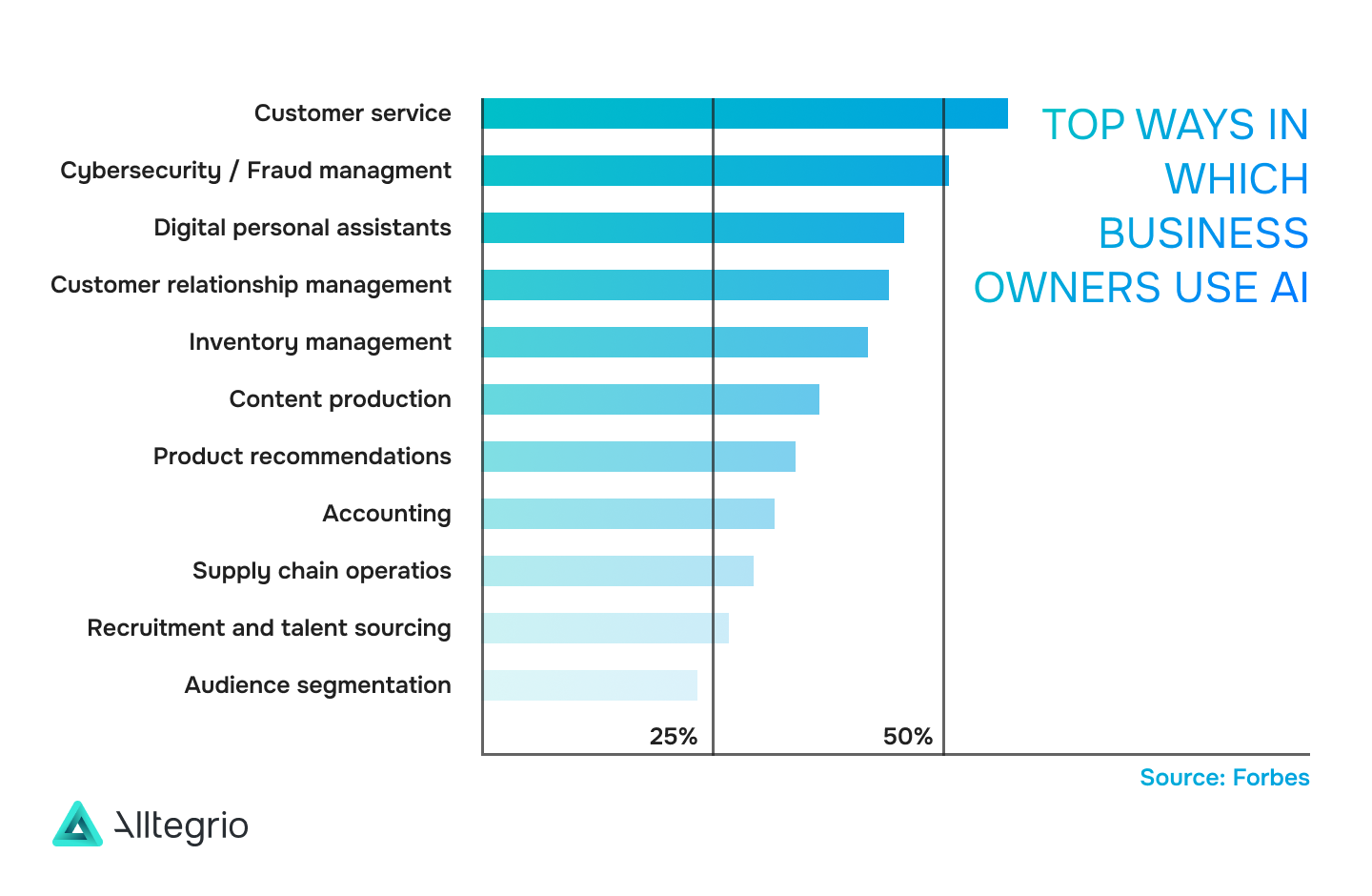
AI comes at a cost, but the benefits it delivers are many. At the moment, it’s most widely implemented in:
Customer service
Fraud management and security
Customer relationship management
Inventory management
Accounting
Another very popular AI implementation is creating virtual assistants. These are quite varied, but there are only a few powerful models, like Siri or Google Assistant.
As artificial intelligence is complex technology, its learning processes vary. There are several methodologies used by AI . if we simplify for explanation, AI is fueled by data. It processes data using a variety of algorithms and learns to see patterns. It uses practices like Deep Learning and Machine Learning to make forecasts and eventually take action based on the forecasts it makes from data analysis.
Why Create AI App: Advantages of AI Integration
AI technology offers some fantastic opportunities for business. However, its implementations are incredibly versatile. If you want your project to succeed, you must have a clear vision of how to implement this solution. Therefore, the first thing you should do before wondering how to build an app with AI is to answer the question of why you want to do this. What goals can you achieve by implementing AI in your business? How exactly do you plan to use artificial intelligence to do this?
The question of ‘why’ is something you need to decide as a business owner. However, the ‘how’ is something an Artificial Intelligence development company will help you do. An experienced team will analyze your processes and goals. Then, they will provide you with ideas supported by actual data to explain the most beneficial areas of AI implementation for your specific company.
Custom AI solutions will be unique for each case because every business is different. However, the main benefits of creating an app with AI are similar regardless of your industry or business size. These advantages are:
Accelerated Development
One of the most significant advantages of using AI when building apps isn’t about actual AI integration within the app. It’s about using AI-powered development platforms. These solutions enable developers to do their work faster and with fewer errors. Moreover, as a client, you can benefit from visualization tools that often allow your developers to give you a good presentation of your ideas and how the solution will work. This information is useful both for working on your plans and attracting investors.
Therefore, as a client, you should ask how to make an app using AI when you discuss your ideas with the development team. They must be proficient in various technologies that speed up the development processes. The goal is to find a company to ensure your product is ready for release faster so you can benefit from it sooner.
Enhanced Performance
AI implementation can help enhance your business performance in many ways. For example, automating routine tasks within your company will speed up the processes overall and improve employee productivity. Another example is using AI to collect and process data to understand how to boost your business through analytics. This way, you can improve resource management, reduce wear and tear on equipment, and reduce costly repairs with predictive maintenance.
Moreover, you can use AI to enhance the overall solution performance. If you are a product owner, this can help improve user experience. As a result, you will grow customer satisfaction and loyalty.
Limitless Customization Options
Have you ever considered that it’s hard to answer the question of how to build an AI application because there are so many available options? Easy and nearly limitless customization is one of the biggest benefits of artificial intelligence.
It’s not only that you can use AI in a multitude of ways. It’s also the fact that AI models can be customized to fit your specific needs exactly. Therefore, you can get a custom solution to fit your requirements to ensure your business gets maximum benefits from this investment.
Cost-Effective Solutions
Another essential advantage to consider is that you are saving money when you build AI apps. The development will indeed require an investment. However, this upgrade can pay for itself by bringing value immediately. So, you will start getting a return on that investment right after deployment.
Artificial Intelligence technology is cost-efficient no matter where you plan to implement it. One of its primary uses is automatization, which helps reduce expenses. Depending on your industry, you can achieve significant money savings even with relatively simple AI app integrations. For example, logistics businesses can use AI to track weather and route conditions to optimize shipping routes. Using AI in manufacturing helps analyze equipment use and build a maintenance schedule to minimize breakdowns. In retail, you can reduce overstocking and predict sales rates for holiday periods.
Build an AI App Today
Start your future project with a free consultation.
If you are sure that investing in AI is the right thing for your business, you should know exactly what to expect. This doesn’t mean you must learn the complexities of AI solution development. However, you definitely need to understand how to create an Artificial Intelligence app to create an efficient business plan for its implementation.
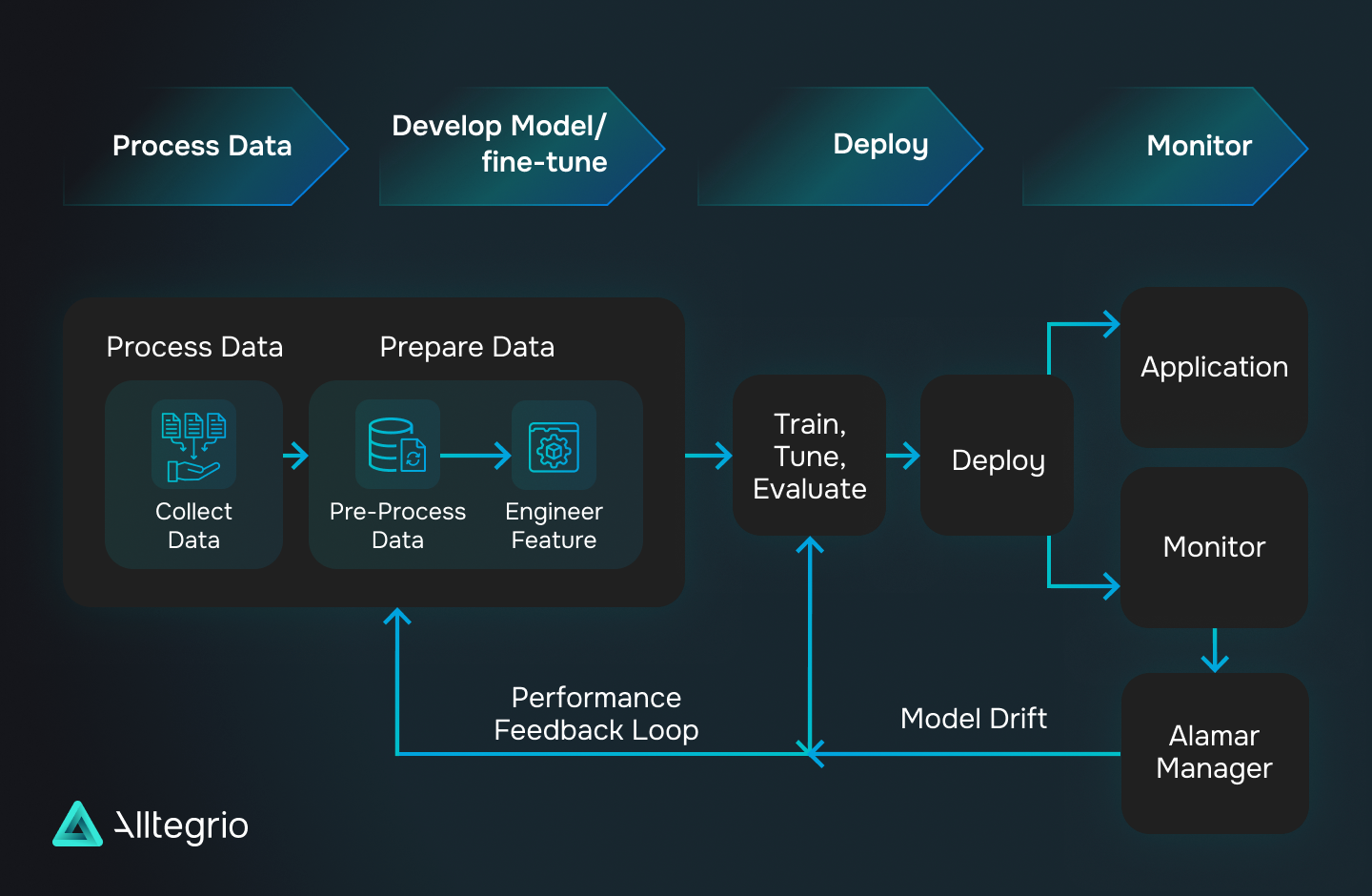
It’s relevant to have this understanding because the process of creating AI solutions is different from traditional product development. AI models learn and evolve with time, so you must account for this growth. Moreover, the model will need some fine-tuning after deployment. Therefore, your business processes might need some adjustments, at least initially.
Step-by-step the process goes like this:
Identifying Problems and Setting Objectives
The first step of any development process is the same, the company you partner with must identify the problems the product must solve and set goals. Defining the problems will determine the functionality of the solution you need to create. Therefore, this is the key to deciding on the technology stack. It’s imperative to work with an experienced company that knows precisely how to create an AI app that meets your needs.
For example, you might like using ChatGPT and want a solution powered by this model because you enjoy it personally. However, your current business infrastructure works on Microsoft solutions. In this case, ChatGPT integration is possible, but it will be costly and less efficient because it’s a third-party product. An experienced AI development services provider will explain this and suggest using Copilot, which is basically the same AI model used by OpenAI, but it’s owned by Microsoft. Therefore, the AI model’s capabilities are equal, but integration with Microsoft systems is much easier and cheaper. In fact, many Microsoft products have default Copilot integrations now, so it will be much cheaper for you to have the AI development team customize the available solutions to fit your needs.
Data Preparation
Data is the core of any artificial intelligence model. Its quality will determine the outcomes the model provides and its ability to learn and improve. Therefore, data collection, cleaning, and processing are essential steps in AI app development.
To get some idea of the importance of data quality, consider that according to Gartner research, businesses lose up to $15 million a year due to faulty data. The impact in any individual business case might be so significant that investing in data science consulting is a wise move, even if you don’t plan to build an AI app.
Selecting Appropriate Tools and Frameworks
One of the hardest things to choose when learning how to create an app using AI is which technologies to use. Many options are available now, and all of them are great in some capacity. The trick here is to find the best match of programming languages, platforms, and frameworks for your specific case. The AI development company you partner with should be able to help you make the best decision.
Some of the most popular frameworks used for creating AI solutions today are:
PyTorch
TensorFlow
Google AutoML
Note that a very important factor that will largely determine which AI tools you should use is the cloud platform. Any AI model can be integrated into any platform. However, it will be much easier, cheaper, and faster to use AI technology best suited for your specific platform, such as Gemini for Google Cloud or Copilot for Microsoft Azure. OpenAI tools can work anywhere, given proper integration solutions.
Designing and Training the AI Model
While it’s considered just one step in learning how to develop an AI app, designing and training the model requires a lot of work. This is a complicated multi-step process that goes through several phases:
Choosing the training method
Methods used for AI learning now include supervised or unsupervised as well as reinforcement learning. Supervised learning is required for apps where output accuracy is a priority. Unsupervised learning is suitable for data analysis, for example, fraud detection. Reinforcement learning is the approach for training AI models that require some level of autonomy, like in gaming.
Choosing model architecture
Here you’ll have a selection between CNN, RNN, and GAN. CNN (Convolutional Neural Network) is the best choice for providing accurate outputs from video and image recognition. RNN (Recurrent Neural Network) is suited for working with sequential data or NLP (Natural Language Processing). GAN (Generative Adversarial Network) is your go-to for generative AI app development.
Preparation for model training
At this stage, developers will work on the data component of building AI applications. Data the model will use for learning will be split. Usually, the split goes 70% for training, 15% for data validation, and 15% for testing the model’s performance. In order to train the model to see various patterns, the development team will engineer new features for it to use while learning.
AI model training
An AI model trains in three major steps. The first is learning from training data with multiple iterations to see how it makes predictions. The second is when the developers adjust hyperparameters (settings the model uses to train) at the data validation stage to improve outcomes. Finally, cross-validation compares various techniques to assess the model’s performance with multiple datasets.
Model evaluation and integration
The last step of model fine-tuning is to test its performance using a different set of unseen data. This enables you to understand how it will perform with real-world tasks. Then, you measure KPIs, and the model can be integrated into the product. If the results are satisfactory, this huge part of the how to make an app with AI process is over.
Please bear in mind that there are more advanced approaches that can be used for generative AI training. For example:
Embeddings: transforming high-dimension data (like images or text) into lower-dimensional data while preserving semantic connections. To achieve this, the embedding technique uses vectors to connect data points.
RAG (Retrieval-Augmented Generation): this approach means the AI model will first retrieve connected information from an enormous database it’s connected to and then generate the outcome for the request.
Integrating the Model into the Application
Model integration is one of the key moments to consider when considering how to develop an AI application. In essence, this is the crucial step in the entire process because it will greatly affect your product’s success. The model itself might be excellent, but if it doesn’t work smoothly and cohesively with your system, the project might fail.
At this stage, your success will largely depend on the competency of your AI development services provider. Experienced professionals will be able to assess your product and determine if it’s best to integrate the model from the front or back end. Both options are possible, so the deciding factors are the model type and your system’s capabilities. For instance, basic chatbots work well with front-end integration. However, large generative models that deal with voice recognition require back-end integration.
Another important integration-related factor is understanding whether the model will process the data within the cloud or the device itself. This choice is easier because, in most cases, the latter is only used by some IoT devices.
Overall, the integration process boils down to your AI development company ensuring that the AI truly enhances your product. A vital criterion for this is making it easy for the user to interact with to improve overall UX.
Model Testing and Iteration
In general, when people start researching how to create an app with AI, they severely underestimate the amount of testing that must be done. Working with artificial intelligence technologies requires tons of testing at every step.
Same here, after integration, the model and the whole solution must undergo rigorous tests. A team of experienced QA engineers working on your project is crucial because they often need to devise customized approaches. This is the best way to ensure your AI app’s top-notch performance.
The solutions will undergo regular unit, integration, and user acceptance testing (UAT). It’s vitally important to not only conduct these tests throughout the whole development process. The developers must also ensure that all results are integrated into a feedback loop that improves the model with every iteration.
Deployment and Maintenance
You might think that you’ve finally reached the final step in how to make an AI app process with deployment. However, working with AI models never really stops. Artificial Intelligence is a technology that evolves constantly. Therefore, your model will require constant monitoring.
In the best-case scenario, the AI development company you partner with will be able to perform monitoring, maintenance, and any necessary future upgrades. This way,. You can ensure that your product’s performance continues improving by expanding the model and increasing its output accuracy.
Emerging Trends to Consider When You Create an AI App
One of the most challenging and exciting factors to think about when you learn how to develop AI applications is the ever-changing tech landscape. AI technology trends appear fast and sometimes, you must get onto them immediately. Otherwise, the whimsical audience led by the latest trends might abandon you for a competitor.
As mentioned before, AI technology evolves at lightning speed. In the second half of 2024, the most notable trends are:
Multimodal AI Unlike single-mode data processing, multimodal AI models can process output in multiple formats. For example, they can work equally well with text, images, and voice. This is the next step in AI development, bringing it closer to how humans simultaneously process multiple types of inputs. GPT-4 is an example of a multimodal AI model.
Open-source AI One thing you’ll see fast when researching how to create AI app is that it’s expensive to build an LLM model from scratch. Therefore, open-source AI models are the key to making this technology accessible for businesses.
Agental AI The first examples of successful AI models were all reactive. However, now is the time to develop AI agents. These solutions have higher autonomy and can set goals based on their understanding of their environment.
Customized Gen AI for enterprises As mentioned before, creating app AI software from scratch is prohibitively expensive. However, with the help of an experienced AI development company, enterprise-level businesses can get custom generative AI platforms.
RAG As mentioned before, RAGs are using information retrieval to increase the accuracy of generated outputs. In essence, this feature enables the machine to get more context. Therefore, it’s able to reduce ‘hallucinations’ in the output. In the AI context, ‘hallucinations’ are results that are incorrect but appear plausible.
Top Examples in Building AI Applications
The AI app industry has exploded recently to the point that some AI-powered apps seem to pop up every other day. This became possible due to open-source AI models that businesses and talented individuals with a vision for innovation use to create versatile tools. There are AI-powered tools for anything, from chatbots in your favorite eCommerce stores and even some governmental institutions to IoT devices.
In the majority of cases, we interact with AI through our favorite well-established solutions. Nowadays, almost every big product, especially one working with creative tasks, has a built-in AI-powered assistant. These vary greatly, for example, Generative Fill is built into Adobe Photoshop to help users work with images, like changing clothing colors, adding elements, etc. There are also apps that use specific AI capabilities to create simple tools that help with everyday tasks. Noted is a good example, as it’s an app that uses voice recognition and text generation to take notes.
However, if you take a closer look, for example, at the Noted app in your App Store, you’ll see that there are a dozen (or more) products with a similar functionality. This is a very good indicator of both how easy it is to create an AI app and how competitive this industry is becoming.
Speaking of more complex and large-scale AI applications, we can’t forget about AI assistants. Many of us are interacting with them daily. The most notable of those are:
Amazon Alexa
In many ways, Alexa was groundbreaking in the world of IoT devices. Created by Amazon, it offered users some level of freedom in choosing smart gadgets for their homes as it supported multiple platforms. It remains quite popular today and functions as a fully capable AI assistant that can provide you with important information and operate devices under your control.
Microsoft Cortana
Cortana is a virtual assistant developed by Microsoft, which means it’s perfect for integrating into their other solutions. Due to this, the tool can be a very helpful office assistant. You should consider this if you are looking into how to develop AI applications for business use. Smooth integration with the platform is essential. Also, you’ll need to consider the capabilities of such big tools. Your product will need to stand out because it offers some unique benefits or features.
Google Assistant and Siri
Google and Apple’s virtual assistants are basically equal in functionality. However, these days, they are great examples of the crucial role of platforms. Developing platform-specific solutions is unnecessary, but it’s an effective way to build a multi-layered business if you are a huge corporation.
For SMBs that plan on creating an app with AI, this is an essential factor because they must choose a platform for AI integration. Usually, it’s recommended to select an AI model best compatible with your cloud platform. This way, you will save money as third-party integrations are harder to build and more expensive in user plans.
How to Choose a Company for Building an App with AI
If you google ‘how to create an AI application’, you’ll see dozens of posts similar to this one. However, few of them will expand on how to find a company for AI development, which is also an integral step of the process.
Simply put, the success of your AI application will largely depend on whether you can find trusted experts to develop it. This reasoning is quite straightforward. If you have a great idea, it also needs great realization. If the user experience provided by the app is mediocre, your chance of beating the competition is small.
If you plan on creating app AI software for in-house use, a poorly functioning product means you won’t get the optimization and benefits you expected. Therefore, finding trustworthy expert developers is crucial.
You may also look into how to build an app using AI, as some platforms allow users to use basic app builders. However, these platforms are very limited. Therefore, if you are considering investing in AI app development, you should hire a company with experience and skills in this industry. Factors to keep in mind during your search are:
Portfolio Always look at case studies first. Find out if the company has proven cases of creating solutions similar to what you seek. Experience in your industry will be a plus. However, it’s not crucial as long as the developer has expertise in creating the specific type of product, for example a self-learning chatbot.
Tech Stack Take a look at the technologies the developers use. Are they proficient in the programming languages and frameworks you are interested in?
Feedback Study verified client reviews to see what people actually think about this AI development company.
In addition, take a look at the questions you should consider before you start searching for an AI development partner:
How to use AI to create an app?
Today you can use some platforms, like GoogleAppSheet, Microsoft PowerApps, Softr, or Construct, to build AI-powered apps ‘by hand’. However, you need to understand that the functionality and integration capabilities of these solutions will be very limited. For example, a small business selling through social media might be able to create a bot to answer very common questions. However, if you want a chatbot that adapts and can take over customer support, you will need a custom solution developed by professionals.
It’s also a bit different if you are wondering how to use AI to build an app. If you are asking from a developer’s perspective, using some specialized tools and assistance from generative AI, like Copilot for GitHub, is the way to go.
How much does it cost to create an AI app?
As the project is developed to meet the unique needs of every business, the cost of AI app development varies greatly. Depending on the app’s functionality, it can range from $50,000 to several million.
As there is no one-fits-all formula for how to build AI apps, there also isn’t a price range everyone can use. You should contact an expert AI development company to get an accurate estimate and discuss your plans.
How much time is required to build an AI app?
Similar to the price, the duration of an AI app development project will vary depending on the app’s functionality and other technical factors. The initial MVP development should take several weeks, but from there everything depends on your plans.
However, note that it is completely possible to release an initial version of a product within a couple of months. Discuss your timing in detail with the development company, and you’ll be able to find a solution that meets your needs and budget.
How to make AI app for Android or iOS?
In essence, mobile app development is very similar to creating desktop applications. Therefore, the steps to take are the same as described in the article above. In some cases, you will need the help of tech experts who specialize in mobile OS and corresponding programming languages. However, in the majority of projects, you will require a web app optimized for mobile devices.
If you are looking into how to make an AI for your phone, you will need a consultation with an expert first. Explain exactly what your goals are and they will be able to advise you on the best course of action.
Start Building Your AI App
Take the first step to creating an AI app by booking a free consultation.
Alltegrio uses an innovative approach in AI app development because we are a customer-centric company. Therefore, we have a team of over 300 technical specialists with a wide range of skills. This enables us to ensure that every product we create is fully customized to suit the customer’s needs exactly.
When you work with Alltegrio, you can be sure that our technical solution is designed with your unique needs in mind. We are ready and willing to expand our employees’ tech stack to ensure we have qualified professionals to handle any task.
Moreover, we follow a route similar to your research on how to develop AI applications when preparing a proposal. Our experts perform in-depth research on the industry and tech solutions your competitors use. We also explore current tech trends, and our experts are always up-to-date on the latest changes in AI technology.
As a result, we make a proposal that is not only custom-tailored to your business. We also ensure that every point is supported by hard evidence. For example, when our solution architects advise using some specific framework, they can prove why it’s the best choice for your app in particular. If you want to see how this works in practice, contact us today for a free consultation.
Conclusion: Who Should Create AI Application?
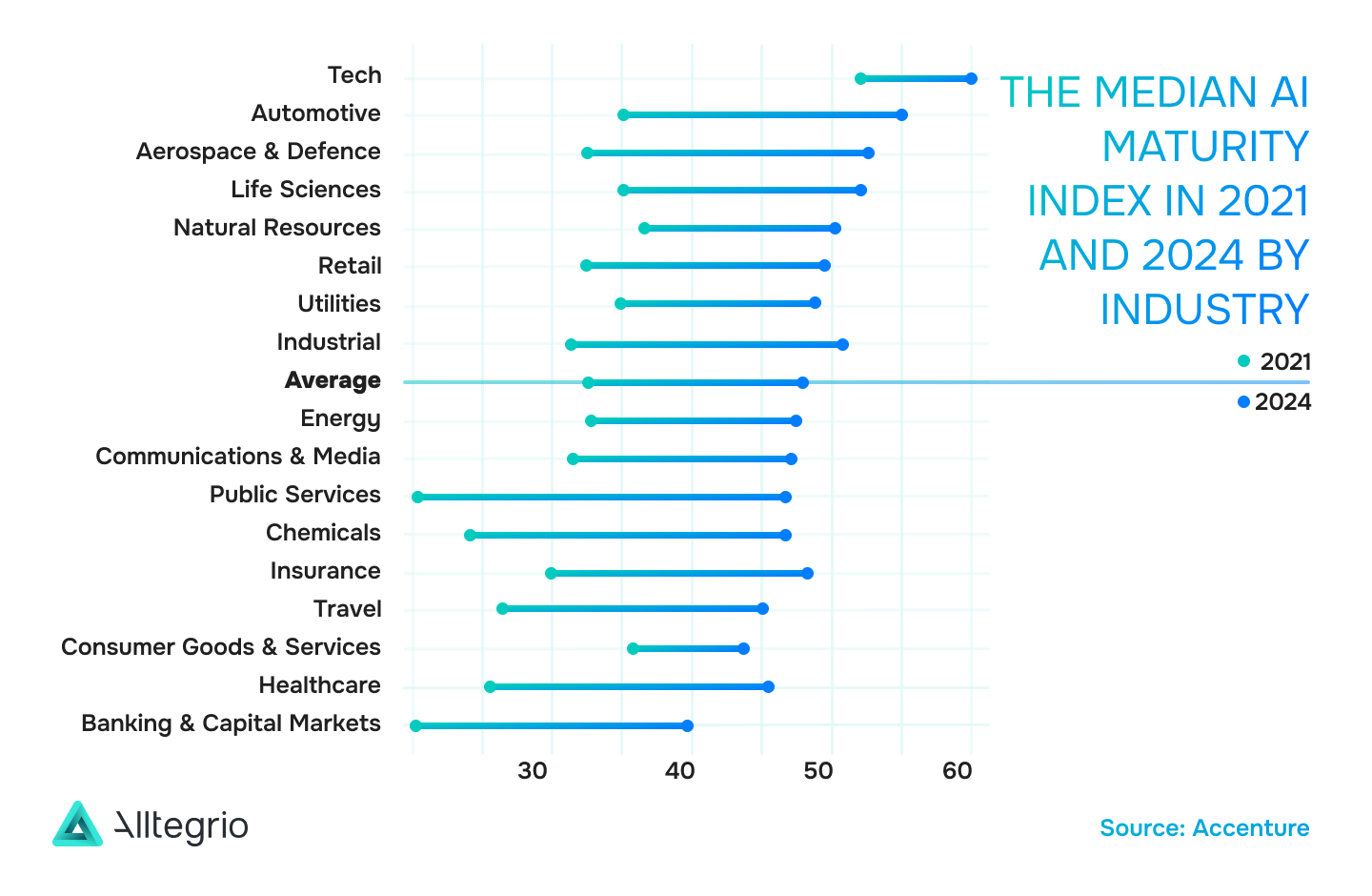
The simplest answer to this question is ‘every business that wants to remain competitive’. It truly is that simple. AI has become such a major component of today’s world that not using its benefits leaves you behind by default. Therefore, ‘how to create AI application?’ and ‘how to use AI in my business?’ are questions everyone should ask.
Considering how fast-paced the business world is, you should start working on your app as soon as possible. As competition is growing more fierce, you need every advantage to stand out. AI can help you on many levels, so your first task is to understand how to make it work for you.
Aren’t sure how to integrate AI to achieve maximum benefits? Start with a professional AI strategy consultation to understand the opportunities available to you. If you want to learn more about how to develop a generative AI model specifically, read this article.






'%3E%3C/rect%3E%3Cpath d='M21.0079 11.1156L21.6244 11.1841C24.4986 11.5025 26.6656 13.982 26.6656 16.9507V24.7908C26.6656 26.3373 27.4992 27.7759 28.8412 28.5458C28.957 28.6124 29.0564 28.7011 29.1345 28.8053H12.8746C12.9528 28.7011 13.0521 28.6124 13.1679 28.5458C14.51 27.7768 15.3436 26.3383 15.3436 24.7908V16.808C15.3436 13.9145 17.5095 11.4967 20.3827 11.1831L21.007 11.1146M21.0041 8.5C20.5902 8.5 20.2554 8.83575 20.2554 9.24869V10.0147C16.8323 10.3881 14.1684 13.2854 14.1684 16.808V24.7908C14.1684 25.9206 13.5635 26.9635 12.5832 27.526C11.9137 27.91 11.5007 28.622 11.5007 29.3939C11.5007 29.718 11.7632 29.9805 12.0873 29.9805H29.9199C30.244 29.9805 30.5065 29.718 30.5065 29.3939C30.5065 28.622 30.0935 27.91 29.424 27.526C28.4437 26.9645 27.8388 25.9206 27.8388 24.7908V16.9507C27.8388 13.4138 25.2048 10.3987 21.7518 10.0157V9.24869C21.7518 8.83479 21.417 8.5 21.0041 8.5Z' fill='white'%3E%3C/path%3E%3Cpath d='M21.0041 8.5C20.5902 8.5 20.2554 8.83575 20.2554 9.24869V10.0147C16.8323 10.3881 14.1684 13.2854 14.1684 16.808V24.7908C14.1684 25.9206 13.5635 26.9635 12.5832 27.526C11.9137 27.91 11.5007 28.622 11.5007 29.3939C11.5007 29.718 11.7632 29.9805 12.0873 29.9805H29.9199C30.244 29.9805 30.5065 29.718 30.5065 29.3939C30.5065 28.622 30.0935 27.91 29.424 27.526C28.4437 26.9645 27.8388 25.9206 27.8388 24.7908V16.9507C27.8388 13.4138 25.2048 10.3987 21.7518 10.0157V9.24869C21.7518 8.83479 21.417 8.5 21.0041 8.5Z' fill='white'%3E%3C/path%3E%3Cpath d='M23.582 31.1199H18.426C18.5698 32.4166 19.6687 33.4267 21.004 33.4267C22.3393 33.4267 23.4382 32.4175 23.582 31.1199Z' fill='white'%3E%3C/path%3E%3Cdefs%3E%3ClinearGradient id='paint0_linear_1536_57632' x1='0' y1='0' x2='42' y2='42' gradientUnits='userSpaceOnUse'%3E%3Cstop stop-color='%2300CBBF'%3E%3C/stop%3E%3Cstop offset='1' stop-color='%23007DFE'%3E%3C/stop%3E%3C/linearGradient%3E%3C/defs%3E%3C/svg%3E)