There is a 97% chance that your business needs Machine Learning software development regardless of your industry and niche. That’s how impactful ML tools can be. About 50% of companies in countries with fast-growing economies are already using AI or ML solutions. It’s safe to say that doing this is a must in today’s competitive markets.

This article will explain ML and the differences between AI and Machine Learning software. We will also discuss implementing ML solutions in real life to get immediate results. In the end, we will outline who can benefit most from ML consulting services and who should dive right into development.

block-image

Differences Between AI and Machine Learning Software

To give you some perspective on the rate of ML software market growth, according to Fortune Business Insights, it’s forecasted to grow from $26.03 billion value in 2023 to $225.91 billion by 2030. This, of course, pales compared to a similar forecast for the AI market, which is expected to go from $538.13 billion to $2575.16 billion by 2032. Note that this difference in itself is also indicative of the difference between AI and ML technologies.

A business owner needs to understand this difference to correctly plan their company’s technological advancements. For example, in many cases, when a business looks for AI software development, machine learning is what they are actually after. As a business owner, you might need a simpler solution that can be created and implemented much faster and at a lesser cost.

In the most basic terms, Artificial Intelligence includes Machine Learning but not vice versa. In practice, it looks like this:

  • AI is the broad scope of technologies that enable machines to emulate human thinking and decision-making.
  • ML is a component of AI that focuses on algorithms that machines use to learn and improve their ‘thinking’ accuracy through iterations.

The most crucial difference between these technologies is that AI is a broad term, while ML deals with teaching machines to do specific tasks. Therefore, Machine Learning software development is about helping businesses grow revenue and improve productivity through creating precisely targeted solutions. Such tools are affordable, efficient, and can be customized to meet your unique business needs.

Machine learning software development for business: How machines learn.

Key Technologies Driving Machine Learning Software Development

ML solutions follow a straightforward path on the operational level. You provide a machine with data, such as your customer database. Then, the machine processes the data and analyzes it using specific algorithms. This is how it ‘learns’ to perform the tasks you need, like generating personalized product offers based on the client’s history.

In reality, the process has more steps, such as preparing data to bring it into a unified format, designing algorithms, etc. Your AI and Machine Learning software developers will walk you through it so you understand precisely how your product will work.

On the ML side, the most critical choice is determining what learning method to use in your business case.

  • Supervised Learning
    Supervised learning is when the machine uses labeled datasets to train and eventually make forecasts. Spam filtering in your email inbox is an example of this ML type.
  • Unsupervised Learning
    Unsupervised learning happens when the machine applies its learning algorithms to unlabeled data clusters. This process doesn’t require human intervention and allows the machine to identify patterns in the data. For example, tools for cross-selling and customer segmentation use this ML method.
  • Semi-Supervised Learning
    As its name implies, semi-supervised learning is a medium between the two mentioned above. The machine will use a large unlabeled dataset during its training. However, it will extract this data into a smaller labeled dataset. This method can be applied to both types of tasks. You should choose it when you don’t have enough labeled data to work with or labeling it is too expensive.
  • Reinforcement Learning
    This ML method follows the same pattern as Supervised Learning. However, the machine receives reinforcement after a series of successful outcomes. It’s the method for self-learning recommendation systems, for example.

block-image

How Machine Learning Software Development Brings Value to Business

Due to the methodology of Machine Learning described above, it’s pretty easy to see that the main areas of its implementation for business are:

  • Automation
  • Fraud detection
  • Personalization

However, those are vague concepts that can be hard to visualize for your situation. Below, we will explain how to benefit from ML in real life.

What Business Problems Can ML Solve in Software Development

Software development companies often use AI and Machine Learning software in their processes.

  • AI-powered coding assistants: Tools like Copilot integrated with GitHub help developers by generating code and speeding up their work.
  • ML-augmented testing: ML and AI software development services greatly benefit from testing with powerful ML models that process data and find deviations more accurately.
  • DevOps automation: ML tools can automate multiple DevOps workflows, improving performance, increasing system stability, and speeding up problem resolution.

For you as a client, the main benefits of software development companies using ML tools are faster time to market and reduced risks.

How to Enhance Efficiency with Software Development Machine Learning

In articles similar to this one, you’ll often see that AI and ML can ‘enhance business efficiency’. However, what does it mean exactly?

Simply put, integrating ML methods into various processes can increase speed and reduce human error. Meanwhile, we can now integrate ML into almost any business process, such as this. Some more examples are:

  • Accounting: invoice tracking, reporting, analytics.
  • Customer support: processing, labeling, and sorting queries; translation; recommendation engine training.
  • HR processes: time-off management automation.
  • Logistics: preventive maintenance, route tracking, forecasting, and more.
  • Retail: personal recommendations, demand forecasting, stock management automation.
  • Insurance: policy recommendation, risk assessment.
  • Sports: betting forecasts, athlete performance analysis, and tracking.
  • Healthcare: appointment scheduling, basic symptoms analysis, health condition forecasting.

If you are using specialized solutions to manage any of these tasks, software development Machine Learning services will allow you to enhance the efficiency of these tools.

ML Software Development to Enhance Business Workflows

ML development is crucial if you don’t have custom software to enhance some or all of your business workflows, like those listed above. The implementation of Machine Learning provides automation. Therefore, this software enables your business to speed up performance and even add more processes for which you couldn’t hire people.

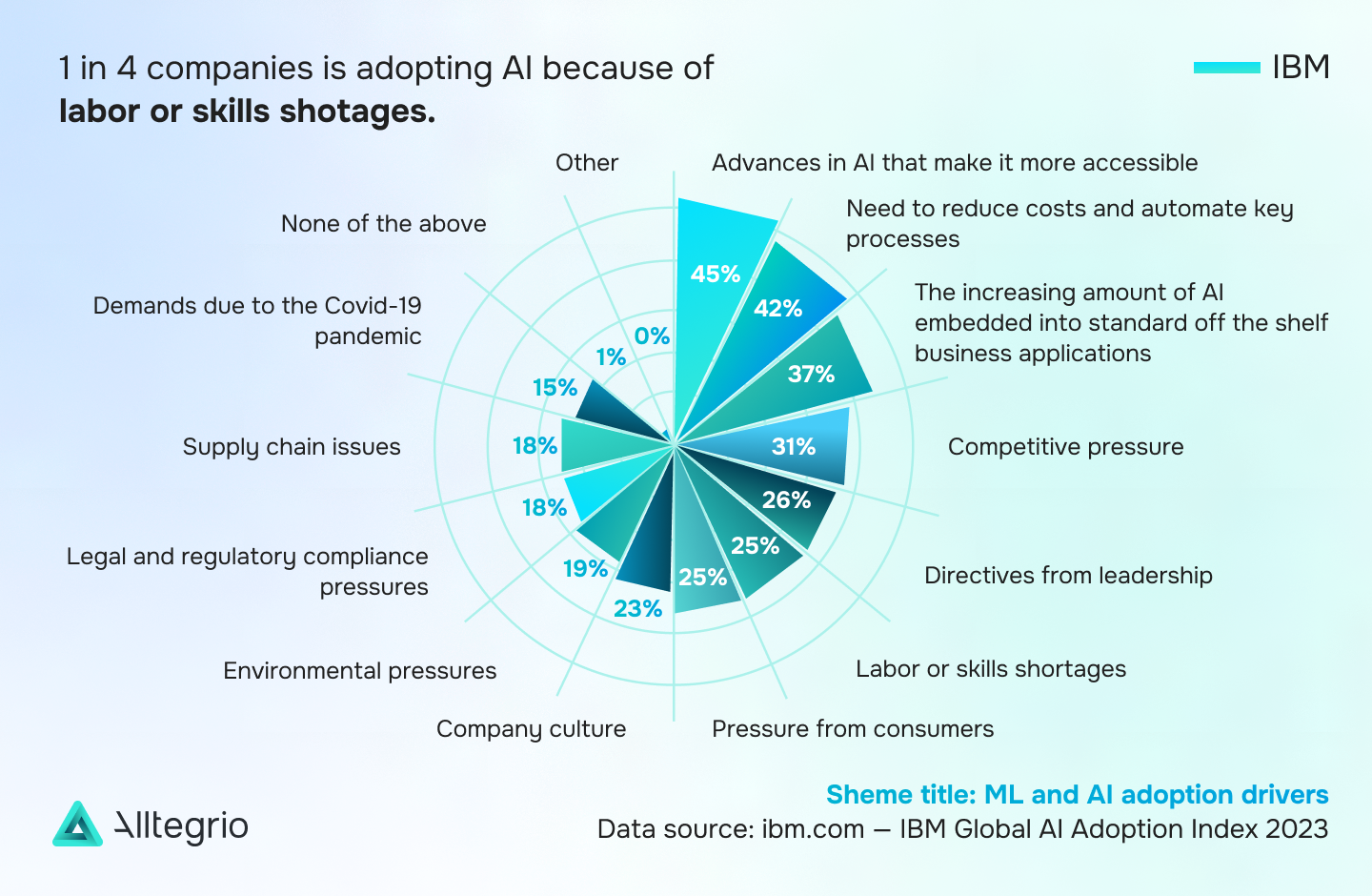
Note that one of the main reasons for the popularity of ML and AI software development these days is the lack of skilled labor. Every business owner knows how hard it is to find a highly qualified professional. Moreover, many SMBs simply cannot afford to have large teams. Therefore, they need to make the most of their employees’ time. ML integrations and automation allow doing that. Machines speed up or completely take over routine tasks. In the meantime, your employees get the time needed to perform more complex and advanced tasks.

AI adoption is not about replacing people. It’s about giving them opportunities to maximize their potential.

How ML Software Is Changing Customer Interactions

You will usually hear about chatbots and NLP (Natural Language Processing) when discussing using AI for customer service. However, Machine Learning software development is integral to those smart chatbots. Personalization is the ultimate technique in any area of working with customers. Machine Learning models power it because they process customer data to provide the desired output, for example:

  • Personalized product offers and bundles
  • Personalized emails and messages (combined with generative AI)
  • Personalized recommendations within streaming services

Automated customer support using self-learning chatbots relies on the ML component to learn through customer interactions. If your business wants to put the customer at the center of everything, you’ll need specialized AI and Machine Learning software to enable you to reach everyone individually.

Machine Learning Impact on Risk Management

As mentioned before, Unsupervised Machine Learning enables machines to analyze data volumes and identify patterns. It also means they can see inconsistencies in the patterns. This is how Machine Learning software can perform risk detection.

For example, these tools can identify patterns that indicate fraud in banks and other financial institutions. Security organizations can use similar solutions to analyze databases to identify potentially risky patterns.

Have you ever had your account blocked for seemingly no reason with a “potentially fraudulent activity detected” message? That is what happens when an ML model used for security is learning. This type of Machine Learning automation is crucial for data security. However, it’s not yet perfect.


block-image

Successful Cases of Machine Learning Software Development

To get a better idea of the AI and Machine Learning software potential for you, consider the implementations you are using daily:

  • Facial recognition
    If you have any device that uses facial recognition technology, you are using Machine Learning protocols. The machine uses them to compare your photo with the image in its memory.
  • Spam filtering
    Your inbox isn’t flooded with hundreds of spam emails due to this ML implementation. However, as you can see, this technology is not yet perfect.
  • Personal recommendations
    Annoying as they are, targeted ads on any platform are a prime example of Machine Learning.
  • Content filtering on social media
    Social media use Machine Learning software development services to identify and block sensitive content.
  • Predictive text (T9)
    ML models create predictive text suggestions when you are typing.

Of course, there are other examples of ML implementations that affect our daily lives. Many of them are niche-based and custom-designed for specialized businesses. For example, large health corporations like Pfizer use this technology for analytics when conducting studies of drug efficiency.

Your business can also get a custom solution because ML software development services can be tailored to any task. With the current technological advancements, this type of service is accessible to enterprise-level businesses and SMBs alike.

Challenges of AI and Machine Learning Software Implementation

We’ve already talked about some problems with ML software, such as blocking innocent accounts for ‘suspicious behavior’. These particular occurrences will be fewer as the model learns and fine-tunes its outcomes. However, there are some other challenges to ML implementation that you need to be aware of:

  • Legal frameworks
    The future of software engineering with AI as a whole is a gray zone for laws right now. The EU AI Act laid some ground rules for this technology,  but those are not well-defined yet. As this industry grows unprecedentedly fast, some legal issues and concerns might arise in the future as legislators take notice.
  • Fear of AI
    If you google ‘technological singularity’, you’ll find multiple sources expressing fear that AI is developing too fast. Technological experts claim that machines surpassing and usurping humans can only happen in sci-fi. However, the fear is there in some layers of society. You must be aware of it and ensure complete transparency when using AI and Machine Learning software to help keep your customers calm.
  • Data privacy and security
    Ensure that any ML solution you use or develop complies with GDPR, CCPA, or other similar data privacy regulations. It’s your responsibility as a business owner to ensure that your customer’s data is protected.
  • Bias and discrimination
    Machine Learning models use data to learn, and their outcomes mainly depend on its quality. Machines don’t have ethics, so if we introduce biased data, they will accept it as a pattern. Bias and discrimination by ML algorithms are serious concerns that must be addressed at the data preparation and model training stages.

How to Prepare Your Business for ML or AI Software Development

If you are ready to explore the incredible possibilities of Machine Learning software implementation, you should start by consulting a development company. Business owners who aren’t yet sure whether they need an AI or ML solution could get an AI strategy consultation. You can share your ideas and goals, and the company will provide you with a comprehensive analysis of how AI technology can achieve them.

In case you want to learn how to make the most of this service, take the following steps:

  1. Make a list of the problems that your business needs to solve with AI.
  2. Do some research to learn more about Machine Learning and Artificial Intelligence tools, and think about how they can help you.
  3. Outline your ideas and vision for AI and Machine learning software implementation.
  4. Prepare a list of requirements the solution will need to meet.
  5. If possible, outline the KPIs you want to use to evaluate the solution’s performance.
  6. Identify what data you can offer for ML model training and list what other information you might need.

Bottom Line: Future of Software Engineering with AI and ML

Machine Learning software development has some risks, but the benefits it brings businesses outweigh them greatly. Therefore, there can be no doubt that this technology will continue to evolve and spread across all industries.

As we enter the transitory period of this next technological revolution, businesses that adapt first have a greater chance of success. If your company is ready to take this leap, contact the Alltegrio AI development team for a free consultation.

Subscribe to our blog!