
Chatbots have been part of digital products for years. Many started as simple systems. They followed a script, matched a keyword, and sent a prepared reply. This approach worked when conversations were predictable, while the number of scenarios was limited.
However, it rarely stays that way.
As usage grows, language becomes messy and inconsistent. Users describe the same request in different ways, skip details, or change direction mid-conversation. Maintaining rule trees in this environment quickly turns into constant patchwork.
This is where machine learning chatbots become vital. It learns from data and recognizes intent behind new phrasing. This way, a chatbot decides when it’s confident, requires clarification, or needs to involve human assistance. What looks like “intelligence” on the surface is actually structured underneath: models trained and evaluated, data prepared, feedback loops added, performance monitored.
Read along to find out how a chatbot in machine learning works in real projects. You will discover how AI chatbots use data, where algorithms influence daily interactions, and what Alltegrio teams pay attention to when building systems that must operate reliably in production.
What are AI chatbots? Definition and key capabilities
AI chatbots are software systems that can understand user requests expressed in natural language and respond in a way that helps move a task forward. Scripted bots stick to predefined paths. In turn, a machine learning chatbot is designed to handle variation. It can understand what the user is trying to achieve, even when the phrasing changes, and it becomes more capable while processing more real conversations.
And the purpose is rarely just to chat. Companies rely on these assistants to solve support issues, qualify leads, and help people move through everyday tasks. Besides, chatbots collect structured information and even connect people with the right team when necessary.
Here are some of the most crucial capabilities of a chatbot working in real operations:
- Intent recognition. The system determines what the user strives to achieve, even when dealing with unclear or unfamiliar phrasing.
- Context awareness. Conversations evolve. Users correct themselves or provide information step by step, and the chatbot has to monitor it.
- Decision logic. The chatbot decides whether it’s better to answer immediately, ask a follow-up question, retrieve data, or escalate.
- Controlled confidence. A reliable chatbot machine learning setup knows when it’s uncertain, so a human should step in. In turn, overconfident automation often breaks trust.
When these elements come together, companies get something more practical than a conversational demo. They gain a system that lives inside real workflows, supports teams under pressure, and keeps information consistent across tools.
Understanding this foundation makes it easier to see where machine learning actually fits. It’s not decoration on top of a chat window, but rather the mechanism allowing a chatbot in machine learning to interpret, adapt, and become more helpful.
Why Machine Learning Is the Foundation of Modern AI Chatbots
With machine learning, chatbots can operate despite inconsistent language and unpredictable situations that appear regularly. Without it, the system depends heavily on predefined rules, so it’s more difficult to keep up with the growing complexity.
At a small scale, rule-based logic is often sufficient. Teams map phrases, design flows, and gradually expand coverage. But when volume increases, other variations emerge. For example, users can describe the same issue differently, mix topics, or change direction mid-conversation. And that’s where static logic starts to break.
In contrast, instead of memorizing exact words or phrases, a chatbot in machine learning follows specific patterns. It recognizes that common user requests (“I can’t log in,” “my password failed,” “access denied,” or else) have a similar goal. This generalization ability makes modern systems more scalable and adaptive.
Machine learning in chatbot environments also streamlines adaptation. Products and policies change, while new services constantly appear. Therefore, updating data and retraining models is often more productive than constantly rebuilding decision patterns.
Of course, ML doesn’t create perfect understanding. It rather produces probabilities. The system estimates intent, measures confidence, and then follows predefined rules on whether to answer, clarify, or escalate. When designed properly, this balance keeps automation secure and useful. Plus, this shift moves effort from maintaining scripts to improving data, evaluation, and feedback loops. Instead of trying to predict language in advance, teams learn from real interactions.
With this approach, learning compounds. Every new interaction contributes additional evidence about how people communicate and what they expect from the system. Gradually, the assistant becomes less dependent on initial rules and can handle variation without constant supervision.
With that principle in mind, let’s look at what happens during AI Chatbot Development, where multiple components work together to interpret requests and decide what the assistant has to do next.
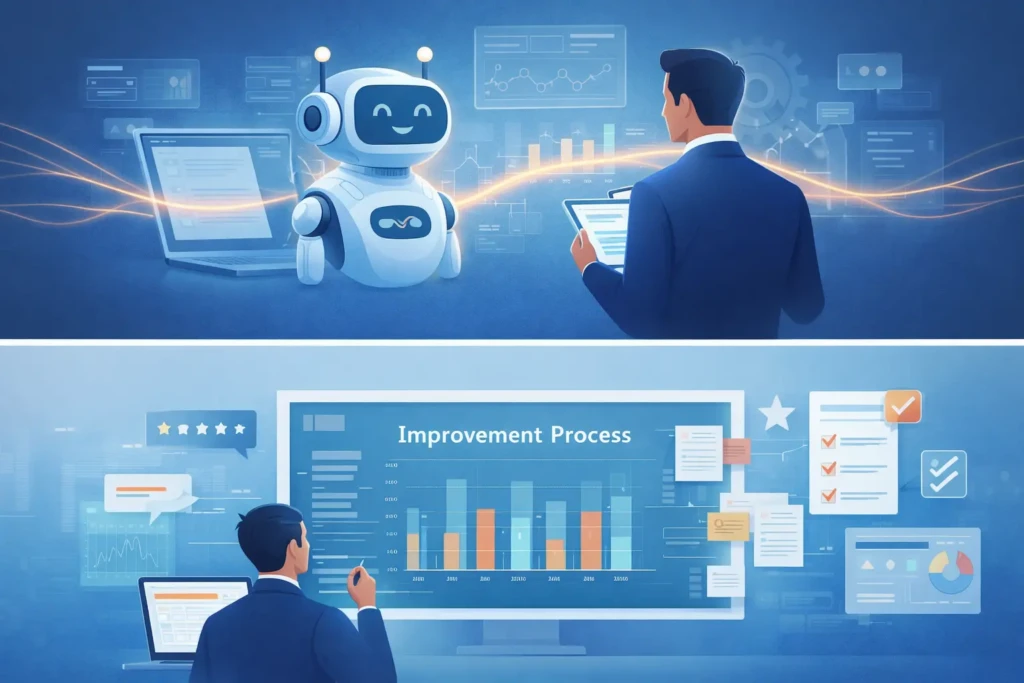
Machine Learning in AI Chatbot Development
When thinking about a chatbot powered by machine learning, people often picture a single model that needs to figure everything out. But real systems are much more structured. In fact, it’s usually a combination of components responsible for various tasks.
During AI chatbot development, teams determine how it understands requests, what it should handle, and how to deliver answers. Machine learning plays a significant role, but it works within multiple rules, integrations, and security checks.
Now, let’s look at the pipeline to clarify this process.
The Core Pieces of a Chatbot Machine Learning Pipeline
A production chatbot doesn’t depend on one prediction. It has several layers collaborating to move a conversation forward.
Most implementations include:
- Intent classification determines what the user wants.
- Entity extraction captures critical details like dates, account numbers, or product names.
- Information retrieval pulls accurate data from knowledge bases or internal systems.
- Dialogue management decides what should happen next (answer, clarify, or escalate).
- Response generation produces language, which should be correct, helpful, and aligned with the main company policies.
Each stage relies on its own models, confidence settings, and checks. What really makes the chatbot reliable is not one brilliant component, but how well everything works together.
Where AI Chatbot Algorithms Actually Show Up
AI chatbot algorithms appear in more places than most users realize.
Some are responsible for classification tasks, such as routing requests to the right department. Others process language representations, map similar phrases together, or rank possible answers. Generative models may also compose responses, but they normally operate within boundaries defined by retrieval systems and business rules.
In many deployments, the architecture is hybrid. While machine learning handles interpretation and flexibility, deterministic logic provides compliance, accuracy, and security. With this combination, companies can benefit from adaptability without losing control.
This layered approach showcases why chatbot quality depends on design decisions as much as model choice. A strong pipeline can make modest models perform reliably. In turn, a weak one may undermine even advanced technology.
Now, where do these models get their knowledge, and how do AI chatbots use data to learn what strong performance looks like? Read on to find out.
How AI Chatbots Use Data to Learn and Improve
Machine learning models build understanding from examples. Every reliable chatbot you interact with uses historical conversations, corrections, edge cases, and numerous small signals collected over time.
That’s why data work is often more critical for success than model choice. Even advanced algorithms can’t make up for unclear labeling, poor coverage, or knowledge sources that don’t reflect reality. In many projects, improvement doesn’t start with changing the model. It begins with reconsidering what the system is being taught.
To see how progress happens, let’s look at the stages that transform regular chatbot conversations.
Step 1: Collecting and Preparing Data for a Machine Learning Chatbot
Most datasets come from daily operations, such as chat histories, support tickets, CRM comments, emails, call transcripts, product documentation, and help centers. Together, they represent how customers actually communicate. It takes into consideration typos, unfinished thoughts, and inconsistent terminology.
However, raw material isn’t sufficient for training.
Before anything reaches a model, teams usually clean and organize it. They remove duplicates, filter spam, anonymize personal information, and standardize formats. They may also split conversations into meaningful turns, tagged with outcomes, or grouped by business function.
Next, they start working on the structure. Developers and analysts define intents, entities, and categories reflecting how the organization wants the assistant to act. This is where developers and business owners need to align. When categories blur or contradict each other, problems appear in production, even with very capable models.
One of the most common surprises is how much interpretation happens here. Two experts may disagree on what a user truly meant. Resolving those ambiguities is a crucial part of building a stable foundation.
Experience shows that clean structure beats raw scale. Well-curated examples typically improve performance more than simply adding volume.
Step 2: NLP and Intent Recognition
With the groundwork done, the chatbot begins to “read” messages in a structured way. This way, it recognizes similarities between different requests.
Without diving into deep theory, the principle is simple: the assistant learns proximity. Messages can look different but point to the same problem. The model learns to connect such variations, so the chatbot reacts properly even when the wording is new.
At this point, intent recognition becomes crucial. Once the assistant realizes what the user is trying to accomplish, everything that follows, from pulling information to triggering actions or giving guidance, becomes far easier to manage.
Another critical aspect is confidence estimation. A well-designed system doesn’t aim to answer everything. Instead, it measures certainty. That’s why the chatbot can ask for clarification, offer options, or involve a human agent when appropriate.
This behavior separates experimental systems from production-ready ones. Users forgive limitations, but they may not forgive errors.
Step 3: Model Training in Practice
Supervised learning is still the backbone of many deployments. Models observe labeled interactions and gradually recognize how to handle similar situations. The system gets better through practice, feedback, and adjustment. But training never really ends.
Businesses change. New services appear. Marketing teams launch campaigns that bring completely different wording. Even seasons can create short-term waves of questions a chatbot has never handled before.
That’s why experienced teams need to combine training with continuous measurement. They examine where conversations fail, how often users rephrase requests, which topics lead to escalation, and where automation saves time. These indicators show whether the assistant meets expectations.
Another factor that plays a major role here is error analysis. Instead of looking only at aggregate accuracy, teams assess challenging cases. Most often, they need to figure out the following:
- Why did the system misunderstand?
- Was the label wrong?
- Did two intents overlap?
- Was information missing from the knowledge base?
Answering these questions improves not only predictions but also the overall design of the chatbot.
Another practical dimension involves balancing automation with security. Expanding coverage increases containment rates, while aggressive automation may introduce risks. Only careful tuning ensures that progress doesn’t compromise trust.
Over multiple cycles, this rhythm of deploying, observing, and refining helps the assistant develop. It gradually takes on more responsibility while staying stable and reliable.
Step 4: Continuous Learning From User Interaction and Feedback
Even after you‘ve launched a chatbot, it’s only the beginning of your machine learning journey. Once real users begin interacting with the system, it starts facing situations that even the most advanced initial dataset couldn’t fully prepare for.
The good news is that continuous learning turns these interactions into improvement through structured monitoring and adjustment. Every conversation provides signals, from obvious ones, such as ratings or corrections, to indirect ones (rephrasing, abandoned sessions, or escalations to human agents). With their help, the team can see where the assistant meets expectations and where it needs optimization.
At the same time, not all feedback is valuable for training. Users make mistakes, experiment, or express disappointment. You need strong filtering to rely on review and selection, not automatic retraining. Besides, it’s important to detect new intents. Teams need to monitor low-confidence predictions to notice gaps before they grow into user frustration.
And finally, there’s knowledge maintenance. If documentation or backend data is outdated, even accurate models return wrong answers. Constant evaluation ensures that responses remain relevant as the organization evolves.
Teams commonly prioritize metrics like resolution rate, handoff frequency, and conversation length. These indicators reveal whether automation really helps or pushes work elsewhere.
Common Machine Learning Challenges for AI Chatbots
Even when the underlying technology is strong, issues often pop up once a chatbot moves from testing to daily use. Why? There are numerous potential reasons. For instance, language may become less predictable. Intents could overlap. Or users might change topics and expect the assistant to understand the context they never provided. As a result, situations that looked simple in design documents turn challenging in production.
Measurement can also be misleading. High accuracy scores do not always translate into smooth experiences. A response may be technically correct but complicated or frustrating for the user.
Finally, knowledge quickly becomes outdated. Products change, policies evolve, and internal information constantly shifts.
Swapping one model for another won’t address these challenges. Instead, these issues require reconsidering the chatbot’s structure, control over decisions, and introducing updates.
And that’s where the implementation approach matters the most.
What Alltegrio Developers Do Differently
A point our engineers often emphasize is that modern chatbot performance doesn’t always require training custom machine learning models.
In many real projects, Alltegrio works with large language models as external services accessed via APIs. The main task is not to recreate intelligence but to orchestrate it:
- ✅ What should the model know about the user?
- ✅ Which sources should it rely on?
- ✅ What boundaries must it respect?
Thus, development focuses on prompts, memory, retrieval, and validation layers. The assistant doesn’t change neural weights but receives better context.
To support this architecture, teams use frameworks like LangChain and DSPy. With their help, they connect language models with internal systems, tool execution, and multi-step reasoning.
A common interaction involves the following process:
- Gathering customer data
- Retrieving relevant documentation
- Verifying permissions
- Generating a response
While users see a simple conversation, you get a controlled pipeline.
This approach also accelerates adaptation. When business rules change, developers update prompts or data sources instead of retraining models. As a result, improvements become operational and easier to govern.
This way, building reliable assistants becomes less about experimenting with algorithms and more about designing environments where models act safely and predictably.
Conclusion
Building a chat bot using machine learning isn’t just a step to tech advancement but an operational decision. The actual reward comes when the system supports the teams’ processes, adapts to change, and stays predictable under pressure.
With design, data, and orchestration handled carefully, chatbots transform from experimental interfaces into reliable parts of everyday workflows. With their help, requests are routed faster, information stays consistent, and employees spend less time on routine steps.
The technology takes on responsibility for interpretation and structure, so your specialists can stay focused on situations that require judgment and experience or simply need human touch.
Over time, it leads to more stable performance and improved service quality.
Looking to explore ML-based AI chatbot solutions? Get in touch with Alltegrio experts! We are ready to design a system that delivers practical value without unnecessary complexity.
'%3E%3C/rect%3E%3Cpath d='M21.0079 11.1156L21.6244 11.1841C24.4986 11.5025 26.6656 13.982 26.6656 16.9507V24.7908C26.6656 26.3373 27.4992 27.7759 28.8412 28.5458C28.957 28.6124 29.0564 28.7011 29.1345 28.8053H12.8746C12.9528 28.7011 13.0521 28.6124 13.1679 28.5458C14.51 27.7768 15.3436 26.3383 15.3436 24.7908V16.808C15.3436 13.9145 17.5095 11.4967 20.3827 11.1831L21.007 11.1146M21.0041 8.5C20.5902 8.5 20.2554 8.83575 20.2554 9.24869V10.0147C16.8323 10.3881 14.1684 13.2854 14.1684 16.808V24.7908C14.1684 25.9206 13.5635 26.9635 12.5832 27.526C11.9137 27.91 11.5007 28.622 11.5007 29.3939C11.5007 29.718 11.7632 29.9805 12.0873 29.9805H29.9199C30.244 29.9805 30.5065 29.718 30.5065 29.3939C30.5065 28.622 30.0935 27.91 29.424 27.526C28.4437 26.9645 27.8388 25.9206 27.8388 24.7908V16.9507C27.8388 13.4138 25.2048 10.3987 21.7518 10.0157V9.24869C21.7518 8.83479 21.417 8.5 21.0041 8.5Z' fill='white'%3E%3C/path%3E%3Cpath d='M21.0041 8.5C20.5902 8.5 20.2554 8.83575 20.2554 9.24869V10.0147C16.8323 10.3881 14.1684 13.2854 14.1684 16.808V24.7908C14.1684 25.9206 13.5635 26.9635 12.5832 27.526C11.9137 27.91 11.5007 28.622 11.5007 29.3939C11.5007 29.718 11.7632 29.9805 12.0873 29.9805H29.9199C30.244 29.9805 30.5065 29.718 30.5065 29.3939C30.5065 28.622 30.0935 27.91 29.424 27.526C28.4437 26.9645 27.8388 25.9206 27.8388 24.7908V16.9507C27.8388 13.4138 25.2048 10.3987 21.7518 10.0157V9.24869C21.7518 8.83479 21.417 8.5 21.0041 8.5Z' fill='white'%3E%3C/path%3E%3Cpath d='M23.582 31.1199H18.426C18.5698 32.4166 19.6687 33.4267 21.004 33.4267C22.3393 33.4267 23.4382 32.4175 23.582 31.1199Z' fill='white'%3E%3C/path%3E%3Cdefs%3E%3ClinearGradient id='paint0_linear_1536_57632' x1='0' y1='0' x2='42' y2='42' gradientUnits='userSpaceOnUse'%3E%3Cstop stop-color='%2300CBBF'%3E%3C/stop%3E%3Cstop offset='1' stop-color='%23007DFE'%3E%3C/stop%3E%3C/linearGradient%3E%3C/defs%3E%3C/svg%3E)