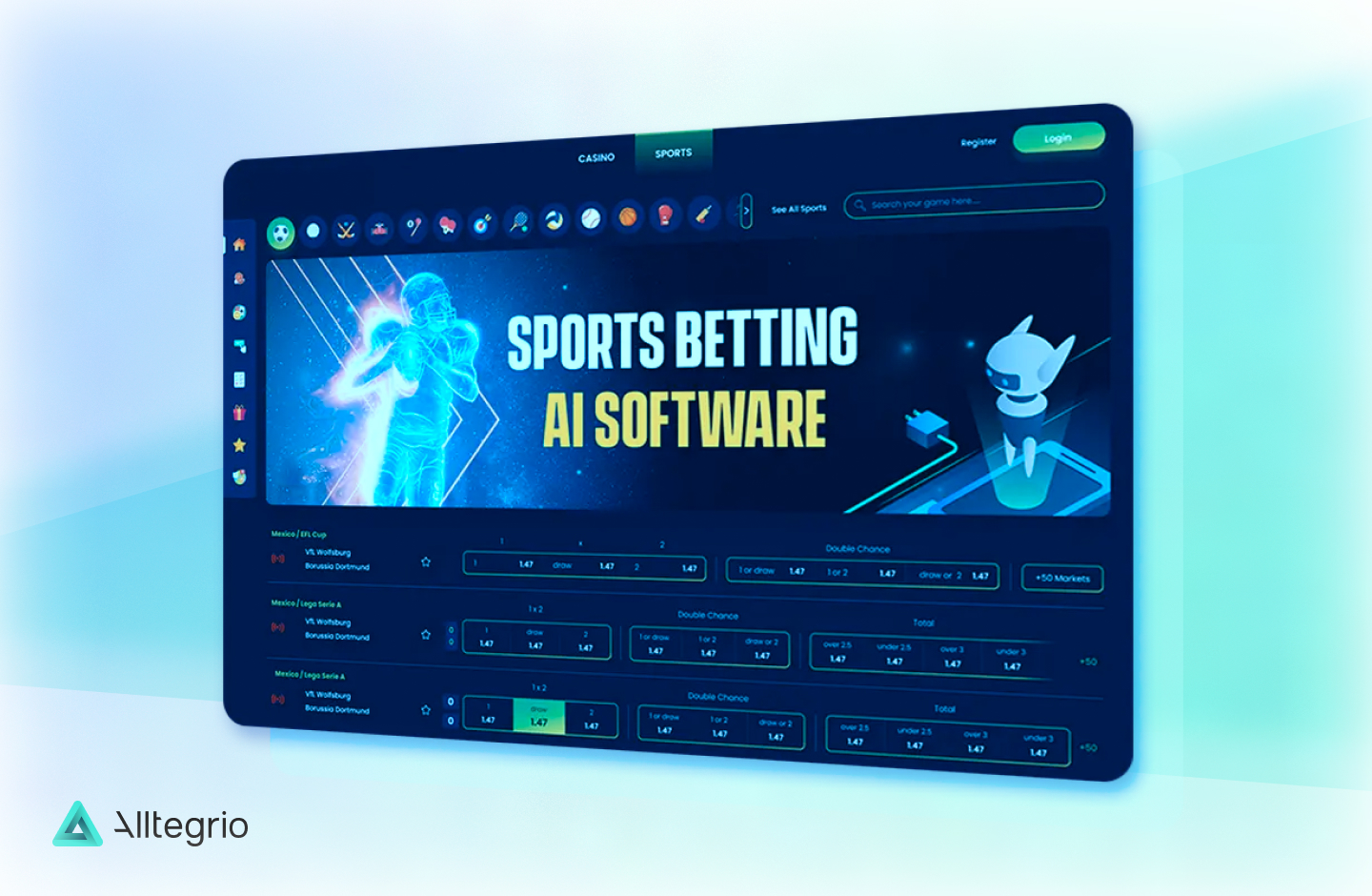
Integrating AI in sports betting is revolutionizing the industry by providing innovative solutions and insights. From real-time data analysis to predictive algorithms, AI is becoming an essential tool for bettors, bookmakers, and regulators alike.

In today’s article, we will discuss various implementations of AI in sports betting, examining its impact on predictions, odds calculation, and ethical considerations.

How Machine Learning Is Used in Predicting Sports Outcomes?

First of all, it’s essential to understand that when we talk about AI in sports betting and analytics as a whole, we are talking about Machine Learning (ML) development services. By analyzing vast amounts of historical data, Machine Learning algorithms can identify complex patterns that may not be immediately apparent to human analysts. For instance, these algorithms evaluate player performance metrics, team statistics, and even environmental conditions that affect game outcomes. This analysis can include factors such as player injuries, weather conditions, and even athletes’ psychological state. All of these can influence the performance of teams and players significantly.

The results of such analytics can be used for many purposes, including:

  • Sports injury prevention
    ML can help protect athletes and improve their performance by alerting coaches and athletes to risks. This article provides more on this subject.
  • Developing more efficient sports team strategies and tactics
    Coaches and teams can use Predictive Analytics in sports to build simulations of games and understand how their tactics will play out. This is invaluable data to understand the competition and improve the team’s own performance through detailed analysis of each player’s movements and behavior.
  • Sports results forecasting
    Using AI in sports gambling can offer a bordering illegal advantage because a well-trained AI model can make highly accurate forecasts. However, to achieve this kind of result, you’ll need to collaborate with an experienced and skilled team of developers. Alltegrio has handled a number of projects similar to this case, where we built a solution powered by Data Annotation that can effectively evaluate team strategies and make predictions on player performance. This can be applied during athlete recruitment, training, or for betting purposes.


block-image

How Is AI Used in Sports?

The most important thing to know about the uses of AI in sports analytics is that they are incredibly versatile. The hard part is building an AI model that will evaluate multiple factors and provide accurate prediction outcomes.

At the technical level, Machine Learning models can adjust to new information in real-time, making more accurate predictions as the season progresses. These systems refine their predictive capabilities by continuously learning from the latest game results and player performances. This feature allows sports bettors to make informed decisions based on up-to-date information rather than relying solely on historical data.

Additionally, integrating sentiment analysis from social media platforms can provide insights into public perception and team morale, further enhancing the predictive power of these models.

Furthermore, running game simulations is a great way to use generative AI in betting. This allows you to test various scenarios based on different variables. These simulations can help bettors understand potential outcomes under varying circumstances, such as an injured key player or a team facing an unexpected challenge.

There are already some solutions used for betting predictions, such as Stats Perform, Sportradar, or Genius Sports. Their successful growth is a clear indication that this is the way forward for the sports betting niche.

Moreover, multiple sports clubs and businesses have already implemented AI in multiple processes, from training to fan management. For example:

  • Manchester City works with SAP to leverage AI-powered predictive analytics to improve player performance.
  • Liverpool FC is using Intel True View to process data on games and analyze them in detail.
  • The National Hockey League uses Amazon’s AI and ML services paired with AWS infrastructure to analyze game footage and collect advanced statistics.

block-image

How Is AI Transforming the Way Sports Betting Odds Are Calculated?

Until recently, setting the odds relied heavily on the bookmaker’s experience and intuition. Implementing AI in sports gambling transformed this by introducing data-driven methodologies. AI algorithms analyze various factors, including team lineup, injuries, and weather conditions. Then, they calculate odds reflecting the high probability of a given outcome.

The automation of the odd-setting process, as implemented through AI in sports betting, reduces human bias by setting odds more objectively. A bookmaker will be able to offer more competitive odds that benefit the bettor. Since AI can process information extremely fast, it can adjust odds quickly against outside influences. These could be sudden player injuries or changes within the teams’ lineups.

Besides real-time changes, using AI in sports analytics leverages historical data to outline patterns and trends not readily obvious to human analysts. For example, Machine Learning models may outline the correlation of certain players’ performance indicators with the outcome of a particular game.

This predictive capability allows for a more nuanced understanding of the game. Such an approach will be particularly beneficial in sports with complex dynamics. For example, this technology provides high accuracy for AI in football betting.

More so, AI integration in sports betting doesn’t stop at odds calculation. It actually goes on to give the bettor a better experience. Through complex algorithms, the sportsbook will now be able to offer tailored betting suggestions based on the user’s preferences and past betting history. Personalization will make the process of betting even more interactive and foster responsible betting because users will understand their habits.

With the continuous evolution of AI in sports, we will see even more innovative approaches to sports betting. They will further blur the lines between technology and traditional gambling practices.

Improve your odds

Learn how to implement AI in sports betting to make accurate predictions.

Book a Consultation

How Is AI Being Used to Detect and Prevent Match-Fixing and Other Forms of Sports Corruption?

One of the major issues that threatens to destroy the integrity of sports is match-fixing. Implementing AI in sports analytics is highly effective in combatting this problem. Organizations can use advanced algorithms to analyze betting patterns, especially those indicative of anomalies. For instance, a sudden spike in bets on a particular outcome against expected trends could trigger an investigation.

Solutions that use AI in sports gambling can also monitor social media and news. This helps identify whether players and teams feel any outside pressures that could affect their behavior. Combined with betting patterns, AI operates an early warning system for potential match-fixing.

Furthermore, AI’s role does not stop at monitoring betting activities. It can also extend to real-time analysis of player performance metrics. By establishing a baseline of expected performance indicators, AI can spot when a player’s performance significantly deviates from its established norms. Such deviations may suggest that a player is under undue influence or intentionally underperforming and would require further investigation. This proactive approach helps sports organizations intervene before corrupt activities escalate.

Moreover, integrating AI in sports allows for continuous improvement in detection techniques. The more data fed into these systems, the more they can recognize subtle patterns that may be difficult for human analysts to identify. This improves the accuracy of predictions on possible match-fixing.

block-image

What Are the Ethical Implications of Using AI in Sports Betting?

The adoption of AI in sports betting raises several ethical considerations.

  • There is the issue of data privacy, as many systems depend on large datasets that contain personal information about the players and users. Ensuring this data is used responsibly and within the bounds of privacy regulations is paramount.
  • Implementing AI in sports gambling might promote hazardous betting practices in some circumstances. Gamblers may feel confident in their decisions and make impulsive choices. This should be a call for regulatory authorities to check on emerging technologies and ensure users bet responsibly.
  • There is also the problem of algorithmic bias. AI can only be as good as the data it gets, and if that data reflects historical biases or inequities, so will the predictions made from it. For instance, if some teams or players have been constantly undervalued because of biased historical data, AI could skew the odds and disadvantage certain participants unfairly.
  • With the integration of AI in sports betting, the gap between the casual bettor and the sophisticated user could grow. Professional gamblers will use AI tools to their advantage, giving them an edge over others. This might discourage amateur bettors from participating and affect the overall integrity and enjoyment of sports betting.

How Is AI Being Used to Personalize the Sports Betting Experience for Individual Users?

Implementing generative AI in betting solutions can provide each user with a highly personalized experience. An AI system will analyze the user’s history and behavior patterns to generate personalized recommendations, odds, and bet options. This level of personalization makes the platforms far more engaging. If you want to learn more about AI’s capabilities in behavioral analytics, check out our expert article on the topic.

Machine Learning algorithms can show the preferred sport, type of bets, and even the time most conducive for users to place bets. With further development of AI in sports, completely personalized betting experiences could lead to even higher user engagement.

Additionally, AI-powered chatbots are gradually evolving in the sports betting market. These virtual assistants interact with users, answering various questions, offering tips, and providing instructions on betting operations. With the application of Natural Language Processing, chatbots understand user queries conversationally and respond to them in the same manner. This direct access to information enhances the overall user experience and the possibility of making more informed decisions, thereby improving their chances.

Real-Time Odds Adjustment

Take your betting business to the next level by implmenting AI in sports gambling.

Contact Us

What Are the Challenges and Limitations of Using AI in Sports Betting?

It’s true that using AI offers multiple advantages. However, there are still challenges to implementing AI in sports betting. The main among them are:

  • Data relevance
    Betting forecasts are largely based on historical data. However, historical data can become less relevant over time as dynamics change in both players and league conditions. Therefore, constant updates and adaptability of the algorithms are required to maintain accuracy. For instance, a player’s performance may completely change due to injuries, coaching staff changes, or even team strategy changes. All these factors may render past data inadequate for making future predictions. This means the algorithms must be designed to take real-time data feeds and change their models accordingly. Building such a system can be complicated and resource-intensive.
  • Transparency
    Many algorithms are black boxes, where the rationale behind predictions is obscure. This lack of transparency leads to distrust among users, who question how their data is used and whether the outcome is fair. Furthermore, most systems that introduce AI in sports betting are proprietary. Therefore, they do not allow the user to see the factors considered while making predictions. This lack of transparency introduces ethical questions because the algorithms might accidentally reflect biases from the historical data on which they are trained.
  • Overfitting
    It’s an issue that occurs when an AI model becomes too fitted to the historical data and doesn’t perform well in generalizing new, unseen scenarios. This could be one of the reasons for inflated confidence in predictions that do not hold up under real-world conditions. Further, using AI in sports gambling is not unique to one solution. The algorithms used by the models are also similar. Therefore, they produce comparable results and bettors don’t get much advantage over others.

How Is AI Being Used to Improve the Efficiency and Security of Online Sports Betting Platforms?

Implementing AI in sports betting websites significantly improves their security and efficiency. From verifying users to processing payouts, automation via AI reduces the time and manpower needed for such operations. Efficiency at the backend automatically results in a smooth user experience, fostering high satisfaction levels.

Moreover, Machine Learning algorithms can go a step ahead by analyzing user behavior and preferences. Based on this data, platforms can provide personalized betting suggestions and promotions. This approach helps keep users loyal and makes them feel valued.

From a security perspective, AI in sports systems is irreplaceable in identifying fraudulent activities and preventing potential breaches. It can monitor transactions in real-time and flag suspicious activities to protect both the platform and its users.

As cybersecurity threats become increasingly sophisticated, AI remains integral to securing online betting environments. Advanced algorithms used by AI in sports betting can learn from past incidents and further improve their detection capabilities. This proactive stance helps mitigate risks and builds trust among users, who feel more secure that their information and funds are protected by cutting-edge technology.

Moreover, AI can support responsible gambling tools that use predictive analytics to spot users who are likely to develop gambling problems and thus promote a safer betting environment.

Also, integrating AI chatbots into customer service operations transforms user interactions on these platforms. Such intelligent systems can handle various inquiries, from account issues to betting rules, and provide responses 24/7. This not only helps reduce the workload on human agents but also ensures timely assistance for the users.

block-image

What Is the Impact of AI on the Sports Betting Industry as a Whole?

The AI revolution in sports betting is going strong now. By increasing the accuracy of predictions, ensuring a fair process, and tailoring user experience, AI restructures how bettors and bookmakers interact. Better efficiency and security will eventually create a robust and trustworthy betting environment.

With each evolution in AI technologies, they promise to bring even more ingenious solutions into the sports betting industry. This can create newer betting markets and opportunities or develop new formats for bets to appeal to varied tastes.

The most significant development brought about by AI in sports gambling is the ability to analyze vast amounts of data in real-time. This capability enables a bookmaker to dynamically adjust odds based on live game conditions, player performances, and even social media sentiment.

For example, in a game where a critical player is injured, AI immediately reassesses the odds to reflect that new reality. Therefore, the bookmaker and the bettor know precisely where their bets stand. This kind of responsiveness not only heightens the gaming experience but maintains the integrity of the betting process.

What is more, Artificial Intelligence plays an important role in programs for responsible gaming. With Machine Learning algorithms, users’ activity is tracked over time to reveal patterns that determine pathological play and notify operators to check in with problem gamblers accordingly. Therefore, AI enhances not only the operational but also the ethical framework of sports betting, contributing to a safer environment for all participants.

What Is the Future of Using AI for Sports Betting Predictions?

The future of AI in sports betting is bright, as continuous technological development promises to provide even more complex and accurate analyses. As Machine Learning algorithms become more sophisticated, predictions of the outcomes will also be more reliable.

However, with its continuous development and evolution, the betting industry has to ensure ethical engagement in responsible wagering practices. It also requires regulatory bodies to move along with the changes, protecting the welfare of the betting public, if not the integrity of the sport. Implemented thoughtfully and with consideration, AI could actually change the landscape of sports betting for good. If you are a part of this business and are ready to implement AI in your business, fill out the form below to book a free consultation with our AI development experts.


Subscribe to our blog!