AI Development
Data Analytics
Data Annotation
ML Development
Real Estate
We live in a data-driven world, so using Big Data Analytics in real estate is a must now. If you want to have any chance of beating the competition, you have to be innovative and use technology to its full potential. Drawing insights from actual real estate analytics is the first step towards it.
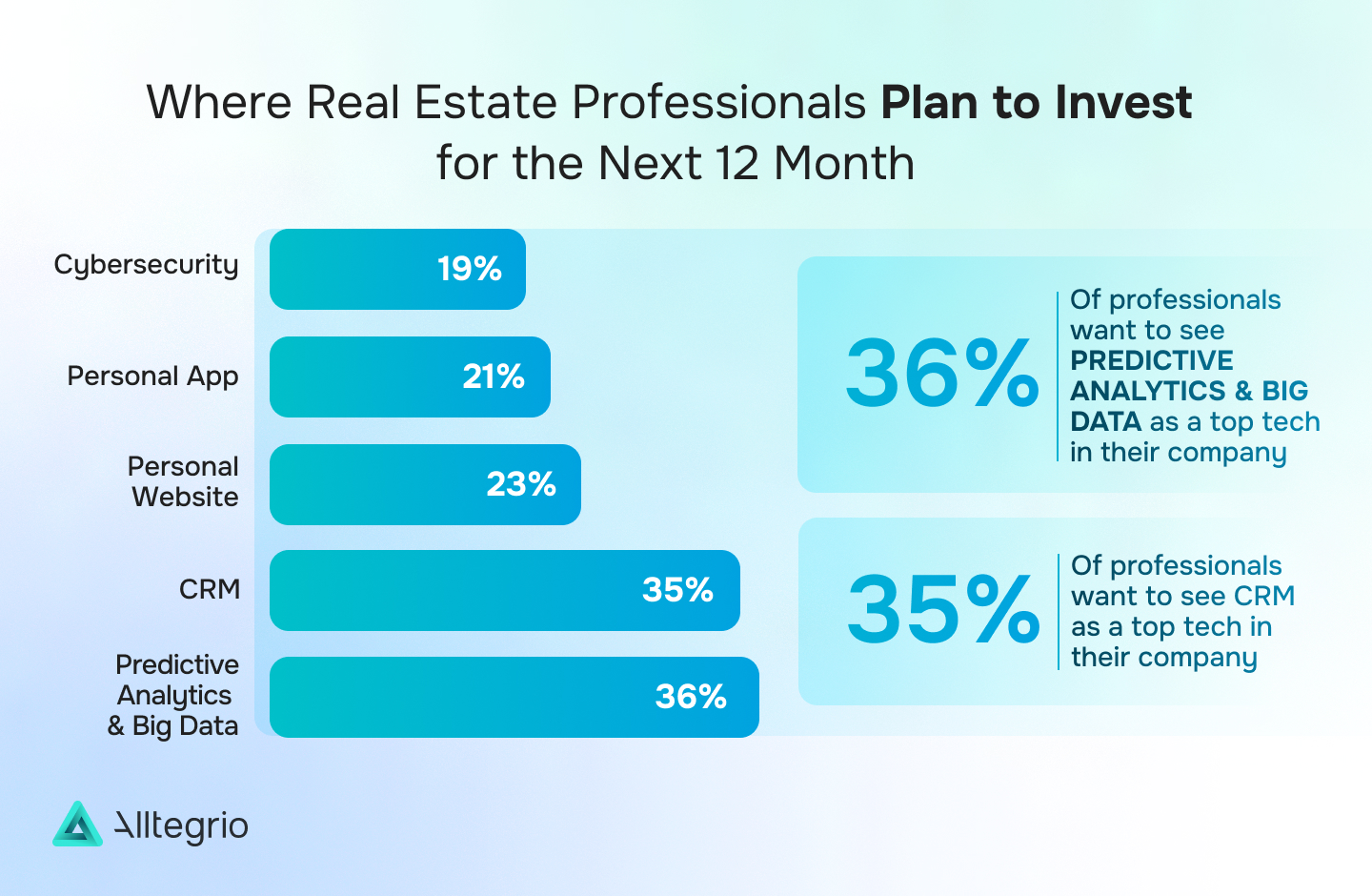
Already, 36% of real estate professionals plan to invest in Big Data and Predictive Analytics services within the next 12 months. If you aren’t among them, you are behind. Real estate has grown extremely complex with volatile market dynamics, shifting consumer preferences, and global economic instability. Big Data Analytics for real estate can help you grow your business even in these uncertain times. In this article, we will explain exactly how you can achieve this with technology.
Simply put, Big Data Analytics services are about processing massive amounts of unstructured and structured data from social media, mobile apps, transactional records, and other sources. In the real estate market context, this also encompasses property listings, demographic statistics, historical sales data, market trends, and consumer behavior patterns.
Most commonly, real estate data analytics is performed on government databases, online listings, and social media networks. Properly analyzing these sources provides real estate businesses with deep market insights and customer preference analysis for better decision-making. However, you can also collect information from other sources, like analyzing the behavior of your website visitors.
Moreover, Big Data Analytics is beneficial not only in market analysis but also in offering great customer experiences. These insights allow estate agents to personalize the service by recommending a property that best suits individual clients based on their past transactions and preferences. For example, when a client keeps searching for eco-friendly homes, agents will use the data to bring those properties forward, increasing the chances of closing a deal. You can learn more about the impact of Data Annotation, a service that procures this type of data, from this article.
Another reason to use Big Data Analytics in real estate is your pricing strategy. By understanding historical sales data and current market conditions, you will be able to ascertain the optimal price for properties to remain competitive and ensure profitability.
Key metrics used in real estate Data Analytics include:
Big Data holds immense potential for real estate analytics because it covers information from multiple sources to better comprehend market trends, investment opportunities, and buyer preferences. This analytics service also enables a company to predict the future market and provides insights into pricing strategies. In a constantly changing market, real-time data will ensure the business can keep pace, optimizing its strategy to stay ahead of the competition.
Moreover, real estate data analysis is critical for providing top-notch customer experiences. Analyzing the pattern of consumer behavior can enable real estate firms to target the specific needs and wants of their future buyers or renters. For instance, analytics will show what amenities are in demand in a certain neighborhood, enabling developers to build properties that will catch attention. This level of personalization not only enhances customer satisfaction but can also lead to quicker sales and raise rental rates. You can use this type of data with a tool like a custom real estate chatbot to take customer experiences to a new level.
Additionally, Big Data real estate analytics merged with other powerful technologies, like AI and ML, can revolutionize how realtors do business. For example, predictive analytics enable investors to identify emerging markets before they become saturated, thus making prudent decisions to maximize their return on investment. All things considered, leveraging Big Data will be essential for those looking to thrive in the increasingly competitive industry of real estate.
To get a look at what AI-powered solutions for real estate can do, check out this case study. The Alltegrio development team created a solution that helped a real estate agency help their clients find a perfect property much faster, which increased their successful sales and rent deals.
Property professionals can use real estate Data Analytics to uncover true hidden gems, which are underestimated, burgeoning markets that would yield high returns with investment. Therefore, analyzing demographic trends, housing directions, and economic indicators can create pathways toward evidence-based decision-making for investment and development sites.
This could, for example, be achieved by advanced real estate analytics that would pinpoint unserved markets showing growth signs. Additionally, historical data analysis might reveal neighborhood development trends, thus helping businesses to stay ahead of the market.
Furthermore, Big Data Analytics in real estate gives you a deeper insight into consumer preferences and behavior. This might make a big difference in investment decisions. Through social media analytics and online search trends, realtors can find out what features or amenities potential buyers or renters are interested in. This insight allows them to align their offer with the market demand, making new developments well-positioned and fitted out with the right characteristics that appeal to the target audience.
Predictive analytics also allows you to glimpse the future. With data from local economic forecasts, employment rates, and even climate, real estate firms can make predictions regarding future changes in the market before they happen. This proactive approach allows businesses to make informed decisions regarding property acquisitions, renovations, and sales strategies that maximize return on investment and minimize risks.

Real Estate professionals can use Big Data Analytics to identify most lucrative emerging markets and get ahead of competition.
Learn HowProperty valuation is one of the most critical areas in real estate transactions and investments. Leveraging Big Data Analytics in real estate enhances the accuracy in this area by analyzing a lot of variables affecting property values, such as location, amenities, and market demand.
Additionally, predictive analytics can be applied to predict future property values through trends and comparative analyses with similar properties in the area. This helps businesses price properties competitively while maximizing their returns on investment.
You can get profound insights with Big Data real estate analytics integrating various datasets on demographic information, economic indicators, and even social media sentiment. They allow realtors to understand the tastes and preferences of the buyers and pitch their marketing campaigns accordingly. In essence, you appeal to highly specific target demographics. For instance, if the data indicates that millennials have a budding interest in eco-friendly homes, then agents can highlight those listings with sustainable features to interest this target audience.
Moreover, property valuation models can be further fine-tuned by applying Machine Learning algorithms. The more data these algorithms process, the more they can detect subtle patterns and correlations that may not be so evident to human analysts. This continuous learning process allows property values to be corrected in real-time. Therefore, the realtor can respond promptly to changes in the market, ensuring competitiveness relevant to property prices.
Real estate investments require an essential understanding of customers’ behavior and preferences. Applying Big Data analytics in real estate captures insights into potential buyers’ and renters’ needs, likes, and dislikes.
Businesses can tailor their offerings and marketing strategies by analyzing customer data to ensure they align with customers’ desires. This targeted approach enhances customer satisfaction and leads to higher conversion rates and sales.
Most significantly, Big Data real estate analytics allows companies to identify emerging market trends. For example, by analyzing demographic changes, one can predict an increase in growth and demand. Grasping this information makes it easier for investors to look ahead and invest before the neighborhood reaches ultimate growth, thus increasing return on investment. In addition, historical data might show buyer trends during different economic cycles, providing further insights into timing and pricing strategies.
Advanced analytics will also further empower customer segmentation as real estate professionals will run very targeted marketing campaigns. Understanding the peculiarities of diverse groups of customers, such as first-time homebuyers, connoisseurs of luxury properties, or renters seeking short-term tenancies, will help businesses craft messages that strike a deeper chord with each segment. Such a level of personalization enhances engagement and brand loyalty.
Real estate analytics of market risks could alert you to poor economic conditions, changes in consumer behavior, or natural calamities. Big Data analytics uses several tools to identify these changes, including predictive modeling and scenario analysis.
Through analysis of various data points, ranging from historical market performance and economic indicators to property-specific characteristics, a real estate company can foresee risks well in advance and create effective strategies to mitigate them. This proactive approach considerably reduces the chances of failures and resultant losses.
Besides, Big Data real estate analysis also helps realtors track trends in real-time. Therefore, they can offer a more dynamic outlook on the market landscape. For instance, using such data to gain information from social media sites, companies can monitor consumer sentiment and preferences. Those often change fast and thus influence demand for a particular kind of property.
Going even further, real estate data analytics coupled with the Geographic Information System (GIS) could provide insights into location-specific risks. Mapping demographic shifts, changes in zoning, and infrastructure development will aid real estate investors in understanding how these factors may influence property values and rental yields. This spatial analysis helps identify lucrative investment opportunities and gauge the risks associated with specific neighborhoods. Therefore, it can help make more prudent decisions in a volatile market.
In today’s competitive real estate market, personalized marketing strategies are crucial. Big Data allows businesses to gain a thorough understanding of customer behavior and preferences, which is necessary to develop tailored marketing messages.
By segmenting customers based on demographics, interests, and previous interactions, businesses can create highly targeted advertising campaigns that resonate with their target audience segments. This level of personalization increases engagement rates while also fostering deeper relationships with potential clients.
Armed with the insights you get from real estate data analysis, you can build solutions that will generate personalized marketing messages quickly so you can capitalize on each. Here’s a look at one such solution developed by the Altegrio team. We created a platform powered by ChatGPT integration, a library of customized prompts, and a voice analyzer. The platform increased our client’s content efficiency by 40%. It also boosted their marketing strategy precision by 20%. This allowed our client, a renowned real estate agency, to increase the number of closed deals while also strengthening their brand and optimizing marketing processes.
In addition, businesses can use predictive analytics to forecast future purchasing or renting behaviors. Companies can analyze historical data for patterns to determine when a buyer is more likely to move or when a renter might upgrade. This proactive approach allows realtors to reach out with personalized offers or relevant property listings at the right time, closing the conversion loop. For example, the system could find that a user searches for family-friendly neighborhoods. Then, the real estate agent might send over a curated listing of that nature, complete with information about homes in that area, schools, and parks.
Use Big Data Analytics for real estate to stay ahead of comeptition by learning valuable information about market opportunities and forecasting trends.
Book a ConsultationImplementing Big Data analytics in real estate brings multiple advantages for your business. However, you shouldn’t forget that data collection and processing have a lot of challenges. Some of the most significant among them are:
Real estate data analytics encompasses multiple technologies and tools, including analytical platforms, Customer Relationship Management systems (CRMs), and GIS (Geographical Information System).
Data analytics platforms process and analyze big data, while CRMs enable the firm to manage customer relationships and interactions. GIS technology allows for spatial analysis, which helps the real estate firm visualize market trends and property values geographically.
Besides these core technologies, Machine Learning algorithms also play a significant role in the real estate data analysis sector. They are used to forecast property prices and find investment opportunities based on historical data and market trends. For example, predictive analytics will use neighborhood demographics, economic indicators, and seasonal trends, enabling real estate professionals to make informed decisions. Furthermore, integrating machine learning into CRM systems will enhance customer targeting and personalization, increasing customer satisfaction and retention.
Besides, cloud computing contributes considerably to managing Big Data analytics for real estate. The employment of cloud solutions allows firms to store a massive volume of data securely and access it from any location. This enables easy collaboration among teams and stakeholders. It’s convenient for real estate agents who are always on the move. They can view critical information and analytics in real-time. Moreover, most cloud platforms are integrated with advanced data processing capabilities that speed up insights and response time to changing market conditions.
In the fast-moving world of real estate, the inclusion of Big Data analytics has become vital. Real estate agencies can invest in these services to improve decision-making, better engage with customers, and manage risks more efficiently.
In a market subject to relentless changes, the data-driven strategies that Big Data real estate analytics provide will define the winner. In this light, embracing Big Data analytics is not an option but a must for every real estate business today. When you are resdy to start using this technology, book a free consultation by filling out a form below.