How to Build a Generative AI Model: a Comprehensive Guide

Generative AI refers to artificial intelligence systems that help create new content like text, images, music, and more, offering specific solutions across various industries. AI-driven predictive analytics can help businesses make informed decisions by analyzing vast amounts of data to identify patterns and trends. These insights enable companies to forecast demand, optimize supply chains, and enhance customer experiences. 

Building a generative AI model involves defining the problem or goal and deploying and monitoring the solution. With the proper approach and technology, generative AI can unlock opportunities to transform routine business tasks into innovative and efficient solutions for startups, SMBs, and large companies in various industries. We at Alltegrio offer our help to explore the possibilities and growth points to meet your business goals with our generative AI solutions.

block-image

Understanding Generative AI

Generative AI generates new content and gives you recommendations and outcomes by using existing data: text, audio files, massive datasets or images. This technology has significant applications across various industries, including art, music, writing, and marketing. Additionally, it is helpful for data augmentation, which generates new data to enhance small datasets, and for synthetic data generation, which produces data for tasks that are difficult or costly to gather in real-world scenarios. By recognizing underlying patterns in the input, generative AI allows computers to produce similar content, fostering unprecedented creativity and innovation.

Generative AI is powered by various techniques, including transformers, generative adversarial networks (GANs), and variational autoencoders (VAEs). Transformers like GPT-3, GPT-4, LaMDA, Wu-Dao, and ChatGPT mimic cognitive attention, assessing the significance of different parts of the input data.

By 2024 Generative AI market is projected to reach a size of $36.06 billion. And for the period from 2024 to 2030 an annual rate (CAGR) is expected to grow by 46.47%, reaching a market volume of $356.10 billion by 2030. In a global comparison, the United States is anticipated to have the largest market size, estimated at $11.66 billion in 2024.

block-image

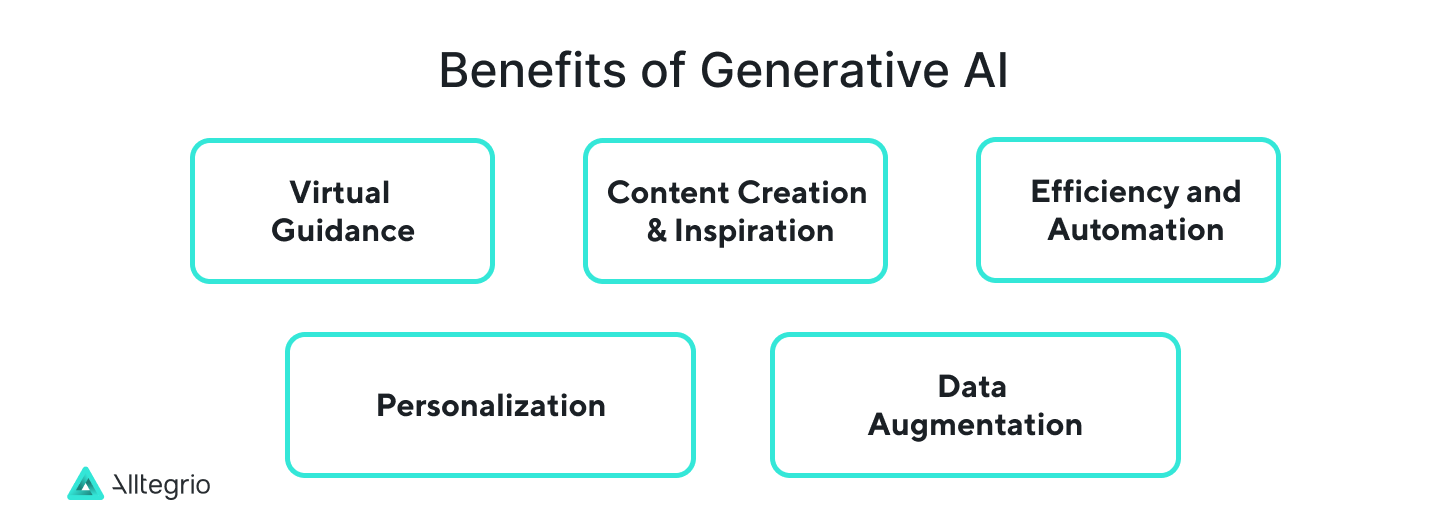
Advantages of Generative AI

Virtual Guidance: Generative AI guides users with intelligent AI trainers that are accessible to everyone. Companies can train these models in various fields, enabling users to discover and learn new ideas and information.

Content Creation & Inspiration: Language models like GPT, trained on vast amounts of text, can craft poetry, creative stories, and scripts. They serve as valuable tools for content creators, aiding in producing imaginative and inspired works.

Efficiency and Automation: AI generative models automate content creation, significantly reducing the time and effort required in industries like marketing and entertainment.

Data Augmentation: These models can generate synthetic data to augment existing datasets, particularly useful in training other machine learning models.

Personalization: Generative AI can create highly personalized content, enhancing user interaction with chatbots, recommendation systems, and virtual assistants.

Image Source: Statista

Let’s talk!

Contact our Generative AI professionals today

Contact us
block-image

Limitations of Generative AI

Quality Control: Ensuring the generated content is of high quality and free from biases remains challenging.

Computational Resources: Training generative models requires significant computational power and resources.

Ethical Concerns: There are ethical implications, such as the potential for misuse in creating deepfakes or generating misleading information.

Data Dependency: The quality and diversity of the generated output heavily depend on the training data.

Varieties of Generative AI Models

Generative AI encompasses several model types, each with unique mechanisms and applications. These include Generative Adversarial Networks (GANs), Expansive Language Models, Diffusion-Based Models, Variational Autoencoders (VAEs), and Transformer Models.

Generative Adversarial Networks (GANs)

GANs architecture consists of a generator neural network and a discriminator neural network. The generator creates fake data that resembles real data, and the discriminator learns to distinguish between the fake and real data.

This training process makes the generator create realistic data as the discriminator becomes more accurate in distinguishing data, resulting in high-quality and realistic outputs.

We use GANs in tasks such as image generation, image enhancement, and video generation. They excel at generating high-quality and realistic content, particularly in computer vision. However, training GANs is challenging due to instability in the interactions between the generator and discriminator. This instability can result in mode collapse, where the generator learns to create a limited subset of samples. Despite these challenges, GANs is considered to be a valuable tool in generative AI.

Advantages: GANs can produce highly realistic images, generate videos, and even create realistic human faces, and they help with data augmentation.

Applications: Image synthesis, video generation, and creating realistic human faces.

Expansive Language Models

Expansive language models are a type of generative AI model that helps generate human-like written text content, revolutionizing natural language processing tasks. These models are trained on large datasets to help generate relevant text based on prompts. Language models like GPT-3 and GPT-4 (Generative Pre-trained Transformer) use self-attention mechanisms to recognize dependencies between words in a text.

Expansive language models have many applications, like text generation, language translation, sentiment analysis, chatbots, recommendation engines, and more. Businesses use these models to create content, automate customer interactions, and improve natural language understanding and processing.

Advantages: They can produce human-like text, making them invaluable in customer service and content generation.

Applications: Chatbots, content creation, translation services, and more.

Diffusion-Based Models

Diffusion-based models are a type of generative AI model that can create new data by learning the underlying structure of the training data. These models transform a simple data distribution into a more complex and realistic one through a series of invertible transformations.

The training process of diffusion-based models involves learning the patterns and structures in the training data by applying these invertible transformations. Once the model has learned the transformation process, it can generate new data by starting from a simple initial distribution and using the learned transformations.

Diffusion-based models are mainly known for generating realistic and high-quality outputs, including image synthesis, video generation, and animation. These models offer a computationally efficient approach to developing new data and can produce diverse samples that resemble the training data.

Advantages: They can handle complex data distributions and generate high-quality outputs.

Applications: Commonly used in generating high-resolution images and scientific data simulations.

Variational Autoencoders (VAEs)

Variational Autoencoders (VAEs) are generative AI models that combine the capabilities of autoencoders and probabilistic modeling to generate new data. VAEs compile the input data into a lower-dimensional latent space and reconstruct the input from the compressed representation.

The training process of VAEs involves two neural networks: an encoder and a decoder. The encoder compresses the input data into the latent space, while the decoder reconstructs the input from the compressed representation. VAEs learn to generate new samples by sampling points from the learned distribution in the latent space.

Applications: Image generation, data compression, and anomaly detection.

Advantages: VAEs provide a structured latent space that can be used for interpolation and exploration.

Transformer Models

Transformer models are a type of generative AI that have made significant advancements in NLP tasks. Transformer architecture uses self-attention mechanisms to capture dependencies between words in a text. Transformer models excel in generating high-quality and contextually relevant text from large datasets.

Applications: Extensively used in language translation, text generation, chatbots, recommendation engines, and sentiment analysis.

Advantages: Transformers can handle long-range dependencies in data and are highly scalable.

block-image

Capabilities of Generative AI

Generative AI models analyze patterns and information within extensive datasets, using this knowledge to generate new content. When incorporating and deploying foundation models, businesses must consider their options. Each use case has specific requirements that you should take into account, including cost, effort, data privacy, intellectual property, and security. Generative AI offers capabilities that are revolutionizing industries and applications.

Image Enhancement and Editing

Generative AI transforms and edits images, improving quality, removing imperfections, and adding realistic elements. We use this in photography, design, and media technology to create stunning visuals.

Customer Service Chatbots

Generative AI helps develop chatbots that provide instant, personalized responses to customer inquiries, enhancing customer support and satisfaction while reducing response times and operational costs.

AI Process Automation

AI can automate various business processes, increasing efficiency and accuracy. This includes many tasks like data entry, information processing, routine decision-making, and interaction with customers allowing human employees to focus on more strategic activities.

AI System Monitoring

Generative AI can monitor IT systems in real-time, detecting anomalies, predicting potential issues, and ensuring optimal performance. This helps in maintaining system reliability and reducing downtime.

Text Generation and Summarization

AI can generate and summarize text, producing high-quality content for articles, reports, and other documents. It can also condense large volumes of information into concise summaries, aiding in quick comprehension.

Automated Human Resources Tasks

Generative AI can handle HR tasks such as resume screening, candidate matching, and employee onboarding. This streamlines the recruitment process and enhances the efficiency of HR departments.

Financial Advisory Services

AI provides financial advisory services by analyzing market data, assessing risks, and providing investment recommendations.

Marketing Assistance

Generative AI aids in marketing by creating personalized content, optimizing campaigns, and analyzing consumer behavior. IMarketers use it to reach their target audience more effectively and improve ROI.

E-commerce Support

AI enhances e-commerce platforms by providing product recommendations, automating customer service, and personalizing the shopping experience. These help to increase customer engagement and sales.

Virtual Travel Assistance

Generative AI offers virtual travel assistance by planning itineraries, booking accommodations, and providing travel recommendations. It improves the travel experience by delivering personalized and efficient planning.

Role-Playing Bots

AI powers role-playing bots used in training and education. These bots simulate real-life scenarios, allowing learners to practice and improve their skills. This is particularly useful in fields like healthcare, customer service, and sales.

Data Organization and Structuring

Generative AI can organize and structure large datasets, making it easier to analyze and extract valuable insights. This capability is crucial for businesses dealing with big data, enhancing data-driven decision-making.

How to Create a Generative AI Solution?

So, Generative AI helps us create text, images, music, and videos, simulating human-like creativity. It gives businesses an invaluable tool to implement AI solutions across various industries to simplify general workflow and different business operations. Let’s outline the algorithms for the most effective way to apply it.

Define the Problem and Set Objectives

We advise you to define what problem you want to solve with generative AI. For example, you may need a solution to generate images, create conversational agents, or develop automated content creation tools. Understanding the problem helps set the right direction for your project.

The next step is to set clear objectives that could range from achieving a certain level of accuracy in generated content to improving user interaction and engagement metrics. Clear objectives provide a roadmap and benchmarks for evaluating success.

Collect and Manage Data

The next step is to define the type of data you’ll input, which depends on the specific problem you’re addressing. For instance, text generation models need massive datasets of text information, while image generation models require extensive datasets of images.

You can collect those data from various sources, including public datasets, proprietary databases, and user-generated content. Efficient data management is crucial for handling large datasets. Organizing data in a structured manner is vital, as ensuring data quality and employing storage solutions that facilitate easy access and retrieval.

Process and Label Data

Data cleaning involves removing noise and inconsistencies from the dataset to ensure the data is accurate, which is vital for training effective models. Tagging data with relevant labels is the process of data labeling. For example, image generation could involve labeling images with descriptions.

Several tools can aid in data processing, such as TensorFlow Data Validation, Pandas for data manipulation, and Labelbox for data annotation. Using the right tools can streamline the data preparation process.

Select a Foundational Model

Developers built generative AI solutions upon foundational models. These models have been pre-trained on vast amounts of data and can be fine-tuned for specific tasks.

When selecting a foundational model, consider factors such as model performance, scalability, and compatibility with your data and objectives. Popular foundational models include GPT-3 for text generation and GANs for image generation.

The Generative Pre-Trained Transformer (GPT): Initially showcased its potential for generating task-specific natural language through unsupervised pre-training and fine-tuning for downstream tasks. It uses transformer-decoder layers for next-word prediction and coherent text generation. Fine-tuning adapts it to specific tasks based on pre-training.

GPT-2 GPT-2 expands on its predecessor’s structure and parameters and is trained on various datasets beyond just web text. Despite showing advanced results with zero-shot learning, it remains focused on task-specific General AI (GAI).
GPT-3 GPT-3 is a language model that employs prompts to reduce dependence on large, supervised datasets. It makes predictions using the linguistic structure of text probability and is pre-trained on vast amounts of text.
GPT-4 OpenAI’s latest model, GPT-4, was trained with unprecedented computational scale and data. It achieved human-like performance across almost all tasks and significantly outperformed its predecessors. GPT-4 represents a major leap in General Artificial Intelligence (GAI), with remarkable capabilities in multimodal data generation, including text, images, and audio.
LLaMA from Meta Meta (formerly Facebook) announced a new LLM in 2023 called LLaMA (Large Language Model for Meta Applications) with 600 billion parameters. LLaMA is trained on diverse data sources. LLaMA incorporates human feedback in its training to enhance ethical standards.
PaLM 2 from Google PaLM 2, released in 2023 with 400 billion parameters, is a multimodal LLM capable of processing and generating text and images. Trained on a large-scale dataset covering 100 languages and 40 visual domains, PaLM 2 excels in cross-modal tasks such as image captioning, visual question answering, and text-to-image synthesis.
BLOOM It generates text in 46 natural languages, dialects, and 13 programming languages. Trained on 1.6 terabytes of data (equivalent to 320 copies of Shakespeare’s works), BLOOM processes 46 languages, including French, Vietnamese, Mandarin, Indonesian, Catalan, 13 Indic languages, and 20 African languages. Despite only 30% of the training data being in English, the system is proficient in all mentioned languages.
BERT from Google Released in 2018, BERT (Bidirectional Encoder Representations from Transformers) contains 340 million parameters and leverages bidirectional self-attention to learn from extensive textual data. BERT excels in natural language tasks such as text classification, and sentiment analysis.
Generative AI Adversarial Networks
DALL·E 2 An AI system that can turn simple natural language descriptions into realistic images or works of art.
Style 

GAN 3

An AI system that generates photorealistic images of anything from human faces to animals and cars, allowing users to manipulate the style, shape, and pose of generated images.
Diffusion Models
Stable Diffusion Stable Diffusion creates photorealistic images, videos, and animations from text and image prompts using diffusion technology and latent space. It reduces processing requirements and can run on desktops or laptops with GPUs. Launched in 2022, it can be fine-tuned with just five images.
DALL-E 2 Developed by OpenAI, this innovative language model uses an advanced diffusion model to convert textual descriptions into breathtaking images. It utilizes contrastive learning to recognize differences between similar images and create new ones. It has practical applications in design, advertising, and content creation and exemplifies human-centered AI.


Train and Fine-Tune the Model

During training, data is fed into the model and the parameters are adjusted to minimize the error. Techniques such as transfer learning can be used to utilize previously trained models to reduce the time and resources required.

Fine-tuning involves adapting the pre-trained model to the task at hand. This can include adjusting hyperparameters, adding layers or using specific training data.

Overfitting occurs when the model learns the training data too well but needs to be generalized. Underfitting occurs when the model is too simple to capture the underlying patterns.

Evaluate and Refine the Model

Evaluating a generative AI model involves using metrics such as accuracy, precision, recall. BLEU and ROUGE scores are two commonly used metrics in NLP evaluation for text generation tasks. These metrics help assess the model’s performance.

Refinement techniques include:

  • Hyperparameter tuning.
  • Additional training with more data.
  • Employing ensemble methods to improve model robustness.

Model development is an iterative process. Regularly evaluating the model and incorporating feedback loops.

Deploy and Monitor the Model

Deploying a generative AI model involves integrating it into the production environment, where end-users can access it. As rule, it’s possible using cloud platforms like AWS, Google Cloud, or Azure.

Post-deployment is when your experts monitor the model’s performance to ensure it meets the desired objectives. Monitoring involves tracking key performance indicators (KPIs) and retraining the model periodically with new data.

Illustrative Healthcare Case by Alltegrio

Generative AI Business Intelligence and Analytics Classic AI/ML
AI-generated content and images

Personalized marketing campaign

Call analysis

Schedule-entry assistant

Report generation

AI-powered search experience for doctors

Voice bot

Text-based alerts and notifications

Personalized treatment plans

Personalized patients care

LLM-powered Diagnosis of Thought (DoT) prompting in psychotherapy

Simulation-based learning (SBL) for med students

AI-powered companions for senior patients
Code development and maintenance productivity Patients screening

Patient outcomes

Virtual customer-service agent

Medical imaging data analysis

Accelerate drugs discovery and drugs development


Unlock Your Generative AI Potential with Alltegrio

At Alltegrio, our experts have skills and experience in many industries and different scopes, so we understand the complexities of integrating AI into existing systems. We offer comprehensive support from initial consultation to full deployment. Our tech stack and successful algorithm of AI solution development, using advanced technology, help our clients streamline operations, reduce costs, and stay ahead of the competition due to the digital transformation of routine tasks.

block-image

Our Tech Stack for Building Generative AI Solutions

Our tech team utilizes an advanced tech stack to develop innovative, generative AI solutions. With over 12 years in the software development market, we work with different programming languages like Python and JavaScript, which are essential for building flexible and scalable AI models. Python, with its extensive libraries like TensorFlow, PyTorch, and Keras, offers the tools needed for deep learning and neural network development. JavaScript, mainly through Node.js, allows us to create efficient and real-time applications integral to deploying AI solutions on the web.

We offer our expertise with cloud computing platforms like AWS, Google Cloud, and Microsoft Azure to ensure our generative AI solutions are scalable and reliable. These platforms offer vast computational resources and advanced machine-learning services that enable us to train complex AI models efficiently.

For data management and processing, we rely on advanced databases and data warehousing solutions such as PostgreSQL, MongoDB, and Apache Spark. These technologies enable us to handle massive datasets, ensuring that our AI models are trained on diverse and high-quality data.

Our DevOps tools like Docker, Kubernetes, and Jenkins help streamline the development, testing, and deployment processes.

Сonclusion

Building a generative AI model involves a detailed process from defining the problem, deploying and monitoring the AI solution. Generative AI can transform routine business tasks into efficient solutions, benefiting startups, SMBs, and large companies.

At Alltegrio, we offer expert support to help businesses explore and implement generative AI solutions. Our expertise and advanced tech stack enable us to develop scalable AI models, ensuring our clients achieve their business goals.

What Is the Cost of Developing a Generative AI Solution?

The cost of developing a generative AI solution can vary significantly based on the project's complexity, the dataset's size, the application's specific requirements, and the level of expertise required. The scope includes data collection and preprocessing expenses, model training, software development, and ongoing maintenance. Working with a knowledgeable AI development partner is essential to get a detailed estimate.

What is the timeline for developing a Generative AI model?

It depends on the project's complexity, the quality and volume of the data, and the resources available. On average, developing a fully functional generative AI model can take up to a year. The process involves several stages, including defining objectives, data collection and preprocessing, model selection, training and fine-tuning, evaluation, and deployment. Efficient project management and experienced development teams can help expedite the process.

What are the leading generative AI tools?

Leading tools and frameworks include TensorFlow and PyTorch, which are widely used for building and training neural networks. Other tools, like Keras, provide a high-level interface for neural network development, making it easier to prototype and deploy models. Additionally, cloud-based platforms such as Google Cloud AI, AWS AI, and Microsoft Azure AI offer robust services for machine learning, including pre-trained models and scalable computing resources. OpenAI's GPT models and Google's BERT are also notable tools due to natural language processing and generation features.

Subscribe to our blog!