
Reduced equipment efficiency often creates operational losses long before a machine actually fails. Compressors operating outside optimal conditions can increase facility-wide power consumption, while small electrical faults may gradually affect surrounding systems and production stability.
Because of this, maintenance has become a much more strategic discipline for companies running high-volume or highly automated environments.
This is why maintenance in 2026 is increasingly treated as part of operational strategy rather than a purely technical support function.
Predictive maintenance takes a different approach. Instead of servicing equipment based primarily on time intervals, it analyzes real operating conditions using sensor data, machine telemetry, and AI-based monitoring systems.
Predictive maintenance can dramatically reduce failure-related losses in high-value or failure-sensitive operations. But for companies with limited monitoring infrastructure or lower asset complexity, traditional preventive maintenance may still produce stronger returns with far less operational overhead.
That is why most organizations in 2026 evaluate maintenance strategies based on practical conditions rather than industry trends alone.
This article compares predictive and preventive maintenance in practical terms — including implementation costs, operational impact, electrical preventive maintenance workflows, and the situations where each approach delivers the strongest business value.
What is preventive maintenance vs. predictive maintenance difference in 2026?
The predictive vs preventive maintenance discussion has shifted far beyond maintenance theory. For many companies, it now directly affects operational efficiency, labor allocation, and long-term infrastructure costs.
Preventive maintenance works through planned servicing cycles. Equipment is inspected, calibrated, repaired, or replaced according to established schedules designed to reduce the probability of unexpected failure.
This may include:
- recurring inspections,
- lubrication cycles,
- electrical preventive maintenance procedures,
- filter replacement,
- HVAC servicing,
- or scheduled shutdowns for equipment checks.
One reason preventive maintenance remains common across industrial operations is that it simplifies coordination. Scheduled servicing helps maintenance teams align inspections, downtime planning, and operational requirements more efficiently.
At the same time, preventive maintenance assumes that equipment health can be managed effectively through scheduled servicing alone — an approach that modern monitoring systems increasingly challenge through real-time condition analysis.
Predictive maintenance replaces fixed assumptions with real-time condition monitoring.
Instead of asking “When should this asset be serviced?”, predictive systems ask:
“Is this asset showing measurable signs of degradation right now?”
To answer that question, companies now use:
- IoT sensors,
- vibration analysis,
- infrared thermography,
- ultrasonic monitoring,
- machine telemetry,
- and AI-driven anomaly detection systems.
Modern predictive maintenance platforms are increasingly integrated into SCADA environments, ERP systems, CMMS platforms, and industrial IoT pipelines to create continuous visibility into equipment behavior and maintenance risk.
The impact of predictive maintenance is much greater in highly interconnected operational environments where equipment failures rarely remain isolated.
Unexpected downtime may affect:
- production scheduling,
- shipment timing,
- labor coordination,
- and downstream operational workflows
across multiple departments at once.
In these environments, early identification of wear and instability can create substantial value by reducing broader operational disruption.
That said, predictive maintenance is not inherently superior to preventive maintenance in every operational environment.
Many companies underestimate:
- sensor deployment costs,
- integration complexity,
- false-positive alerts,
- cybersecurity requirements,
- and the organizational discipline needed to maintain reliable monitoring systems over time.
That is why hybrid maintenance models are becoming increasingly common in 2026. Companies selectively apply predictive maintenance to critical systems while continuing to use preventive maintenance service programs for equipment that does not justify continuous monitoring infrastructure.
How do predictive and preventive maintenance strategies impact operational efficiency?
The difference between predictive and preventive maintenance becomes most visible in day-to-day operations.
On paper, both approaches are designed to reduce equipment failure. In practice, these strategies influence much more than equipment servicing alone. They affect production planning, technician allocation, downtime coordination, and the overall rhythm of facility operations.
Preventive maintenance improves stability primarily through structured and predictable servicing schedules.
A predefined preventive maintenance schedule allows teams to:
- plan maintenance windows in advance,
- coordinate technician availability,
- prepare spare parts ahead of time,
- and reduce the risk of sudden equipment failure.
For many facilities, especially those operating older infrastructure, that predictability still matters more than advanced analytics.
A food processing plant, for example, may service motors and refrigeration systems every few months regardless of current equipment condition because unexpected downtime during production cycles creates a larger operational risk than slightly over-servicing equipment.
The tradeoff is efficiency loss over time.
In large industrial environments, maintenance teams often inspect or replace components that are still functioning normally. Equipment may be temporarily shut down for scheduled service even when no degradation exists yet.
This becomes expensive at scale.
A facility operating hundreds of motors, conveyors, pumps, and electrical systems can lose substantial labor hours to maintenance activity that was never operationally necessary in the first place.
Predictive maintenance changes the workflow entirely.
Instead of asking:
“When was this asset last serviced?”
the system asks:
“Is this asset currently showing signs of abnormal behavior?”
That shift allows companies to focus maintenance effort only where degradation actually exists.
Operational changes companies usually see with predictive maintenance
- fewer unnecessary inspections,
- lower planned downtime,
- more targeted technician work,
- reduced spare-part waste,
- earlier detection of equipment instability,
- and better visibility into asset health across facilities.
In a warehouse automation environment, vibration analysis may reveal early bearing degradation in a single conveyor motor before the problem spreads through the system. Maintenance teams can replace one component during a short service window instead of interrupting larger operational workflows for full-line inspections.
In large automated facilities, that targeted approach can substantially reduce unnecessary downtime.
But predictive maintenance also creates new operational demands.
Where predictive maintenance becomes difficult
- sensor deployment across older infrastructure,
- false-positive alerts,
- inconsistent telemetry data,
- integration with ERP or CMMS systems,
- cybersecurity exposure,
- and the need for teams capable of interpreting monitoring outputs correctly.
This is one reason many companies in 2026 avoid treating predictive maintenance as a complete replacement for preventive maintenance.
Instead, they combine both approaches:
- predictive monitoring for critical assets,
- preventive maintenance service workflows for lower-risk infrastructure,
- and reactive maintenance only for low-cost noncritical systems.
For many industrial operators, the most effective strategy is not choosing one model exclusively, but combining both according to asset criticality and operational risk.
Which industries benefit most from predictive maintenance compared to preventive maintenance?
Not every industry benefits from predictive maintenance in the same way.
The financial value of predictive monitoring depends heavily on:
- how expensive downtime is,
- how predictable equipment failure patterns are,
- how automated the environment is,
- and how difficult maintenance interruptions are to coordinate.
In some industries, predictive maintenance can generate major operational savings. In others, traditional preventive maintenance still provides a better cost-to-complexity balance.
Manufacturing and automated production
Manufacturing environments tend to see measurable ROI from predictive maintenance because production systems rely heavily on synchronized operational flow.
In many facilities, equipment operates as part of interconnected workflows where failures can quickly affect multiple production stages simultaneously.
A malfunctioning conveyor drive or robotic assembly unit may quickly affect production sequencing across multiple operational stages at once.
In automotive manufacturing especially, the financial impact of downtime can escalate extremely quickly once production delays, idle labor, and supply chain disruption are included. Industry estimates in highly automated environments sometimes place downtime losses at tens of thousands of dollars per minute.
At the same time, preventive maintenance remains common for:
- abnormal vibration,
- thermal instability,
- lubrication degradation,
- motor imbalance,
- and early-stage bearing wear.
This allows maintenance teams to intervene before failures affect throughput.
At the same time, preventive maintenance remains common for:
- lower-priority assets,
- auxiliary infrastructure,
- HVAC systems,
- and equipment with predictable wear cycles.
Utilities and energy infrastructure
Utilities benefit heavily from predictive maintenance because equipment failures can affect large service areas and create regulatory risk.
Power transformers, substations, turbines, and distribution infrastructure are increasingly monitored using:
- thermal imaging,
- electrical load analysis,
- oil diagnostics,
- and AI-driven anomaly detection.
For utilities, the financial impact of equipment failure is often matched by broader reliability and compliance risks. This makes predictive monitoring highly effective for critical infrastructure assets.
However, preventive maintenance remains deeply embedded in the sector due to:
- regulatory requirements,
- safety compliance,
- and the need for standardized inspection procedures.
Most operators combine both approaches rather than replacing one entirely.
Logistics and warehouse automation
Predictive maintenance adoption has accelerated rapidly across logistics infrastructure due to the growth of automated fulfillment environments.
Modern warehouses may contain:
- thousands of conveyor motors,
- robotic picking systems,
- automated sorting infrastructure,
- and high-speed packaging equipment.
In these environments, downtime directly affects delivery timelines and throughput capacity.
Predictive systems allow operators to identify:
- overheating motors,
- abnormal vibration patterns,
- electrical instability,
- and declining equipment performance before outages occur.
This is particularly valuable during high-volume operational periods where downtime costs increase dramatically.
Facilities management and commercial infrastructure
Commercial facilities generally rely more heavily on preventive maintenance than full predictive monitoring deployments.
Infrastructure such as HVAC equipment, elevators, backup generators, and electrical systems is commonly maintained through recurring service schedules because:
- failures are relatively predictable,
- downtime impact is lower,
- and the infrastructure required for predictive monitoring may not justify the cost.
That said, larger smart-building environments increasingly deploy predictive monitoring for critical systems with high energy or uptime sensitivity.
Where preventive maintenance still performs best
Preventive maintenance often remains the better option when:
- equipment replacement costs are relatively low,
- downtime impact is manageable,
- asset behavior is predictable,
- or operational environments lack reliable telemetry infrastructure.
In many mid-sized operational environments, preventive maintenance continues providing strong results without the additional integration, telemetry, and analytics requirements associated with predictive systems.
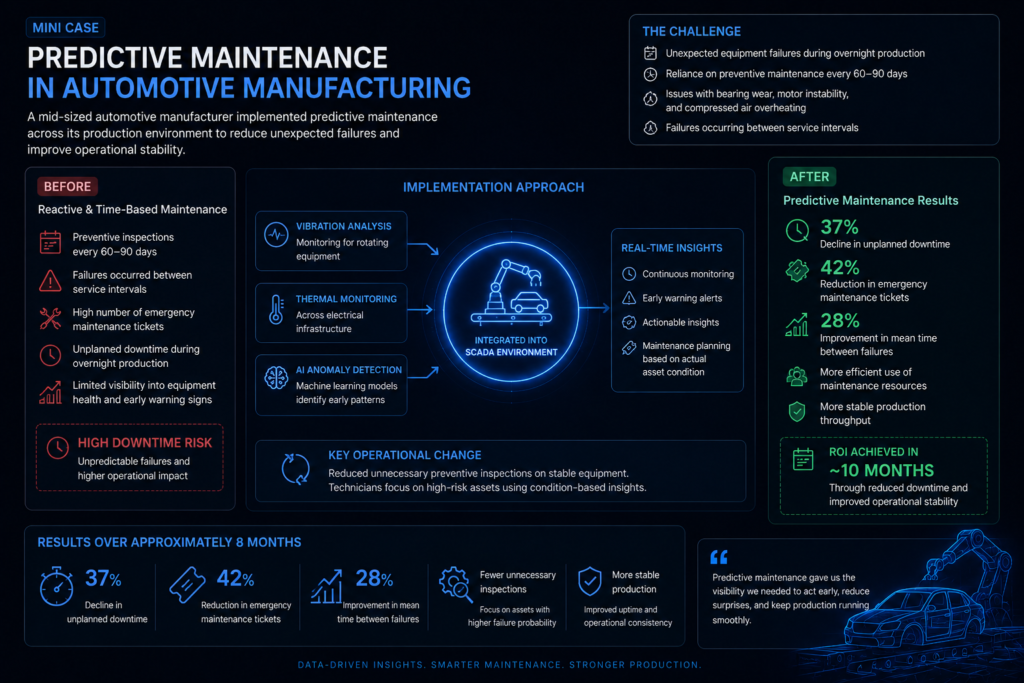
Operational case study: Predictive maintenance in automotive manufacturing
Repeated overnight equipment failures led a mid-sized automotive manufacturer to move beyond purely schedule-based maintenance practices and begin implementing predictive monitoring technologies.
At the time, the facility relied mostly on preventive maintenance inspections performed every 60–90 days. While this reduced many severe mechanical failures, it did not fully eliminate issues tied to bearing wear, motor instability, and overheating compressed air systems between service periods.
To address the issue, the company implemented:
- vibration analysis for rotating equipment,
- thermal monitoring across the electrical infrastructure,
- and machine-learning anomaly detection integrated into its SCADA environment.
Over approximately eight months, the facility recorded:
- a 37% decline in unplanned downtime,
- a 42% reduction in emergency maintenance tickets,
- and roughly 28% improvement in mean time between failures.
One of the biggest operational changes was a reduction in unnecessary preventive inspections across stable equipment. Condition-based monitoring allowed technicians to allocate maintenance resources more efficiently around assets with higher failure probability instead of servicing every system on the same schedule.
The company estimated that operational ROI was achieved within approximately 10 months, mainly through reduced downtime and more stable production throughput.
What technologies enable predictive maintenance in today’s industrial environment?
Predictive maintenance has become far more viable because modern industrial equipment generates continuous operational telemetry instead of isolated inspection data.
Machines continuously generate signals about:
- vibration,
- temperature,
- electrical load,
- pressure,
- runtime behavior,
- and energy consumption.
The goal of predictive maintenance is to turn those signals into early warnings before failures happen.
Sensors are the starting point
At the core of most predictive maintenance systems are sensors connected to production-critical assets.
The goal is to monitor normal operating behavior continuously and identify subtle deviations that may indicate developing equipment problems before failure occurs.
For example:
- vibration sensors can detect bearing degradation,
- thermal cameras can identify overheating electrical components,
- and power monitoring systems may reveal declining motor efficiency before failure occurs.
In many facilities, this data is collected continuously instead of only during scheduled inspections.
Industrial systems are now interconnected
Modern predictive maintenance platforms rarely operate in isolation.
Many facilities connect predictive monitoring directly into:
- SCADA environments,
- ERP systems,
- CMMS platforms,
- and industrial control infrastructure.
This gives maintenance teams continuous visibility into equipment condition instead of depending entirely on scheduled manual inspections.
For example, abnormal vibration behavior in a conveyor motor may trigger an automated maintenance alert long before the issue is severe enough to affect production throughput.
AI has changed predictive maintenance significantly
Earlier monitoring platforms were largely based on static rules:
if a specific temperature or vibration threshold was exceeded, the system generated a warning.
Modern predictive systems are moving beyond that model through machine-learning algorithms capable of analyzing broader equipment behavior patterns.
AI models analyze:
- historical equipment behavior,
- previous failure events,
- operating conditions,
- and real-time telemetry
to identify degradation patterns that are difficult to detect manually.
This is especially valuable in highly automated environments where thousands of assets may be operating simultaneously.
But more data does not automatically improve maintenance
One mistake many companies make is assuming that installing sensors alone will improve reliability.
In reality, predictive maintenance systems still require:
- clean telemetry,
- accurate asset labeling,
- integration with maintenance workflows,
- and teams capable of responding correctly to alerts.
Otherwise, facilities often end up with:
- noisy dashboards,
- excessive false positives,
- and monitoring systems that generate data without improving operational decisions.
Many successful deployments begin with focused pilots targeting equipment where predictive monitoring is most likely to generate measurable operational value.
How does predictive maintenance add value in the era of AI-based systems?
In modern industrial operations, predictive maintenance is becoming closely connected to wider AI-driven infrastructure management systems.
These platforms now support much more than failure detection alone. They increasingly support production planning, maintenance coordination, energy optimization, and infrastructure reliability simultaneously.
This has changed how predictive systems operate.
Earlier monitoring platforms relied primarily on static thresholds:
- if vibration exceeded a fixed limit,
- if the temperature crossed a predefined value,
- or if pressure dropped below expected levels,
the system generated an alert.
AI-based systems operate differently.
Predictive maintenance platforms using AI are designed to recognize complex degradation behavior rather than relying only on fixed operating thresholds.
This allows machine-learning models to identify early instability patterns by analyzing historical equipment performance and real-time telemetry together.
AI systems can identify complex degradation patterns
Modern predictive platforms increasingly use:
- anomaly detection models,
- time-series forecasting,
- pattern recognition,
- and probabilistic failure modeling.
These systems compare current operational behavior against historical performance baselines and estimate failure probability under changing production conditions.
For example:
- a motor may technically remain within acceptable vibration limits,
- but the combination of thermal behavior, load fluctuation, and energy consumption may indicate rising instability long before traditional alerts would activate.
This allows maintenance teams to intervene earlier and more selectively.
Predictive maintenance is becoming part of operational automation
Many industrial operators now integrate predictive maintenance directly into broader operational workflows.
Modern systems can:
- automatically generate maintenance tickets,
- prioritize repair schedules,
- trigger spare-part ordering,
- recommend shutdown timing,
- and escalate high-risk events to operations teams.
Some facilities now use AI copilots connected to maintenance platforms that allow technicians to:
- query historical equipment failures,
- review degradation trends,
- and receive recommended troubleshooting actions conversationally.
This is one reason predictive maintenance is increasingly viewed as part of industrial AI infrastructure rather than a standalone maintenance tool.
AI improves maintenance prioritization
One of the biggest operational problems in large facilities is maintenance overload.
Industrial environments may generate thousands of equipment alerts daily, many of which are low priority or operationally irrelevant.
AI systems increasingly help classify:
- alert severity,
- operational risk,
- probability of failure,
- and production impact.
Instead of treating every anomaly equally, maintenance teams can focus attention on failures most likely to affect:
- production throughput,
- safety,
- energy efficiency,
- or critical infrastructure continuity.
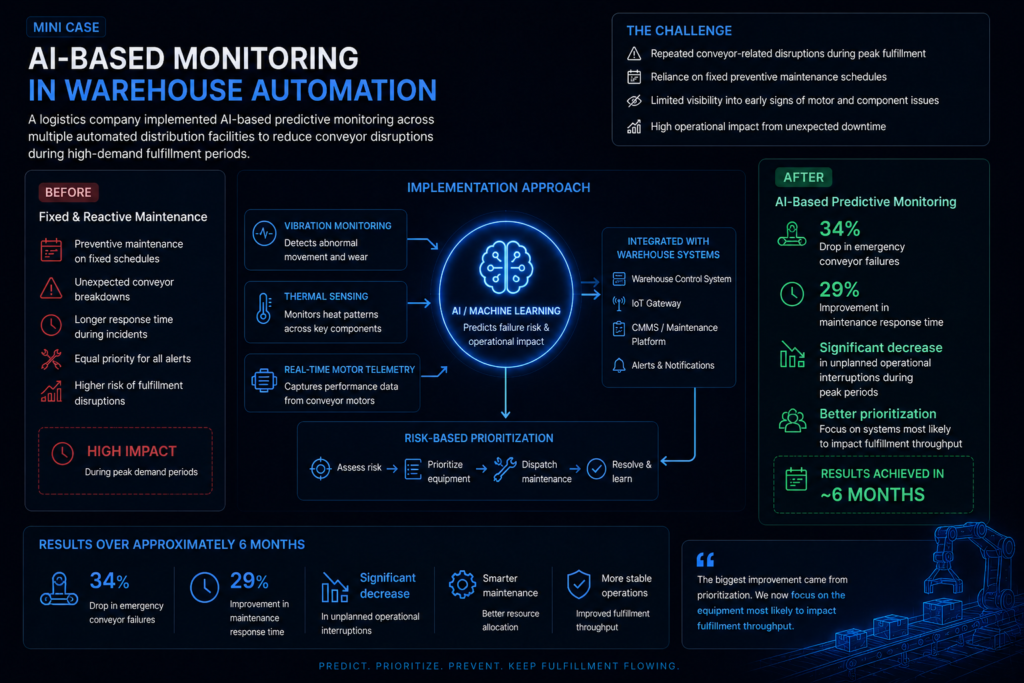
Mini-case: AI-based monitoring in warehouse automation
Following repeated conveyor-related disruptions during high-demand fulfillment periods, a logistics company introduced AI-based predictive monitoring across several automated distribution facilities.
The company integrated:
- vibration monitoring,
- thermal sensing,
- and real-time motor telemetry
into a machine-learning platform connected to warehouse control systems.
Instead of depending only on fixed preventive maintenance schedules, the system continuously prioritized equipment based on predicted failure risk and potential operational disruption.
Within approximately six months:
- emergency conveyor failures reportedly dropped by 34%,
- maintenance response time improved by 29%,
- and unplanned operational interruptions during peak periods decreased significantly.
The largest improvement came from prioritization. Maintenance teams no longer responded equally to every equipment alert and instead focused on systems most likely to affect fulfillment throughput.
But AI doesn’t eliminate operational challenges
AI-driven predictive maintenance systems have become significantly more sophisticated, but implementation quality still determines whether they produce reliable operational results.
Many industrial environments continue struggling with issues such as inconsistent telemetry, fragmented system integration, incomplete maintenance histories, and unstable asset labeling — all of which can reduce predictive accuracy.
Many companies also underestimate:
- alert fatigue,
- sensor drift,
- false positives,
- and cybersecurity risks tied to connected industrial infrastructure.
Because of this, successful AI-driven maintenance programs usually combine:
- predictive analytics,
- human oversight,
- operational escalation logic,
- and traditional preventive maintenance workflows together.
What are the cost implications of predictive and preventive maintenance approaches?
The cost discussion around maintenance strategies is often oversimplified.
Predictive maintenance is frequently presented as the “advanced” option, while preventive maintenance is treated as outdated or inefficient. In reality, economics is much more dependent on operational context.
Preventive maintenance usually costs less to implement initially.
Most facilities can build preventive maintenance workflows using:
- technician schedules,
- inspection routines,
- maintenance software,
- and planned servicing intervals.
There is no immediate need for:
- sensor networks,
- industrial IoT infrastructure,
- AI analytics platforms,
- or large telemetry environments.
That simplicity matters operationally.
For many companies, especially mid-sized facilities, preventive maintenance remains manageable because the process is already familiar to maintenance teams and easier to coordinate operationally.
The downside is that preventive maintenance also creates invisible costs.
Equipment may be serviced too early.
Production lines may stop for inspections unnecessarily.
Perfectly functional components may be replaced simply because the schedule requires it.
Across large facilities, those inefficiencies become expensive over time.
Predictive maintenance changes where the money is spent.
Instead of allocating more cost toward routine servicing, companies invest more heavily in:
- sensors,
- connectivity,
- analytics infrastructure,
- AI monitoring systems,
- and operational integration.
That infrastructure is not cheap.
Many industrial deployments also require:
- SCADA integration,
- cybersecurity upgrades,
- edge computing,
- cloud storage,
- and telemetry management.
But the financial tradeoff changes when downtime becomes extremely expensive.
A failed conveyor in a warehouse may delay fulfillment throughput.
A failed transformer may interrupt utility service.
A failed robotic system may stop an automotive production line completely.
Under those conditions, preventing even a small number of major failures can justify predictive maintenance investment surprisingly quickly.
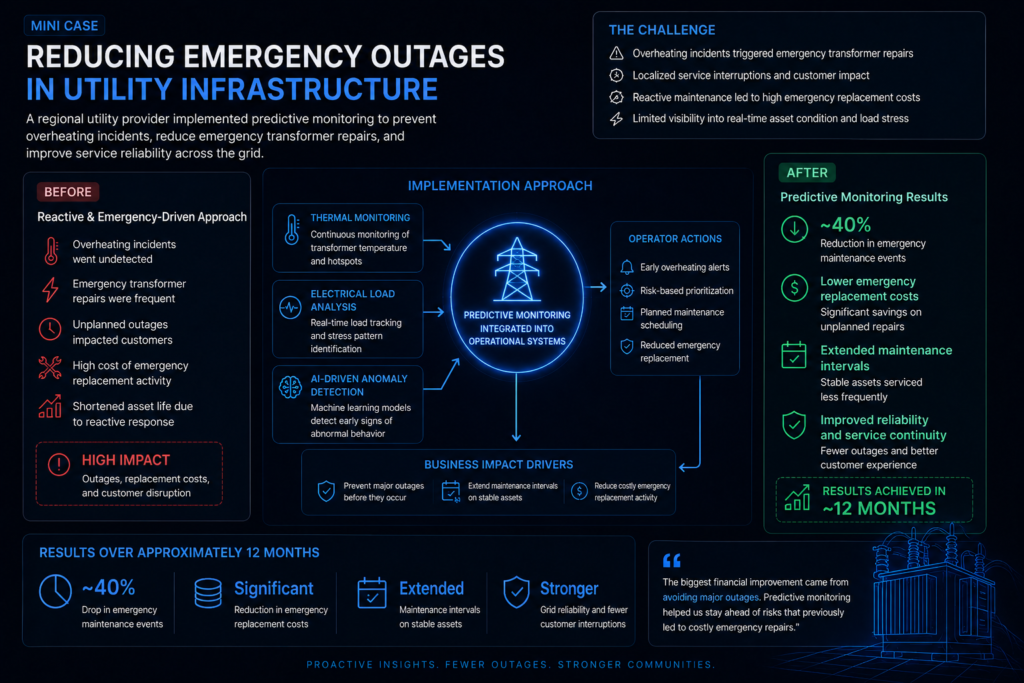
Mini-case: Reducing emergency outages in utility infrastructure
A regional utility provider introduced predictive monitoring after several overheating incidents caused emergency transformer repairs and localized service interruptions.
The company deployed:
- thermal monitoring,
- electrical load analysis,
- and AI-driven anomaly detection integrated into existing operational systems.
Within roughly a year, emergency maintenance events reportedly dropped by nearly 40%. More importantly, operators reduced costly emergency replacement activity and extended maintenance intervals on stable assets.
The biggest financial improvement came from avoiding major outages rather than reducing maintenance labor directly.
Why many companies still combine both approaches
For all the advantages of predictive maintenance, not every asset justifies continuous monitoring.
Many organizations continue relying on preventive maintenance for:
- HVAC systems,
- backup infrastructure,
- low-risk motors,
- and stable equipment with predictable wear behavior.
For many organizations, the strongest long-term results come from combining both approaches according to operational risk and asset criticality.
How can companies calculate the return on investment (ROI) for predictive and preventive maintenance strategies?
In practice, maintenance ROI usually comes down to one question:
“Does the maintenance strategy reduce larger operational losses?”
For preventive maintenance, calculations are relatively straightforward.
Companies compare:
- scheduled maintenance costs,
- planned downtime,
- labor requirements,
- and replacement-part expenses
against the cost of unexpected equipment failures.
Predictive maintenance is more complex because the investment extends beyond maintenance itself.
Organizations may need:
- sensors,
- telemetry infrastructure,
- AI monitoring systems,
- integration with operational platforms,
- and ongoing analytics support.
The financial value comes from avoiding:
- production interruptions,
- emergency repairs,
- delayed fulfillment,
- energy inefficiencies,
- and secondary equipment damage.
Most companies, therefore, measure predictive maintenance ROI through operational metrics such as:
- reduced unplanned downtime,
- fewer emergency maintenance events,
- improved uptime,
- and a longer equipment lifespan.
For many industrial operators, the strongest ROI appears when predictive monitoring is focused on assets where downtime creates disproportionate operational cost.
What are the risks in companies that rely on predictive maintenance?
The growth of industrial AI has increased interest in predictive maintenance significantly, but preventive maintenance remains highly effective in many operational settings.
For a large number of companies, structured maintenance schedules still offer a stronger balance between reliability, operational simplicity, and infrastructure cost.
Predictive monitoring systems are also highly sensitive to data quality problems such as:
- sensor drift,
- poor telemetry quality,
- incomplete historical data,
- and fragmented maintenance records
can reduce model reliability and increase inaccurate predictions.
As industrial monitoring environments become more connected, cybersecurity risks become more important as well. Predictive systems often integrate directly with:
- SCADA infrastructure,
- ERP platforms,
- cloud analytics systems,
- and remote monitoring tools.
The more connected predictive maintenance environments become, the more important infrastructure security and operational coordination also become.
AI systems can improve visibility into equipment behavior significantly, but industrial environments are still unpredictable. Certain failures happen too quickly, too inconsistently, or under conditions where historical data provides limited warning.
Because of this, most facilities still rely on a combination of:
- predictive analytics,
- preventive maintenance schedules,
- and direct maintenance-team oversight.
When is preventive maintenance a better choice than predictive maintenance?
Predictive maintenance is increasingly associated with modern industrial AI systems, but preventive maintenance continues to provide strong operational value in many real-world environments.
For many companies, scheduled maintenance still provides a more manageable and cost-efficient operational model.
Not every asset justifies:
- continuous monitoring,
- sensor deployment,
- AI analytics,
- or real-time telemetry infrastructure.
For example, replacing a small motor periodically may simply cost less than building predictive monitoring around it.
Preventive maintenance tends to work best when:
- equipment wear behavior is relatively predictable,
- operational risk is moderate,
- downtime is manageable,
- and maintenance workflows are already stable.
This is why preventive maintenance remains common across:
- commercial buildings,
- HVAC infrastructure,
- backup systems,
- utility support equipment,
- and many mid-sized industrial facilities.
Regulatory requirements also matter.
In heavily regulated sectors, preventive maintenance remains essential because scheduled inspections are frequently required regardless of real-time equipment condition.
For many organizations, this creates a more predictable and operationally manageable maintenance model than fully scaled predictive monitoring alone.
Choosing the right maintenance strategy in 2026
In 2026, the most effective maintenance strategies are rarely fully predictive or fully preventive.
Instead, organizations increasingly combine both approaches according to:
- asset criticality,
- downtime cost,
- infrastructure maturity,
- and operational complexity.
Predictive maintenance delivers the strongest ROI when:
- downtime is expensive,
- equipment failures affect broader workflows,
- and real-time operational visibility creates measurable value.
Preventive maintenance remains highly effective when:
- asset behavior is predictable,
- infrastructure is stable,
- regulatory compliance requires recurring inspections,
- or continuous monitoring infrastructure is difficult to justify economically.
For most industrial operators, the goal is no longer maximizing technology adoption. It is improving operational reliability without introducing unnecessary complexity.
That shift is pushing many organizations toward hybrid maintenance models that combine:
- predictive analytics,
- preventive maintenance schedules,
- AI-driven prioritization,
- and human operational oversight together.
Companies that approach maintenance strategically — instead of treating predictive monitoring as a universal upgrade — will typically achieve stronger long-term ROI and more sustainable operational performance.
At Alltegrio, we work with industrial and enterprise teams to build predictive maintenance systems, operational analytics workflows, and AI-driven monitoring environments tailored to real operational requirements.
That includes:
- predictive analytics integration,
- telemetry infrastructure,
- maintenance workflow automation,
- AI-based anomaly detection,
- and operational visibility across production environments.
If you are exploring predictive maintenance initiatives and want to identify where they can create measurable operational value, schedule a working session with our team.