

What Are Machine Customers and How Do They Affect Your Business?
Machine customers are a result of truly futuristic technological advancements that will completely change the way marketing and sales work. In fact, this AI-powered solution will irreversibly change the face of business as a whole. At this moment, this is only a nascent technology. However, as it’s based on AI, it’s evolving quite fast. We are sure to see these artificial customers becoming commonplace by the end of the decade at the latest.
In this article, we will talk about what are machine customers and why they are so important for businesses to prepare for right now.
AI implementation is already a high-speed chase, and the level of adoption of this tech leaves many businesses behind. The effect of AI-powered customers will be so profound that not being prepared to cater to them might literally ruin your business overnight.
Let’s take a closer look at why it’s so.
A machine customer is any automated process or device that makes purchase decisions and executes a transaction without direct human intervention. Examples we can already see in use include smart appliances, IoT devices, and autonomous vehicles. These machines are embedded with algorithms and data management systems that enable them to assess options and make choices based on user-defined parameters.
What Is the Estimated Impact of Machine Customers on Business?
The concept of machine customers extends beyond simple transactions. These AI-driven solutions also interact with businesses in ways that mimic human customer behavior. For instance, they seek to fulfill specific needs, compare products and services, and even place recurring orders based on previously established patterns. This interaction fundamentally alters the entire fields of customer service, marketing, and sales.
As machine customers become more common, their impacts on the bottom line for businesses will continue to increase. Therefore, any company that wants to stay relevant must re-strategize marketing and sales efforts toward such automated buyers. You can do this by making your algorithms similarly complex and qualified for efficient interaction with an AI-driven buyer.
Product development has to adapt to machine-compatible products as machines replace traditional buyers. Therefore, every production step, from manufacturing and design point to sales and promotion, must be altered to accommodate this new tech advancement. For example, a smart refrigerator now might need to not only order groceries in case supplies run low but also analyze dietary preferences and suggest healthier alternatives for the owner’s eating patterns.
Furthermore, the emergence of machine buyers raises critical questions about data privacy and security. Since these devices collect and process a great deal of personal information to make informed purchasing decisions, the potential for misuse or breaches is a major concern. Companies must implement robust cybersecurity measures and be transparent in handling data to gain consumer trust and ensure that their AI-powered customers can operate safely and effectively. This evolving relationship between technology and consumer behavior is paving the way toward a future where machines will not just be tools but also active participants in the marketplace.
Why Are Machine Customers Important?
Machine customers have become crucial for a variety of reasons. First, they enhance efficiency in multiple operations. Automated purchasing saves time and effort that were previously used on transactions. Therefore, it enables speedy service and smooth operations.
Moreover, automated customers generate a lot of information that can be used for Predictive Analytics. Companies can grasp the trends in customer behaviors and preferences, thus enhancing their offerings and marketing strategies. In an economy that increasingly puts a premium on data-driven decisions, the ability to harness information is a game-changer.
Another reason AI-powered customers matter so much to businesses now is that they drive innovation. Companies implementing Artificial Intelligence and Machine Learning app development services can now build more comprehensive machine customers that can make purchase decisions autonomously. This evolution not only helps improve the buying process but also opens up new perspectives on product development and service delivery.
The rise of AI-driven customers can also lead to improved human customer experiences. With the ability to analyze purchasing patterns and preferences in real-time, businesses can offer products and services that more accurately meet their customers’ needs. This level of personalization may result in greater satisfaction and loyalty.
Prepare for the Rise of Machine Customers
Ensure your business is prepared to face the new level of technological revolution
Contact UsWhat Types of Machines Can Be Customers?
At the moment, an experienced Machine Learning development company can create several types of automated customers. Each of them can serve different functions across various industries. The most common categories include:
| Type | Examples | Features |
| Smart Appliances | Refrigerators, ovens, washing machines, toasters, etc. | Can order supplies, like detergent or food items automatically |
| Industrial Machinery | Manufacturing equipment for various industries | Can order spare parts or raw materials upon reaching a certain threshold of low stock |
| IoT for Autonomous Vehicles | Cars and drones | Can purchase maintenance services or fuel, with route optimization based on real-time data |
| IoT Devices | Wearables, smart home systems, connected devices, etc. | Can interact with various services such as health monitoring and energy management |
Each of these machines works within parameters, but all share one pivotal factor: the capability to make autonomous transactions. They can even go beyond that by integrating other benefits of AI. For example, some smart devices can bring a great efficiency boost for logistics supply chain optimization. They not only offer convenience through ease of use but also contribute toward energy efficiency, as operational activities are performed based on optimal consumption patterns. Meanwhile, an appliance connected to food inventory can recommend recipes with available ingredients and remind users to order groceries upon running out of items.
Industrial machinery is also vital to maintain productivity within a manufacturing environment. These machines can predict when a component is likely to fail and will proactively order the same for replacement, reducing downtime and maintaining a smooth workflow. This predictive maintenance capability saves costs and enhances safety by reducing the likelihood of equipment failure during operation. This technology will continue to evolve as more businesses adopt it, making machine customers even more sophisticated.

How Do Machine Customers Interact with Businesses?
Machine customers have different ways of reaching organizations. The easiest method is an API through which machines will send requests and get information at the back end. With this kind of connection, transactions take place without any delay to make the market more dynamic. The Machine Learning development company that creates the solution will determine the exact method.
All AI-based customers rely on data in decision-making. A smart thermostat will auto-adjust settings and reorder energy-efficient solutions based on usage patterns and utility company data. It uses data inputs to create an optimized purchase for specific needs, adding value for businesses and consumers.
In addition to APIs, machine customers use several advanced Machine Learning algorithms to improve business interactions. This technology makes machines intelligent enough to foresee the need for the future through past evidence and, hence, shop in advance. If you want to learn more about ML development services’ capabilities, check out this article.
For example, a fleet management system might use data on how vehicles have performed to make an early booking for their maintenance before the breakdown. This predictive capability simplifies operations and gives rise to a more reactive relationship between machines and service providers.
Additionally, machine customers are adopting blockchain technology more and more to ensure secure and transparent transactions. Interactions recorded on a decentralized ledger enable machines to verify the authenticity of transactions without intermediaries. This will help build trust between businesses and machine customers, reducing fraud risks. With industries continuing to adopt these technologies, the landscape of machine-to-business interactions is rapidly changing, making way for even more innovative solutions and customer experiences.
What Data Do Machine Customers Generate?
Machine customers can generate and collect a wide variety of data. This could include a history of transactions, usage patterns, environmental conditions, and even predictive metrics computed from historical data. This data collection and analysis yield important insights about customer behavior and market demand.
For example, smart refrigerators monitor your buying habits and set trends for meal prep and grocery purchases. These insights can help companies develop focused marketing strategies by tailoring promotions to best resonate with their customer base.
Besides buying habits, AI-powered customers also generate data from operational efficiency. For example, smart thermostats are able to monitor in real-time how much energy a place is using, allowing both the consumer and utility companies to see peak hours and possible areas of cost savings. This helps the consumer manage energy use more effectively and allows utility companies to optimize their energy distribution strategies efficiently. It can enable demand-response programs whereby businesses and other users are incentivized to reduce consumption during peak periods, thus helping to develop a more sustainable energy ecosystem.
In addition, integration with ML development services lets businesses forecast future behaviors from data emanating from autonomous customers. For example, connected vehicles can capture data on driving habits, maintenance needs, and even traffic patterns. This could be useful in enhancing the safety features of vehicles, improving their navigation systems, and even informing insurance companies about risk assessment. As a result, the insights derived from AI-driven customers enhance the user experience and drive innovation across various industries, paving the way for smarter, more interconnected products and services.
Future-Proof Your Business for Machine Customers
Learn how to make the most of this new technology and make it work for you
Book a MeetingHow Can Businesses Identify and Understand Machine Customers?
Machine customer identification requires a set of technological tools and associated data analytics services. A business has to institute systems through which machine interactions can be tracked and data points assembled. Using sophisticated algorithms, businesses should be able to segment autonomous customers based on behavior, preferences, and buying patterns. This segmentation also provides a clear platform for target marketing strategies. Moreover, it can aid in inventory management and supply chain logistics, ensuring efficient utilization of resources to meet demands from these automated entities.
Machine Learning algorithms can also be used to gain valuable insights. By running large volumes of historical data through these systems, companies can predict how machines will behave in the future and adjust their offerings to meet those needs. The idea is to provide a frictionless experience that meets the unique needs of machine customers. This predictive capability is especially critical for industries such as manufacturing and logistics, where insights into machine downtime and maintenance needs can drive significant cost savings and improvements in operational efficiency.
In addition, real-time data analytics enables the capture of machine interactions in real-time. This dynamic nature empowers companies to react immediately whenever machine behaviors or preferences change, with the goal of keeping enterprises competitive in a dynamic environment. For example, if an AI-driven customer constantly chooses the same type of component or service, businesses can automatically readjust their inventories and marketing efforts to provide a more tailored and timely relationship.
Moreover, the integration of the Internet of Things (IoT) can considerably extend this identification process. The results from IoT devices can stream continuous data of machine performance, usage patterns, and even environmental conditions affecting operations. Therefore, businesses will have greater knowledge about the operating context in which their automated customers work and should be able to make suggestions for even more tailored solutions.

How Can Businesses Prepare for the Rise of Machine Customers?
Preparing for the rise of AI-powered customers requires a strategic approach. First, businesses need to invest in technologies that will allow the seamless integration of machine learning and analytics. This infrastructure will provide a conduit for real-time transactions and data accumulation. Big data will, in turn, aid in analyzing consumer behavior and preferences. This, in turn, will allow businesses to target their offerings. Anticipating what a customer might need, even before the need arises, would be an edge in today’s fast-changing market.
Companies should also forge partnerships with technology providers and platforms that specialize in IoT and automation. Such partnerships would be beneficial in offering the required know-how to lead through this new landscape.
Staff training to understand these technologies and their implications for customer interactions is equally important. The training should focus not only on the technical aspects but also on maintaining a human touch in customer service as machines become increasingly used for more transactional roles. Workers will need to be encouraged to interact with machine customers in ways that enhance the overall experience rather than detract from it as automated systems come into play.
Additionally, businesses also have to take into consideration the ethics of machine customers. As AI systems become increasingly intertwined in the purchase cycle, issues such as data privacy and algorithmic bias will arise. Companies should establish clear policies that would guide customer data use, thus ensuring transparency and building trust among their clientele.
Regular auditing of AI systems will help find and reduce the biases that arise, making customer service more inclusive. By taking proactive approaches to such issues, businesses can position themselves as leaders in ethical AI practices, further enhancing their brand reputation in an increasingly tech-driven marketplace.
What Businesses Benefit from Serving Machine Customers?
Many different industries have something to gain by serving machine customers. Some of these include:
- Retail and E-commerce
Smart appliances that initiate inventory management and reordering, enhancing the smart supply chain. - Manufacturing
Machines independently ordering their parts minimize downtime and maximize production schedules. - Healthcare
Devices monitoring patient health and automatically ordering medication or services improve patient outcomes. - Transportation
Autonomous vehicles create routes that prioritize efficiency and benefit from logistics and delivery services.
The integration of machine customers enables businesses to optimize their operations and enhance customers’ satisfaction with more exact and timely responses to their needs.
Moreover, the financial benefits of serving machine customers are huge. By applying data analytics and Machine Learning, businesses can forecast trends and customer behaviors with uncanny accuracy. For example, retailers can analyze purchasing patterns from smart fridges to tailor their marketing strategies, ensuring that promotions align with consumer preferences. This drives sales and fosters a deeper connection between brands and their customers, as consumers feel understood and valued.
This enables new business models, such as subscription services in which machines automatically reorder supplies based on usage rates. The shift ensures a continuing revenue stream for businesses while offering greater convenience to consumers, who will not have to worry about running out of key items. As technology continues to evolve, new revenue opportunities and gains in operational efficiencies will increase, meaning businesses will need to be much more adept at adapting and innovating in a machine-driven world.

When Will Machine Customers Become Widespread?
This technology is not yet mainstream, and it’s largely dependent on three major conditions:
- Technical advancements
- Regulatory factors
- Market acceptance.
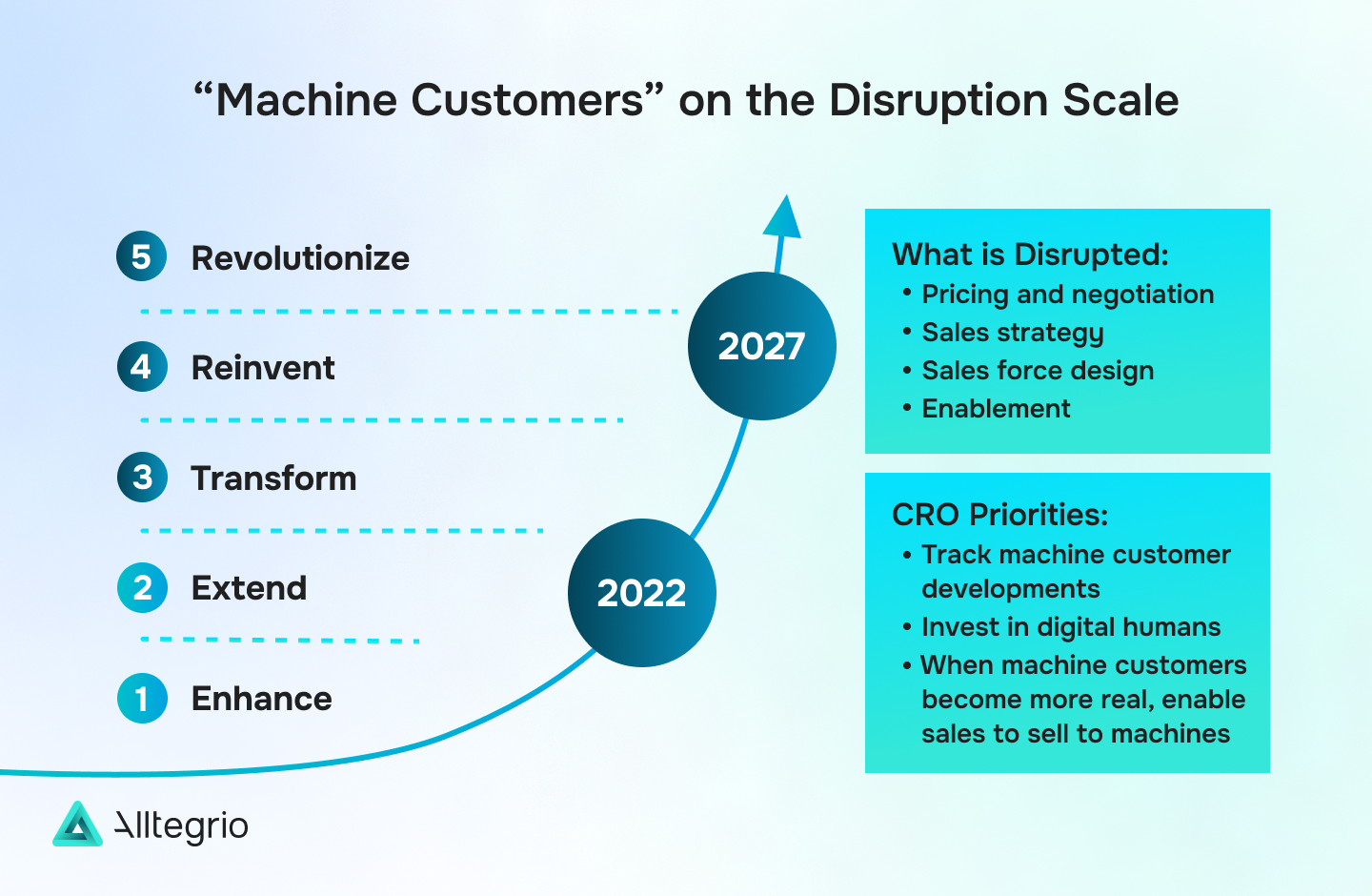
According to industry analysts, we have already reached a point beyond which growth in this sector will rise steeply. By the end of 2030, Machine customers could be as much a feature of the marketplace as conventional customers.
This evolution results from the continuous expansion of IoT devices and improvements in AI technologies. In fact, as more industries recognize the value of efficiency and data analysis brought about by machine customers, the adoption rate is likely to increase significantly.
The integration of AI-driven customers across industries will probably bring about a change in customer service paradigms. For instance, in retail, machine buyers would work out purchasing patterns in real-time to enable businesses to tune their offerings and promotions with the same speed. Personalization at this level, enabled by machine learning algorithms, may increase customer satisfaction and loyalty, creating a more dynamic shopping experience.
Apart from retail, this machine customer effect will also take place in the healthcare and transport industries. In the healthcare industry, this could imply that through automated data collection and collation of patients, diagnoses are performed quicker and treatment pathways established. In transport, machines would act as customers for transport services, whereas autonomous vehicles would change the way logistics and delivery systems operate: cheaper more efficient.
With each passing day and growing insight, these technologies evolve further. Therefore, the landscape of customer interaction will dramatically change toward the reality of machine customers at almost every level of life routine.
How Can Businesses Prepare to Offer Their Services and Products to Machine Customers?
Businesses must prepare in advance for engagement with AI-powered customers by enacting stringent data management policies that deal with the volumes of generated information. Systems must be capable of processing data efficiently and quickly to support real-time decision-making.
In addition, it is essential that organizations develop customized marketing strategies to suit automated customers’ behaviors. Understanding their particular needs and preferences will be critical to success. Equally important will be the need for collaboration with technology partners to develop innovative solutions to their needs.
The rise of AI-powered customers presents a special opportunity for businesses that can change with the dynamic environment. If an organization understands the nature of machine customers and the data they generate, it will be able to enhance operational efficiency and responsiveness.
This revolution in customer interaction calls for forward-thinking approaches and investment in technology that support automated transactions. Embracing automated customers is not a fad but one sure pathway to future growth and innovation across industries.
'%3E%3C/rect%3E%3Cpath d='M21.0079 11.1156L21.6244 11.1841C24.4986 11.5025 26.6656 13.982 26.6656 16.9507V24.7908C26.6656 26.3373 27.4992 27.7759 28.8412 28.5458C28.957 28.6124 29.0564 28.7011 29.1345 28.8053H12.8746C12.9528 28.7011 13.0521 28.6124 13.1679 28.5458C14.51 27.7768 15.3436 26.3383 15.3436 24.7908V16.808C15.3436 13.9145 17.5095 11.4967 20.3827 11.1831L21.007 11.1146M21.0041 8.5C20.5902 8.5 20.2554 8.83575 20.2554 9.24869V10.0147C16.8323 10.3881 14.1684 13.2854 14.1684 16.808V24.7908C14.1684 25.9206 13.5635 26.9635 12.5832 27.526C11.9137 27.91 11.5007 28.622 11.5007 29.3939C11.5007 29.718 11.7632 29.9805 12.0873 29.9805H29.9199C30.244 29.9805 30.5065 29.718 30.5065 29.3939C30.5065 28.622 30.0935 27.91 29.424 27.526C28.4437 26.9645 27.8388 25.9206 27.8388 24.7908V16.9507C27.8388 13.4138 25.2048 10.3987 21.7518 10.0157V9.24869C21.7518 8.83479 21.417 8.5 21.0041 8.5Z' fill='white'%3E%3C/path%3E%3Cpath d='M21.0041 8.5C20.5902 8.5 20.2554 8.83575 20.2554 9.24869V10.0147C16.8323 10.3881 14.1684 13.2854 14.1684 16.808V24.7908C14.1684 25.9206 13.5635 26.9635 12.5832 27.526C11.9137 27.91 11.5007 28.622 11.5007 29.3939C11.5007 29.718 11.7632 29.9805 12.0873 29.9805H29.9199C30.244 29.9805 30.5065 29.718 30.5065 29.3939C30.5065 28.622 30.0935 27.91 29.424 27.526C28.4437 26.9645 27.8388 25.9206 27.8388 24.7908V16.9507C27.8388 13.4138 25.2048 10.3987 21.7518 10.0157V9.24869C21.7518 8.83479 21.417 8.5 21.0041 8.5Z' fill='white'%3E%3C/path%3E%3Cpath d='M23.582 31.1199H18.426C18.5698 32.4166 19.6687 33.4267 21.004 33.4267C22.3393 33.4267 23.4382 32.4175 23.582 31.1199Z' fill='white'%3E%3C/path%3E%3Cdefs%3E%3ClinearGradient id='paint0_linear_1536_57632' x1='0' y1='0' x2='42' y2='42' gradientUnits='userSpaceOnUse'%3E%3Cstop stop-color='%2300CBBF'%3E%3C/stop%3E%3Cstop offset='1' stop-color='%23007DFE'%3E%3C/stop%3E%3C/linearGradient%3E%3C/defs%3E%3C/svg%3E)