

Overcoming Integration Challenges: Implementing AI in Legacy Logistics Systems
What Is AI Integration in Logistics Systems?
Fast-paced and brutal competition is the name of the game in business today, so integrating AI logistics solutions has become an essential tool for winning. While the benefits of AI are clear, the journey toward integration is fraught with challenges that need to be resolved strategically.
AI integration in logistics systems refers to embedding Artificial Intelligence technologies into existing logistics frameworks. This leads to better operational efficiency, decision-making, and supply chain management. AI can automate repetitive tasks, enhance data analysis, and improve predictive capabilities, resulting in faster and more cost-efficient business operations.
AI in supply chain management in particular, can optimize routes, manage inventories, forecast demand, and predict potential disruptions. By transforming these traditional processes via AI integrating in logistics your business can create an agile and responsive environment.
Perhaps the biggest benefit of integrating AI into operations is its ability to process large volumes of data in real-time. This gives logistics companies access to valuable insights into customers’ behavior, market trends, and operational bottlenecks. For example, Machine Learning models can process historical shipping data to identify patterns and suggest the most efficient delivery schedules. Furthermore, AI can facilitate dynamic pricing strategies by analyzing competitor pricing and demand fluctuations. This ensures that your company can remain competitive while maximizing profit margins.
Moreover, AI can power customer service in logistics systems. Chatbots driven by Natural Language Processing can handle customer inquiries at any time of the day and instantly answer frequently asked questions about order status, delivery times, and product availability. AI can also analyze customer feedback and sentiment to improve service offerings and proactively address pain points. This level of responsiveness not only enhances customer satisfaction but also engenders loyalty. Your clients will surely appreciate the seamless and efficient service that AI-driven logistics can provide.

Why It’s Important to Integrate AI in Logistics Systems?
If you wonder how is AI improving logistics, consider the following:
- It enhances a firm’s operational efficiency by automating time-consuming tasks and reducing human error. This leads to better resource allocation and cost savings.
- AI provides capabilities for top-quality Data Analytics services. Logistic operations involve a huge amount of data. AI’s analytical capability draws valuable insights for making wiser decisions. It makes it easier for organizations to respond to market fluctuations in record time and stay competitive.
- AI can significantly enhance demand forecasting, which is crucial for inventory management. AI logistics tools can predict future demand by analyzing historical sales data, market trends, and even social media sentiment with remarkable accuracy. This predictive capability allows companies to optimize their inventory levels. Therefore, you can reduce the risk of overstocking or stockouts, which can be detrimental to customer satisfaction and profitability.
- AI-driven logistics systems can improve transportation route optimization. By leveraging real-time traffic data, weather conditions, and vehicle performance metrics, AI can suggest the most efficient routes for delivery trucks. This alone can reduce fuel consumption and transportation costs while ensuring timely deliveries, which is crucial in today’s competitive market.
As you can see, AI solutions for logistics improve service on multiple levels. Therefore, they help you develop good relationships with your customers, commanding loyalty and repeat business.
Upgrade Your Legacy Logistics Systems
Make sure your business is ready to face modern challenges and grow fast in the digital world.
Book a ConsultationWhy Businesses Use Legacy Logistics Systems?
Businesses rely on legacy logistics systems in a number of instances because they’ve been operating like this for years and have decades of data and associated processes tied up in them. The majority of companies are quite hesitant to start adopting AI in logistics on grounds such as cost, complexity, and uncertainty related to leaving behind established systems.
Besides, legacy systems usually represent big investments in technology that organizations want to protect. There is also a psychological comfort in familiarity with traditional processes, even if they may not be as efficient as contemporary alternatives.
Besides, the integration of legacy systems into the general business framework can result in a web of dependencies that complicate any potential transition. Employees are accustomed to the workflows and functionalities of these systems, and retraining staff on new technologies can be daunting.
The fear of disrupting operations during the transition period often causes businesses to delay or altogether avoid upgrading their logistics systems. Furthermore, many legacy systems have been customized over the years to meet specific business needs, making them unique to the organization. This customization can lead to a perception that new systems will not meet the same level of specificity or performance, further entrenching the reliance on older technologies.
Furthermore, regulatory compliance and industry standards can play a big role in deciding to keep legacy systems. Legacy systems that have been adapted to meet these requirements seem more reliable than newer systems that may not yet have proven their compliance capabilities. This is the paradox: businesses are compelled to stick with the devil they know, technologies that are outdated, rather than risk the unknowns associated with adopting AI in supply chain management and logistics.
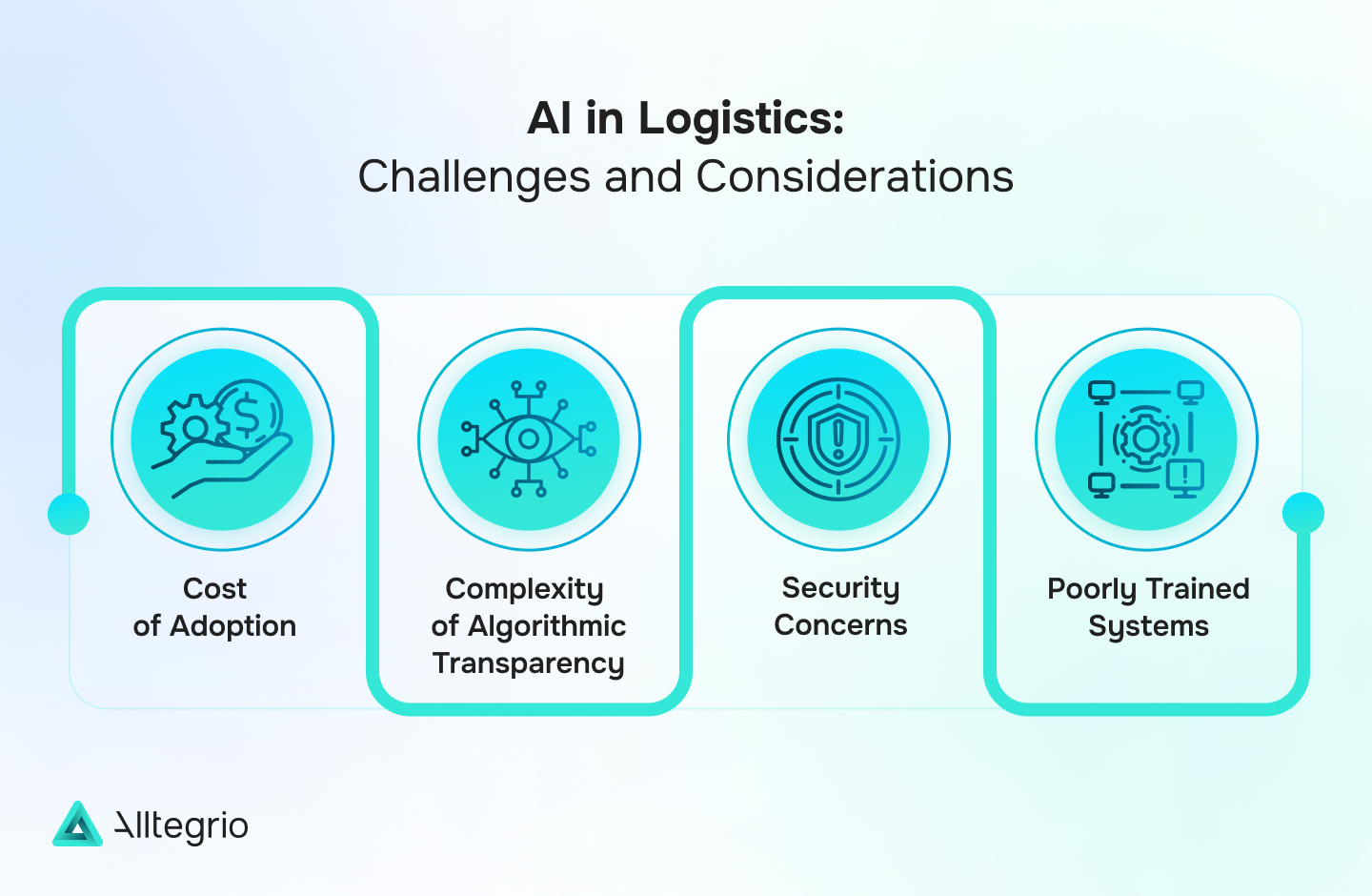
What Are the Main Obstacles When Integrating AI into Legacy Logistics Systems?
Some major hurdles always prevent AI integrating in logistic legacy systems:
- The most common one is a lack of interoperability between old and new technologies. Most of the time, old legacy systems cannot support advanced AI applications, making it necessary to overhaul the operation completely.
- Another challenge is data quality and availability in legacy systems. Poor-quality or siloed data will compromise the power of the algorithms feeding the AI applications. This might result in bad insights and decisions.
- Additionally, cultural resistance to change within organizations can pose a significant barrier. Employees accustomed to traditional methods may be hesitant to adopt AI-driven processes, fearing job displacement or the complexities of new technologies. This resistance can slow down the integration process, necessitating comprehensive training programs and a change in management strategies to foster a more adaptive workplace culture.
- Moreover, the initial investment for integrating AI solutions for logistics into core systems is huge. An organization may incur heavy expenses on upgrading software, purchasing hardware, and recruiting experts. This can discourage businesses from undertaking an AI initiative due to uncertainty in the returns on investment. Most firms might find themselves in an awful cycle of hesitation and further reduce the capability of AI for totally changing logistics.
However, while all these challenges are valid concerns, you should never forget that implementing AI logistics tools can bring exceptional benefits. These include savings that make these tools highly cost-efficient in the long run. As the market is getting more competitive, those who embrace all the advantages of AI and capitalize on them early have a higher chance of success.

How Can Businesses Assess Their System’s Compatibility with Modern AI Solutions for Logistics?
The first thing to do if you decide to embark on the journey of integrating AI in supply chain management and logistics is to run a compatibility test. It starts with a comprehensive audit of the existing logistics systems used by your business. This includes auditing hardware, software, data storage, and processing capabilities.
Organizations should identify gaps that could hinder AI implementation. It is not only important to look at the current state of technology but also to consider scalability in the future. As AI solutions for logistics continue to evolve, businesses should ensure their infrastructure is agile enough to adapt to new updates and innovations without needing a complete overhaul.
Participation in pilot projects is also essential. This way, AI solutions can be applied to smaller areas of the enterprise to evaluate how they actually fit with the existing systems and what kind of modification might be necessary. While executing such pilot projects or MVPs, feedback needs to be taken from every kind of stakeholder: logistics personnel, IT staff, and end-users. This feedback might give much-needed insight into the hands-on challenges and benefits of integrating AI logistics tools. Therefore, feedback helps you refine the approach before a full rollout.
In addition, businesses should not forget the importance of data quality and accessibility in their assessment process. AI systems thrive on high-quality data. Therefore, organizations should ensure that their data is clean, structured, and readily available for analysis.
This may involve investing in data management tools or processes to improve data collection and storage practices. Moreover, additional staff training on how to work with AI tools and interpret data generated by them contributes to better compatibility and effectiveness of the proposed AI solutions for logistics. To learn more about the data you’ll need to collect to implement AI in supply chain management and logistics, download our free e-book.

How Do Outdated Software and Hardware Components in Legacy Systems Hinder AI Integration Efforts?
Outdated software can lead to processing power and speed limitations, which is a critical issue for running modern AI algorithms. If the legacy system cannot handle large datasets or the complexity of AI models, integration will inevitably fail.
Another problem is that legacy hardware was designed in a way that lacks technical prerequisites for hosting infrastructure from any AI solution. Common issues include slow processing speed, absence, or complete memory scarcity, which usually provokes delays and inefficiencies when using AI logistics tools.
Besides, another challenge comes with compatibility between the legacy system and newer technologies. Most legacy systems are designed for specific functionalities and may not support APIs or data formats of modern AI tools. In this case, it is a bottleneck, and extra resources must be spent to bridge the gap between old and new technologies.
Additionally, when updates and patches are not done on time in older software, systems may be exposed to security vulnerabilities. Therefore, they become targets of cyber threats. This alone compromises data integrity and compliance in industries that deal with sensitive information.
Moreover, knowledge gaps within an organization can further complicate the AI logistics integration process. Since technologies are constantly changing, the workforce may not have the necessary skills to keep both legacy systems and new AI solutions running. This puts an organization in a precarious situation, relying on an increasingly smaller pool of experts knowledgeable in outdated technologies. In the process, organizations may find themselves stuck in a vicious circle wherein they cannot fully exploit AI capabilities due to the limitations imposed by their old systems.

Why Is It Important to Think About Data for Successful Implementation of AI in Logistics?
Data is the lifeblood of AI solutions for logistics. Without high-quality, relevant, and accessible data, AI just cannot perform optimally. The key to successful AI integration in logistics is clean, comprehensive data reflecting real operations and market conditions.
In addition, it is essential to establish effective data governance practices for businesses planning to use AI. This ranges from how data is collected and stored to how it is managed so that AI has the best possible foundation to make informed decisions.
Moreover, the dynamic nature of logistics requires that data be updated and analyzed constantly. Real-time data feeds from various sources, such as GPS tracking, inventory management systems, and customer feedback, can substantially improve the performance of AI algorithms. For example, by using real-time data, AI in supply chain management can optimize routing for delivery trucks, thus reducing fuel consumption and improving delivery times. This not only leads to cost savings but also enhances customer satisfaction by ensuring timely deliveries.
Besides, the integration of advanced analytics and machine learning models can provide predictive insights that are invaluable in logistics. By analyzing historical data trends, AI can predict demand fluctuations, enabling businesses to adjust their inventory levels and workforce accordingly. This proactive approach minimizes the risk of stockouts or overstock situations, thus making the supply chain more efficient. As companies are getting increasingly dependent on data-driven strategies, strong data management practices cannot be emphasized enough because they form the foundation of any AI solutions for logistics.
Boost Your Logistics Business
Integrate AI to speed up operations, cut costs, and reduce risks.
Contact UsHow to Organize the Process of Integrating AI Solutions in Legacy Logistics Systems
AI integration can be achieved through structured approaches. This process might go as follows:
- First, you will need to build a team of expert IT professionals and data scientists who will work with the representatives of your business to ensure a smooth and efficient integration.
- The team must develop a clear roadmap that includes timelines, milestones, and measurable outcomes. Continuous communication with all stakeholders is essential to facilitate a smooth transition when integrating AI solutions for logistics.
- Perform an in-depth evaluation of the prevailing logistics systems. This implies the identification of pain points, inefficiencies, and spots where AI will add considerable value. In this way, the present landscape will be understandable. At the same time, the team will prioritize AI applications that match business objectives, like optimizing supply chain management, increasing the efficiency of inventory tracking, or perfecting demand forecasting. Note that leveraging MVP development can provide valuable insights and allow adjustments before full-scale implementation.
- Training and upskilling the existing staff is an indispensable part of the AI logistics integration process. The employees must have the necessary knowledge and toolset to interact with the AI technologies effectively. This can be achieved through multiple workshops, online courses, or hands-on training, focusing on both the purely technical aspects of the proposed AI solutions and the way strategic thinking can be activated to take advantage of the solutions in daily operations.
Last but not least, don’t forget that your business culture is key to success when upgrading legacy systems to meet contemporary challenges. Therefore, your company should ensure that your work culture is attuned to innovation and changeability to make the workforce not only ready but eager to enjoy the benefits of AI logistics solutions.

What Are the Risks of AI Integration in Legacy Logistics Systems?
Obviously, there are inherent risks in integrating AI into any legacy system. These commonly include challenges in technology migration, data privacy, and business disruption during the transition. Moreover, implementing AI in supply chain management might cause resistance among the workforce that is accustomed to traditional ways of operation.
It is also essential to be aware that AI logistics technology will continue to evolve. Therefore, businesses must commit to ongoing improvements and updates beyond the initial integration phase.
Besides, the complexity of legacy systems can create significant barriers to compatibility with AI solutions for logistics. Most of the older systems were never designed to bear the load of modern data processing that may be required by an AI solution. Therefore, their inherent inefficiencies might result in complete failure in the implementation of AI-driven functionalities. This could require heavy customization or even a complete overhaul of the existing systems.
Moreover, the integration process may expose vulnerabilities in the legacy systems that were previously unnoticed. This might result in security breaches or data loss if not managed appropriately.
Another critical issue that needs deliberation involves the ethical effects of deploying AI logistics solutions. As AI systems become more self-decisional, bias in algorithms becomes a critical issue that impacts operation fairness and transparency For example, if AI is trained from historical data that has biases in them, then the AI might end up giving recommendations or taking action based on those biases resulting in monetary and perhaps reputational losses for the company.
How to Measure the ROI of AI Integration in Logistics Processes?
Measuring the return on investment of AI in supply chain management and logistics integration is a nuanced and multi-faceted process. Organizations can start by pinpointing key performance indicators that match their logistics objectives, such as reduced delivery times, lower operational costs, or improved inventory turnover rates.
Data analytics can also be critical in tracking the performance of AI logistics solutions over time. Establishing a pre-integration baseline will help highlight the improvements and quantify benefits accrued through AI technologies.
Companies should complement traditional KPIs by using qualitative measures reflecting customer satisfaction and employee engagement. For example, AI can improve customer experience through real-time tracking information and personalized delivery options. This might increase customer retention. Similarly, automating routine tasks frees the workforce to work on more strategic initiatives, improving job satisfaction and productivity.
Besides, long-term implications regarding AI integration have to be considered. That includes assessing how AI solutions for logistics can enhance the supply chain in terms of resilience and adaptability to any kind of disruption. It would require the analytics of past data and forecasts for future trends that provide companies with a clear view of how AI-driven insights result in better decision-making, leading to a more agile logistics operation. The ability to pivot fast can be a big differentiator in response to changing markets, which makes the investment in AI technologies more valuable.

What Cases and Insights on Integrating AI Solutions into Logistics Can Our Experts Share?
Quite a few companies have already found an answer to the question of ‘how is AI improving logistics?’ At Alltegrio, we have a case example where we helped a railway company ensure code compliance with ERTMS standards using AI. The solution is cloud-based and powered by a custom tool powered by generative AI. It helped the client to greatly increase operational efficiency and improve security.
Some other stellar examples of implementing AI in supply chain management and logistics come from renowned brands such as:
- DHL is using AI for demand forecasting and route optimization. There is also publicly-shared information that the company implements AI logistics tools for warehouse automation.
- UPS has the ORION (On-Road Integrated Optimization and Navigation) system powered by AI and ML algorithms that also assist with package volume forecasting.
- Amazon uses AI for route planning and demand forecasting. It also implements AI logistics solutions powered by Computer Vision to implement robots in their warehouses.
- Maersk collaborates with IBM to develop an AI-powered blockchain platform. It’s a suburb example of AI in supply chain management as it increases visibility of the chain assisting in documentation and cargo tracking.
- XPO Logistics is using collaborative robots (cobots) powered by Computer Vision and AI to help with sorting and packing within warehouses.
- JD Logistics is a Chinese company that is already using AI-powered delivery drones both in remote and urban areas.
As you can see, industry leaders are already using AI solutions for logistics across multiple processes. However, this technology is now affordable even to those far from the top 10 within their niche. So, don’t be afraid to explore your options regarding AI integration in logistics.
Why You Should Consider AI Integration in Legacy Logistics Systems?
Upgrading legacy logistics systems has become paramount for maintaining an edge in this increasingly competitive business. Today, more and more companies realize the power of AI in supply chain management optimization. Therefore, standing still will definitely make you fall behind the market trends and customer expectations.
Investing in a modern AI logistics system development not only serves as a means for innovation but also provides operational resilience and adaptability. Simply put, it enables your business to withstand future tests in an ever-evolving digital environment.
An organization should take a gradual approach to integrate AI solutions for logistics seamlessly. First, small-scale pilots should be implemented to see how AI affects your processes. Then, you need to evaluate results and make necessary adjustments before full implementation.
Moreover, emphasizing cross-functional collaboration between IT, operations, and data analytics departments will ensure better communication and problem-solving during the integration process. So, if you want to make sure your logistics business is ready to grow and succeed in the progressively digitalized world, give us a call for a free consultation!
'%3E%3C/rect%3E%3Cpath d='M21.0079 11.1156L21.6244 11.1841C24.4986 11.5025 26.6656 13.982 26.6656 16.9507V24.7908C26.6656 26.3373 27.4992 27.7759 28.8412 28.5458C28.957 28.6124 29.0564 28.7011 29.1345 28.8053H12.8746C12.9528 28.7011 13.0521 28.6124 13.1679 28.5458C14.51 27.7768 15.3436 26.3383 15.3436 24.7908V16.808C15.3436 13.9145 17.5095 11.4967 20.3827 11.1831L21.007 11.1146M21.0041 8.5C20.5902 8.5 20.2554 8.83575 20.2554 9.24869V10.0147C16.8323 10.3881 14.1684 13.2854 14.1684 16.808V24.7908C14.1684 25.9206 13.5635 26.9635 12.5832 27.526C11.9137 27.91 11.5007 28.622 11.5007 29.3939C11.5007 29.718 11.7632 29.9805 12.0873 29.9805H29.9199C30.244 29.9805 30.5065 29.718 30.5065 29.3939C30.5065 28.622 30.0935 27.91 29.424 27.526C28.4437 26.9645 27.8388 25.9206 27.8388 24.7908V16.9507C27.8388 13.4138 25.2048 10.3987 21.7518 10.0157V9.24869C21.7518 8.83479 21.417 8.5 21.0041 8.5Z' fill='white'%3E%3C/path%3E%3Cpath d='M21.0041 8.5C20.5902 8.5 20.2554 8.83575 20.2554 9.24869V10.0147C16.8323 10.3881 14.1684 13.2854 14.1684 16.808V24.7908C14.1684 25.9206 13.5635 26.9635 12.5832 27.526C11.9137 27.91 11.5007 28.622 11.5007 29.3939C11.5007 29.718 11.7632 29.9805 12.0873 29.9805H29.9199C30.244 29.9805 30.5065 29.718 30.5065 29.3939C30.5065 28.622 30.0935 27.91 29.424 27.526C28.4437 26.9645 27.8388 25.9206 27.8388 24.7908V16.9507C27.8388 13.4138 25.2048 10.3987 21.7518 10.0157V9.24869C21.7518 8.83479 21.417 8.5 21.0041 8.5Z' fill='white'%3E%3C/path%3E%3Cpath d='M23.582 31.1199H18.426C18.5698 32.4166 19.6687 33.4267 21.004 33.4267C22.3393 33.4267 23.4382 32.4175 23.582 31.1199Z' fill='white'%3E%3C/path%3E%3Cdefs%3E%3ClinearGradient id='paint0_linear_1536_57632' x1='0' y1='0' x2='42' y2='42' gradientUnits='userSpaceOnUse'%3E%3Cstop stop-color='%2300CBBF'%3E%3C/stop%3E%3Cstop offset='1' stop-color='%23007DFE'%3E%3C/stop%3E%3C/linearGradient%3E%3C/defs%3E%3C/svg%3E)