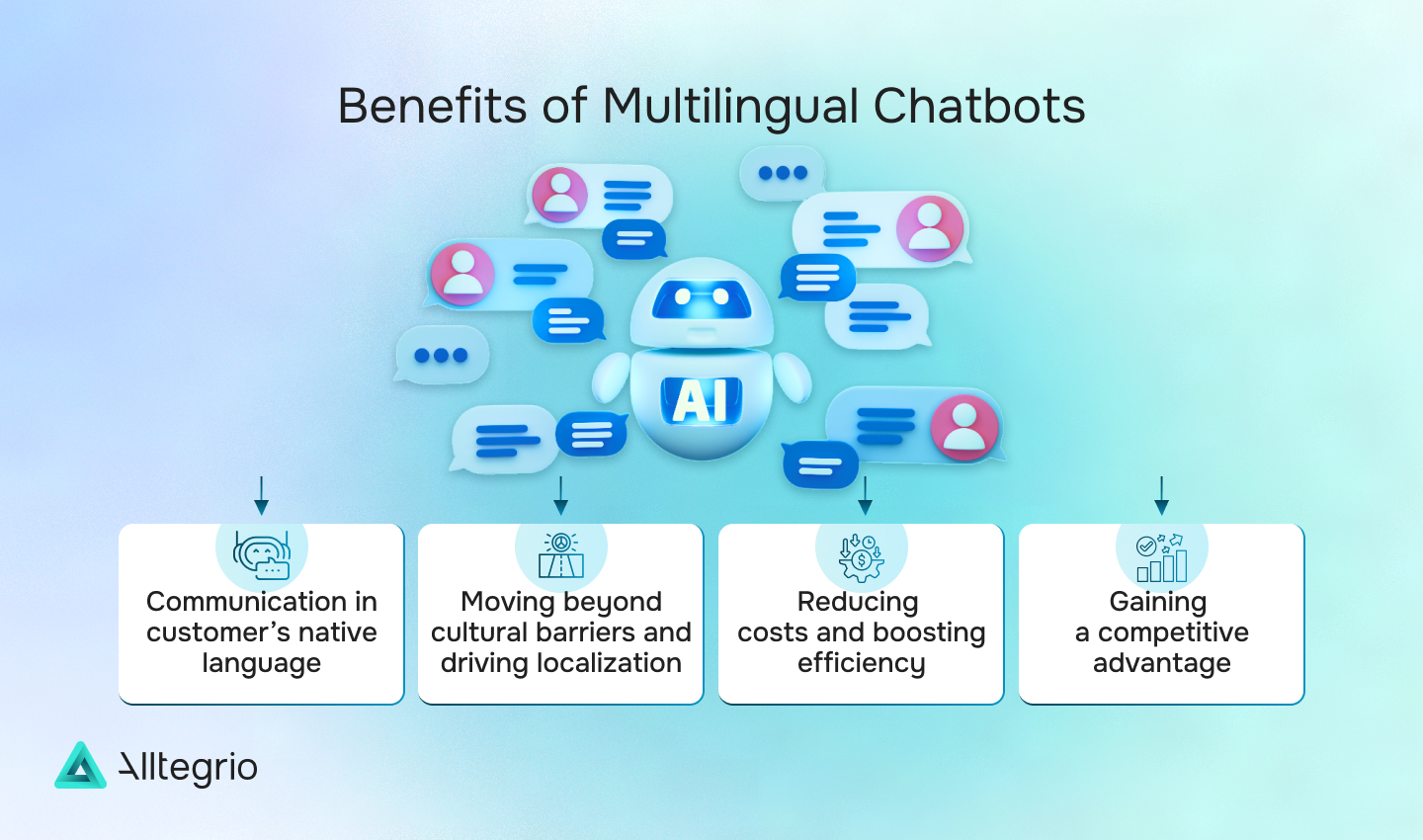
Offering multilingual support to your clients is not an optional feature for any business that wants to succeed these days. According to surveys, 40% of customers won’t even consider buying from a brand that doesn’t offer support in their native language. Therefore, if you have any ambitions of entering the global market, multi-language customer support is an absolute must.
Luckily for you, today, offering this feature is very easy. All you need to do is use multi-language AI.
Multilingual AI is a branch of Artificial Intelligence services that allows machines to understand, interpret, and generate human language in multiple languages. It is based on Natural Language Processing (NLP) and Machine Learning algorithms that facilitate communication across language barriers.
Today, Alltegrio’s expert AI developers will explain how universal multi-language models work and how any business can implement them cost-efficiently.
Why Does Your Business Need Multi-Language AI?
Of course, offering multi-language customer support powered by AI is the main reason why the majority of businesses use multi-language models and applications. However, there are more reasons why you can benefit from this type of AI model. The most important among them are:
Reason
Where to Use
Business Benefits
Offer personalized experiences
Integrate multi-language AI models into your marketing tools and CMS.
Results in higher customer satisfaction and improves brand loyalty.
Reduce operational costs
Translate documents you need yourself.
Using generative AI models to translate documents and conversations means you don’t have to hire translators or employees who speak other languages. You save both money and time.
Automate customer support
Integrate multilingual support AI models into your website and CMS or use chatbots in social media.
Streamline processes, increase customer satisfaction, cut costs of outsourcing a call center, and boost your conversions all in one go.
Analyze data
Integrate multi-language AI into your data processing solutions.
Perform sentiment analysis in various foreign markets, and analyze social media discussions, reviews, and other communications to better understand your customers, their demands, and desires.
Enhance global collaboration
Use custom-made AI-powered translation apps and chatbots or integrate them directly into your ecosystem.
If you run a business with multiple international teams, these simple solutions will facilitate communication, smooth out the workflow, and reduce the number of possible errors in your projects.
What You Need to Think About Before Implementing Multilingual AI
Before adopting any multi-language AI, you need to consider several things:
Choose the languages needed in the target market. Bear in mind that you will often need to consider cultural diversity in the region, not just the country’s official language. For example, you can benefit from including Spanish and Chinese when targeting the US market. When working with Asian countries, look for opportunities to offer multilingual support in local dialects. Multi-language AI voice conversion models might be limited in this for now. However, this technology advances very fast, so keep an eye on it.
Consider the AI multi-language models’ performance. Not all multilingual AI platforms are equal. Some of them perform exceptionally well in certain languages and poorly in others. You might be tempted to go for ChatGPT integration services right off the bat. However, this might not be an optimal choice, depending on your target audience. The Alltegrio team will help you choose the best model for each specific application.
Take into account the cultural connotations of language. Communication is not just about translation. It’s also about the cultural context and adjusting messages for it. For instance, idioms or humor in one culture are not necessarily effective in another and could cause misunderstandings or even offense. Therefore, when investing in multi-language AI chatbot development services, you must work with a team that will program your chatbot to be sensitive to such details. At Alltegrio, we have a lot of experience creating generative AI-powered chatbots for multiple niches and will ensure your target audience enjoys communicating with your bot without misunderstandings. See examples in our case studies: this one for a Japanese telecommunication company, this bot for e-commerce in Europe, or this case for a bot that generates personalized recommendations for a US business.
What Are the Top Multi-Language Models of AI in 2025?
As technology continues to evolve, numerous universal multi-language models of AI get some spotlight in the industry. The most remarkable among them are:
OpenAI’s GPT line is one of the key models that have impressed everyone with its capability to generate human-readable text across many languages. Its adaptability and contextual intelligence make it the best fit for companies that are looking to implement multi-language AI solutions. The ability of the model to customize its responses based on user input also allows for a more personalized experience, catering to various cultural sensitivities and preferences.
Google’s BERT (Bidirectional Encoder Representations from Transformers) is another great model. It’s especially capable of understanding the context of words in search queries. This model has been instrumental in improving search engine results and can be applied for multilingual use to enhance user experience. Due to its design being rooted in deep learning, BERT can learn the dynamics of word relationships inside a sentence and understand nuances in meaning that easily get lost in translation. This is particularly helpful to companies attempting to appeal to users from different linguistic backgrounds because it ensures their content is attractive to users with a different linguistic background.
Facebook’s M2M-100 model is an innovative multilingual translation model that can translate any two 100 languages without the use of English as an intermediary. It decreases reliance on an intermediate language and maximizes the direct and accurate translation, making it a useful tool for global businesses.
DeepMind’s Gopher is designed to tackle difficult language tasks, focusing on context recognition and offering coherent answers. Its architecture is precisely optimized to ensure multilingual performance so that it can easily have conversations in multiple languages. This model has great potential for applications in multi-language customer support.
How Does Multi-Language AI Voice Conversion Work?
Multi-language AI voice conversion technology relies on advanced Machine Learning development services. ML algorithms translate text to speech in many languages. This multi-stage process includes text analysis, language processing, and voice synthesis.
First, the AI system examines the input text in order to comprehend its meaning and structure.
Next, universal multi-language models apply linguistic rules native to the target language to preserve proper pronunciation and intonation.
The voice synthesis unit finally creates the audio output, synthesizing a natural-sounding voice similar to human speech.
The latest advances in Deep Learning have significantly improved the quality of voice conversion, generating more natural and expressive speech. The technology can be applied to various applications, such as virtual assistants, customer service systems, and language learning websites, enhancing user experience and interactivity.
How Is Multi-Language AI Integrated into Programs?
Integrating multi-language AI with various applications demands a strategic approach. The process usually involves integrating AI language models into existing software applications, such as Customer Relationship Management (CRM) software, e-commerce platforms, and Content Management Systems (CMS).
For instance, in a CRM solution, universal multi-language models may be employed to automate communication by answering in the client’s preferred language. This makes the process more efficient and increases customer satisfaction through timely and relevant information.
In addition, multi-language AI may be incorporated into virtual assistants and chatbots to process inquiries in various languages. This feature lets your business offer 24/7 multilingual support worldwide, enhancing service responsiveness and availability.
What Related Solutions Should You Consider When Using Multilingual AI?
When implementing multi-language AI, you should seek complementary products to optimize its application. Localization tools, in particular, are crucial for such applications. Multilingual AI can translate text, but localization ensures that content is culturally relevant and tailored to a specific audience. That may involve modifying marketing messages, images, and even products to suit local preferences. For example, consider a chatbot developed specifically for real estate businesses. The localization element in this tool not only makes it culturally relevant but also ensures the bot understands industry-specific terms that your clients are most likely to use.
In addition, installing analytics software has the potential to provide valuable analysis of customer interactions across different languages. Businesses can refine their multilingual strategies and overall customer engagement by analyzing this data.
What Are the Technical Features of Supporting Multilingual AI?
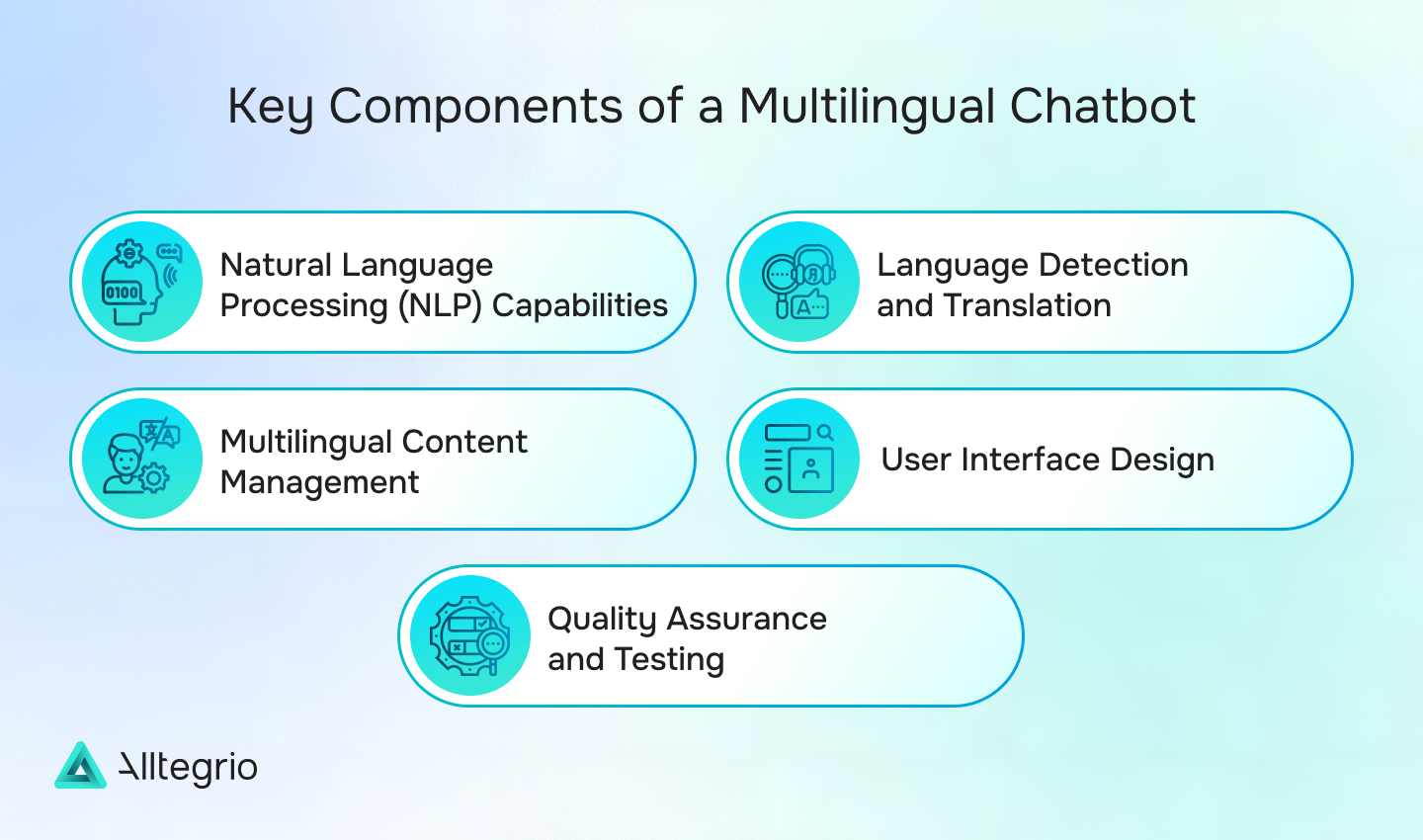
Empowering multi-language AI requires a series of technical capabilities that enhance its functionality and performance. One of the prominent features is using Neural Networks, which enable AI to learn by processing volumes of multilingual data, becoming more fluent and accurate over time.
Another essential feature is the implementation of Natural Language Processing (NLP) techniques. NLP allows AI to understand the nuances of different languages, including grammar, syntax, and semantics, to make translations contextually accurate.
Besides, AI multi-language models usually have speech recognition capabilities, which allow them to analyze spoken words with various dialects and accents. This is very useful in applications such as voice assistants and multilingual support hotlines.
Which Niches Benefit most from Multi-Language AI Implementation?
Multi-language customer support is equally relevant for any business with customers from several countries. Moreover, these systems are crucial for e-commerce and retail businesses to enhance customer experience through localized product descriptions and multilingual support.
In the healthcare industry, multilingual AI facilitates communication between medical professionals and non-English-speaking patients. This support is vital to ensure that critical information is conveyed effectively and accurately.
In addition, the travel and hospitality industry can benefit from multi-language AI in offering personalized services to foreign travelers, such as support with bookings and local tips in their languages.
How to Implement Multi-Language Customer Support with AI
Implementing multi-language customer support via AI involves several strategic measures. First, you must identify the languages you need and choose matching AI tools.
Second, you must establish a strong knowledge base with FAQs and general questions in multiple languages. The Alltegrio team can help you integrate these resources through AI chatbots to provide instant responses to customer queries.
It is also essential to keep training the AI system. By providing a diverse data set comprising various languages and contexts, you can be certain that AI multi-language models remain aware of and respond accurately to customer inquiries.
Multilingual support can enhance customer experience and operational efficiency in many business aspects. Customer service is one application where it is most potent, with AI-powered chatbots handling multilingual queries and providing real-time assistance to users worldwide.
Whether you are after this result or want to implement multi-language AI in some other capacity, Alltegrio will help you build it seamlessly into yoru existing system. Learn how you can get most value from universal multi-language models by starting with a free consultation. Just fill out the contact form below!






'%3E%3C/rect%3E%3Cpath d='M21.0079 11.1156L21.6244 11.1841C24.4986 11.5025 26.6656 13.982 26.6656 16.9507V24.7908C26.6656 26.3373 27.4992 27.7759 28.8412 28.5458C28.957 28.6124 29.0564 28.7011 29.1345 28.8053H12.8746C12.9528 28.7011 13.0521 28.6124 13.1679 28.5458C14.51 27.7768 15.3436 26.3383 15.3436 24.7908V16.808C15.3436 13.9145 17.5095 11.4967 20.3827 11.1831L21.007 11.1146M21.0041 8.5C20.5902 8.5 20.2554 8.83575 20.2554 9.24869V10.0147C16.8323 10.3881 14.1684 13.2854 14.1684 16.808V24.7908C14.1684 25.9206 13.5635 26.9635 12.5832 27.526C11.9137 27.91 11.5007 28.622 11.5007 29.3939C11.5007 29.718 11.7632 29.9805 12.0873 29.9805H29.9199C30.244 29.9805 30.5065 29.718 30.5065 29.3939C30.5065 28.622 30.0935 27.91 29.424 27.526C28.4437 26.9645 27.8388 25.9206 27.8388 24.7908V16.9507C27.8388 13.4138 25.2048 10.3987 21.7518 10.0157V9.24869C21.7518 8.83479 21.417 8.5 21.0041 8.5Z' fill='white'%3E%3C/path%3E%3Cpath d='M21.0041 8.5C20.5902 8.5 20.2554 8.83575 20.2554 9.24869V10.0147C16.8323 10.3881 14.1684 13.2854 14.1684 16.808V24.7908C14.1684 25.9206 13.5635 26.9635 12.5832 27.526C11.9137 27.91 11.5007 28.622 11.5007 29.3939C11.5007 29.718 11.7632 29.9805 12.0873 29.9805H29.9199C30.244 29.9805 30.5065 29.718 30.5065 29.3939C30.5065 28.622 30.0935 27.91 29.424 27.526C28.4437 26.9645 27.8388 25.9206 27.8388 24.7908V16.9507C27.8388 13.4138 25.2048 10.3987 21.7518 10.0157V9.24869C21.7518 8.83479 21.417 8.5 21.0041 8.5Z' fill='white'%3E%3C/path%3E%3Cpath d='M23.582 31.1199H18.426C18.5698 32.4166 19.6687 33.4267 21.004 33.4267C22.3393 33.4267 23.4382 32.4175 23.582 31.1199Z' fill='white'%3E%3C/path%3E%3Cdefs%3E%3ClinearGradient id='paint0_linear_1536_57632' x1='0' y1='0' x2='42' y2='42' gradientUnits='userSpaceOnUse'%3E%3Cstop stop-color='%2300CBBF'%3E%3C/stop%3E%3Cstop offset='1' stop-color='%23007DFE'%3E%3C/stop%3E%3C/linearGradient%3E%3C/defs%3E%3C/svg%3E)