The world is changing to become more digitalized with every passing minute, and no industry shows it more than retail. The eCommerce market is already worth over $4.3 trillion, and with a CAGR of 8.02%, it’ll be almost $6 trillion by 2029. However, those are modest predictions as eCommerce grows rapidly and sometimes with unpredictable spurts. The same goes for the competition within the industry.

As the situation stands, the only way forward is to maximize the value of Big Data Analytics for eCommerce. Without using the edge that can be provided by detailed data analysis, an online shop or even a marketplace stands no chance of succeeding.

What Is Big Data Analytics in eCommerce?

Big Data for eCommerce refers to the unrivaled volume of data that arises from internet transactions, consumer interactions, and online advertising campaigns. Big Data does not simply comprise structured information in the form of sale transactions but also unstructured information in customers’ feedback, social media conversations, and browsing patterns used to analyze consumer behavior.

Big Data features, more commonly defined through the “Three Vs” of Volume, Variety, and Velocity, define its complexity.

  • Volume addresses the sheer quantity of information that is generated each day.
  • Variety addresses multiple sources of information.
  • Velocity addresses the pace with which the data is produced and processed.

Put together, these elements provide a rich source of eCommerce business analytics that help companies make better decisions.

In addition to the Three Vs, Big Data in e-commerce market also brings in the concept of “Veracity”. It stands for the reliability and trustworthiness of the information collected. With such massive data sources, businesses must be sure they receive actionable insights from genuine information. For example, a store owner can collect customer feedback on social media. However, if the feedback is biased or misinterpreted, the store owner might launch poor marketing campaigns or produce wrong products. Hence, the e-commerce industry requires strong data validation processes to uphold the integrity of analytics.

Moreover, Big Data analytics solutions have revolutionized how online retailers understand consumer behavior. With Predictive Analytics services and Machine Learning development, companies can now uncover patterns and trends previously concealed by the sheer volume of data.

This allows you to create more personalized shopping experiences based on customer history and preferences. For instance, if a client keeps buying products related to the outdoors, you can use this information to recommend complementary products or even provide selective discounts.

block-image

Why Use Big Data Analytics in eCommerce?

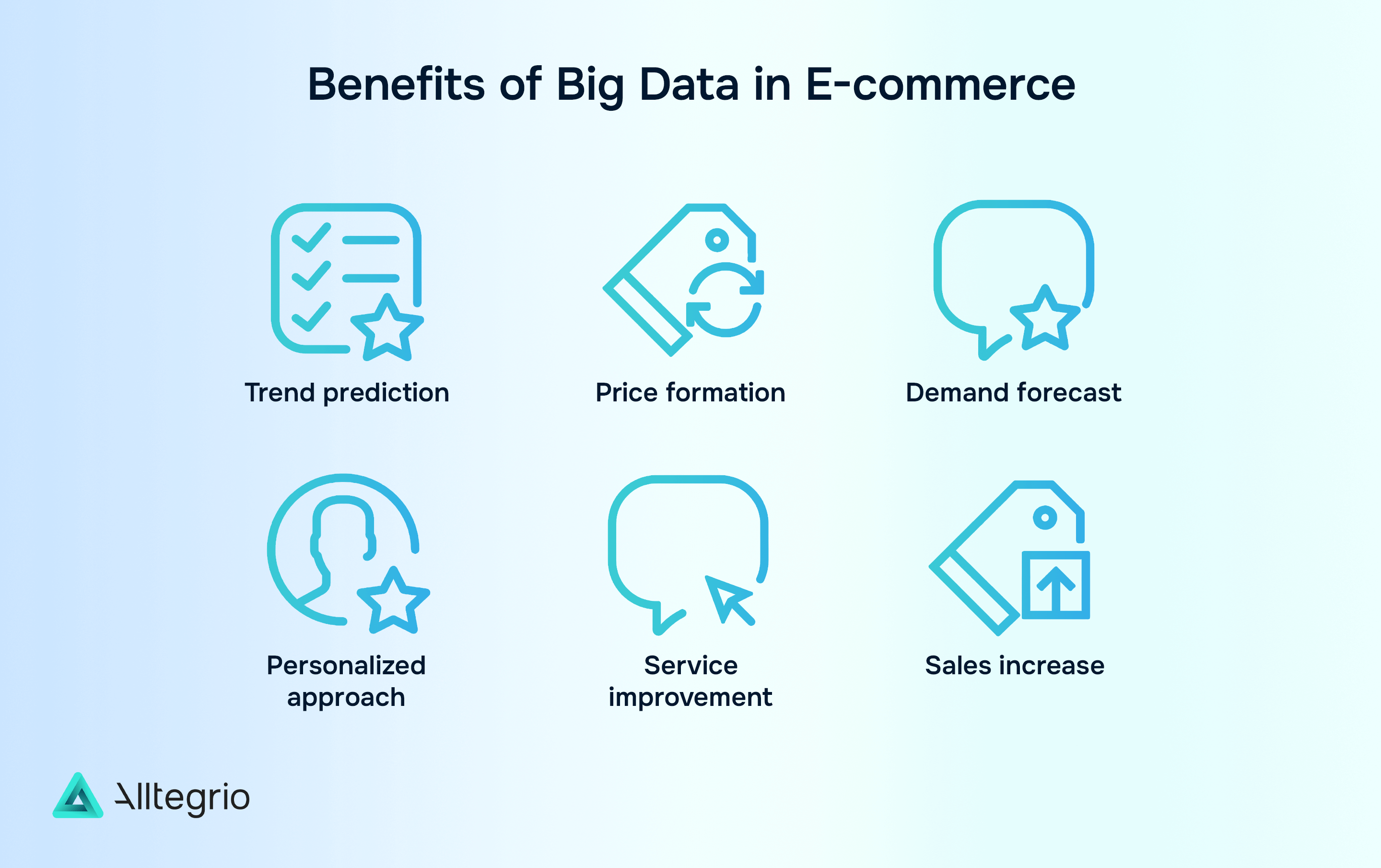
The benefits of Big Data in e-commerce are quite numerous. The most important of them include:

  • Decisions that lead to success
    Using Big Data Analytics in eCommerce optimizes decision-making by accessing information collected and processed in real-time. Therefore, you can quickly identify trends, consumer choices, and future market requirements and adjust your strategies accordingly.
  • More effective marketing
    ECommerce Data Analytics allows you to analyze customer behavior and preferences. Then, use this data to tailor your marketing strategies to ensure more accurate targeting and personalization. This leads to improved conversion rates and stronger customer loyalty.
  • Supply chain optimization
    Implementing Big Data analytics for eCommerce can improve supply chain efficiency and inventory control. With Predictive Analytics, online stores can precisely forecast demand, minimizing overstocking and stockouts. This saves costs associated with excess inventory and enhances customer satisfaction by making best-sellers readily available. Moreover, merging Big Data with Internet of Things (IoT) devices allows companies to monitor their inventory and shipping statuses in real-time. Click here to learn more about the benefits of AI, Computer Vision, and Data Analytics in warehouse management. You can also learn more about how AI can help with supply chain optimization from this post.
  • Personalized customer experiences
    Another significant role of Big Data in e-commerce market is providing personalized customer experiences. By analyzing massive amounts of data (including social media engagement, search history, and purchasing behavior), your business can generate highly customized shopping experiences. These increase the chance of conversions and create a closer connection between the brand and your customers.
  • Predicting customer churn
    Implementing eCommerce business analytics solutions is one of the main elements of successful customer churn prediction. It’s an invaluable tool for retailers because it allows you to build more effective sales strategies. 

What Types of Data Are Relevant for eCommerce Business Analytics?

In order to understand all the ways how Big Data is used in e-commerce you need to see exactly what information can be processed to draw valuable business insights:

Data Type Examples Purpose
Transactional Data
  • Shipping information
  • Payment history
  • Purchase history
Provides an understanding of customer buying behavior
Customer Data
  • Engagement rates
  • Preferences
  • Demographics
Draws a detailed picture of your audience
Behavioral Data Web interaction metrics:

  • Page views
  • Click streams
  • Time on site
Provides insights into user experiences, interests, and satisfaction
Social Media Data Various activities on social platforms Informs you about customer opinions and trends that can shape purchasing decisions
Market Data 
  • Industry research
  • Global statistics
  • Specialized niche databases
Provides information on industry trends, competitor pricing policies, and market demand
Feedback Data
  • Customer surveys
  • Reviews
Identifies your weaknesses and allows businesses to gauge customer satisfaction and loyalty 


You can leverage all this eCommerce Data Analytics to create highly personalized experiences for any target market. Therefore, you will boost conversion rates and ensure better customer retention.

How to Implement Big Data Analytics for eCommerce?

Implementing Big Data Analytics in eCommerce is a systematic process that includes the following steps:

  • Establish well-defined goals that align with business objectives. This will help ensure that the data you collect is relevant and actionable.
  • Invest in robust data management systems that process, store, and analyze vast amounts of information. To handle all this effectively, you’ll need to use distributed databases and cloud computing technologies. Such systems support storing structured and unstructured data, which is increasingly prevalent in today’s digital era. With technologies like Hadoop or Apache Spark, online stores can process Big Data and eCommerce business analytics in real-time. The Alltegrio Data Analysts will help you design systems that best fit your existing infrastructure and set them up to ensure faster decision-making and better operational efficiency.
  • Use Predictive Modeling and ML algorithms to uncover implicit patterns and insights. For instance, customer segmentation analysis allows e-commerce businesses to craft targeted marketing campaigns for specific constituencies, maximizing customer engagement and conversion rates.
  • Train your employees in data literacy because well-informed employees can use data insights productively. That involves being able to read the data and building a culture of data-driven decision-making across the entire organization, from marketing to inventory management.
  • Integrate Big Data Analytics for eCommerce with customer relationship management (CRM) systems to get a 360-degree view of customer interactions. This solution enables businesses to track customer behavior across various touchpoints, which, in turn, enables personalization for increased customer loyalty. By analyzing purchase history, browsing, and feedback, online retail businesses can pre-empt customer needs, predict trends, and optimize inventory accordingly. In addition, adopting real-time analytics can enable companies to act quickly to shift in the marketplace, making them competitive in an ever-changing e-commerce landscape.

Start Using e-Commerce Data Analytics for Growth

Understand how to best use Big Data Analytics in eCommerce and implement solutions that will drive your success with the help of Alltegrio’s Data Scientists.

Book a Consultation

How Big Data Is Used in E-Commerce to Personalize Customer Experiences

Personalization is among the main benefits of Big Data Analytics for e-commerce. By studying customer data, companies can offer experiences customized to individual preferences. For example, using ML algorithms, companies can offer recommendations based on what the customer bought or searched for in the past. Not only does this result in a sale, but it also strengthens the brand and customer relationship because the customer feels they are being understood and appreciated.

This technique is particularly effective when paired with a solution like a custom-trained chatbot. Our case study of developing a generative AI bot for customer service shows how well this works for an e-commerce business.

Also, Big Data analytics in eCommerce supports real-time personalization. You can modify product recommendations, offers, and content displayed in web stores based on current customer behavior. The dynamic approach drives customer interactions and satisfaction.

This level of responsiveness is essential when dealing with Machine Customers. They are already becoming a great disruptive force for retail. Therefore, if you want your business to have a competitive advantage, you must have a system that adapts instantly both to human and machine requirements and interests.

In addition to product recommendations, online stores can leverage eCommerce Data Analytics to enhance the shopping experience. By analyzing customer reviews, comments, and social media updates, companies can identify their products’ pain points and areas of concern. For instance, if data indicates that customers are consistently abandoning their carts due to shipping charges, companies can implement promotions or free shipping thresholds to address this need.

Furthermore, Big Data analytics for eCommerce can facilitate focused marketing campaigns. By segmenting customers based on demographics, purchasing history, and web behavior, you can craft personalized email and ad campaigns that specifically target each segment’s interests and needs.

How Can Big Data Analytics Improve E-commerce Operations?

Using Big Data analytics in eCommerce has the potential to significantly ease operations, including:

  • Inventory Management
    By determining sales trends and consumer behavior, businesses can anticipate demand, thus preventing stockouts or overstocking.
  • Supply Chain Effectiveness
    With insight into where holdups happen and how to forestall them, companies can refine distribution processes and lower operational expenses.
  • Marketing Strategies
    With eCommerce data analytics you can segment audience by behavior, demographics, and purchase history. This allows for personalized promotions and product recommendations that increase conversion rates and foster customer loyalty.
  • Customer Sentiment Analysis
    Using Big Data analytics for eCommerce provides critical insights into consumers’ opinions and preferences. Social media tracking, reviews, and comments allow online retail businesses to identify the popularity of their services and products among the public. Through this real-time feedback system, your company can make decisions that can drive product innovation, advertising, and service improvement.

block-image

What Are the Disadvantages of Using Big Data Analytics in eCommerce Projects?

Though the benefits of Big Data are substantial, there are possible drawbacks to using it that e-commerce companies must consider carefully. The main among them are:

  • Data Privacy
    The more data companies gather on their customers, the greater the need to address privacy legislation and protect sensitive data. When working with the Alltegrio team, you can be sure that any Big Data Analytics solution we develop for you will be secure and adhere to the regulations relevant to your region.
  • Initial Cost Investment
    Implementing advanced Big Data analytics in eCommerce solutions can be expensive.  Investing in technology and skilled personnel requires a lot of resources initially. However, you can compensate for this investment as it starts to pay off. In order to understand precisely how to use your resources best and develop a solution that would be most beneficial and cost-efficient, you should consider starting with the Discovery Phase before making any significant financial commitments.

What Are the Business Benefits of Big Data in E-commerce Projects?

To sum up the reasons why you should invest in Big Data analytics for eCommerce, take a look at the list of direct benefits your business can get immediately:

  • Unparalleled customer insights to fuel informed decision-making.
  • Segmented marketing plans that create greater engagement and conversions.
  • Ability to forecast trends to speed up your responses to the fast-shifting global retail industry. 
  • Quick responsiveness in a competitive landscape that allows you to seize opportunities as soon as they arise.

What Results Can Be Achieved by Using Big Data Analytics in eCommerce?

Implementing Big Data analytics in eCommerce can bring about high returns, such as:

  • Higher number of sales
  • Greater customer satisfaction
  • Increased operational efficiency
  • Better Return on Investment (ROI)
  • Market share growth
  • Successful data-driven personalization
  • Stronger brand loyalty
  • Higher customer retention rates

Lastly, using Big Data in e-commerce market has become a necessity at this point. Even with some drawbacks, the benefits of using eCommerce Data Analytics are game-changing in our competitive economy. Today, any eCommerce business must use even the slightest advantage to the fullest. Big Data opens the doors to some of the biggest advantages that technology can offer. You can achieve better results only when using Big Data analytics as a part of advanced AI solutions.

For example, check out how this e-commerce business completely transformed by investing in a Computer Vision and GenAI-powered personal recommendation bot to boost sales.

With the continued growth of e-commerce, the strategic application of Big Data analytics will play a central role in defining successful companies. Businesses that have the foresight to invest in data-driven projects now will not only survive but thrive in the digital competitive landscape.

Leverage the power of Big Data Analytics for eCommerce with Alltegrio, your ally in the ever-evolving landscape. Discover how our innovative AI technology can empower your business by filling out the form below for a free consultation.

Subscribe to our blog!